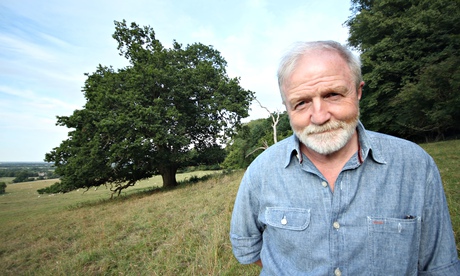
Chances are you didn’t see Oak Tree: Nature’s Greatest Survivor (BBC4). It was, after all, a feature-length film about a single tree presented by a bearded insect botherer on a channel not a lot of people get down to. That’s not an obvious sell. But it was fascinating and lovely.
The tree in question has stood in Oxfordshire for nearly 400 years – it was an oakling during the English civil war. This tree has seen a lot … well it would have seen a lot if a tree could see. Dr George McGavin is going to spend another year with it, starting in the autumn.
You know what’s going to happen? The leaves will fall off, then grow again in spring. There will be acorns, possibly a squirrel or two, and at some point Dr George will pull himself slowly up the tree with ropes – they always do that. Well, yes, but there’s more to it than that.
Some 700,000 leaves for starters. And this tree can kind of see, in its own special tree-like way. In those leaves is a chemical pigment that can sense the red light in the spectrum and let them know when to drop off and when the tree needs to deploy its special winter hormones; it doesn’t have to rely on unreliable English seasonal temperature change.
The acorns are pretty cool, too. And the roots, with their threads of mycorrhizal fungi, enough on one mature tree like ours (I’m now claiming part ownership) to stretch around the entire world, which help the tree extract phosphates from the rocks in the soil. See, phosphates – now you’re interested.
It’s not just about the phosphates and fungi and science though. It’s about the great buildings that have been born out of oak (like the lattice structure inside the inspiring spire of Salisbury Cathedral). It’s about oak’s leading role in the building of great ships, navies, English heroes. And in flavouring great Scotch whiskies. It’s about how oak – specifically the oak gall, like a wart made by a wasp – was turned into ink and helped us to express our most profound ideas in writing, drawing and music. It’s about how oak has permeated our culture. Potheads may disagree, but the oak is probably the plant that more than any other has become part of us.
There are some excellent critters in an oak too, if you look carefully. Not the squirrels, but the thousands of insects that call a tree home. Hence McGavin, entomologist by trade, who – inevitably – does pull himself slowly up a rope to the canopy to fetch some down with his net for a closer look.
It’s worth the effort, for the green cricket that has its ears on the knees of its front legs, which allow it to triangulate. For the planthopper that sucks the sap and the life from a leaf. And, best of all, for the acorn weevil – a bizarre little monster, a cross between a Dalek, a curlew and a lunar module – that drills into acorns to deposit its evil weevil offspring. “It doesn’t get any better than this, really, that is evolution at its most wonderful,” says McGavin, in a rare moment of exuberance.
He’s good as well. I’ve never met him but I imagine he’s just like he is here on the screen. Meaning he appears natural, not “presenting”, striding towards the camera, waving his arms around, giving it the Robert Peston with the intonation. When he does get excited about something, like the acorn weevil, you know it must be properly exciting. A refreshing relief. Dear presenters, please do this, be more yourselves, thanks.
It’s beautiful to look at too, of course. The tree, in leaf, not in leaf; also a laser-created 3D model of it, like a computer-generated bonsai oak. Plus the roots, of another much younger tree, painstakingly unearthed, and spread out. Dendrology is brought to life through time-lapse photography, and thoughtfully chosen music. Worth catching up on, if you’ve got a spare 90 minutes, for a tree.
I’m not sure what’s extreme about Chris Tarrant: Extreme Railways (Channel 5). The Burma Railway, from Thailand to what’s now Myanmar was extreme when it was built by allied PoWs held by Japan – at enormous cost of life. Now it’s just a bumpy ride.
These celebrity travelogues – someone off the telly takes a train somewhere – have had their day haven’t they? It probably doesn’t help that Tarrant isn’t exactly my dream travelling companion.
- This article was amended on 2 October 2015 to clarify a reference in the earlier version to “Japanese PoWs”.