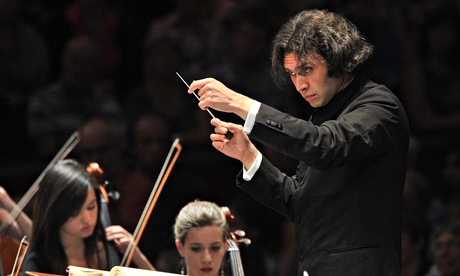
It used to be commonplace to say that Mussorgsky couldn’t orchestrate, and for decades after his death his work was fashionably rewritten or tinkered with by other composers, most notably Rimsky-Korsakov and Shostakovich. Nowadays, of course, his original scores are rightly deemed innovative. Vladimir Jurowski’s latest concert with the Orchestra of the Age of Enlightenment, though imperfect, offered further insights into the composer’s work by allowing us to hear it on period instruments.
St John’s Night on a Bare Mountain and a clutch of extracts from Borís Godunóv, with Sergei Leiferkus as the tortured tsar, formed the first half of the programme. St John’s Night on a Bare Mountain is better known simply as Night on Bare Mountain (or Bald Mountain), in a version by Rimsky-Korsakov that assuages its demonic frenzy by tacking on a spiritually consoling ending – the original offers no such comfort. Lean period brass and winds, meanwhile, add an element of abrasion to Mussorgsky’s already bleak vision.
In the Boris extracts, the austere strings suggested an almost Dostoyevskian aridity of soul as the tsar’s mind twists and snaps. Leiferkus remains a superb vocal actor, even though his upper registers are fraying a bit. Performing the coronation scene with no choir, but using a recording of the chorus of St Petersburg’s Mikhailovsky theatre for the funeral dirge seemed perverse. But I, for one, wanted to hear more.
No one could accuse Tchaikovsky of being unable to orchestrate. His first symphony, Winter Daydreams, came after the interval. Period style heightens both the chill and sense of alienation in a work that can teeter on sentimental nostalgia when performed on conventional instruments. Jurowski’s slow tempi added to the sadness of the opening movement, but led to moments of uncertainty during its development. It was ravishingly played.