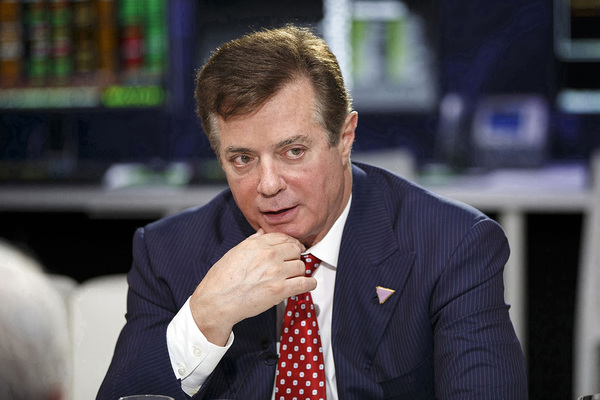
NEW YORK _ State appeals court justices seemed sympathetic Friday to the idea that Manhattan prosecutors are seeking to try ex-Trump campaign manager Paul Manafort twice for the same crime.
Manafort was sentenced to 7{ years in prison in March 2019 on federal charges that he hid millions of dollars in offshore accounts and then lied to get loans after income dried up from his work for pro-Russian Ukrainian politicians.
The day Manafort was sentenced in a Virginia federal courtroom, Manhattan District Attorney Cy Vance announced his office would try the former lobbyist on state fraud charges based on some of the facts covered by the federal charges.
The 16-count Manhattan indictment charges Manafort, 71, with lying on loan applications that led banks to lend him more than $4 million against his former SoHo loft and other properties.
Manhattan Supreme Court Justice Maxwell Wiley tossed the case in December after finding it was barred by New York's double-jeopardy law, which is meant to protect suspects from being tried twice for the same crime.
During a hearing held via remote video, Manhattan Assistant D.A. Valerie Figueredo argued that even though the facts in the state and federal are the same, the state and federal statutes involved cover different elements of Manafort's alleged crime.
State Appellate Division Justice Dianne Renwick challenged whether the state charges in fact "address a different harm or evil."
Manafort lawyer Todd Blanche said Vance's office is trying to bend the rules. "Judge Wiley got it right," Blanche said.
Appellate Division Justice Jeffrey Oing saw Blanche's point, and said Vance's office seemed to be "doing a pivot" to save their case.
It's unclear when the Appellate Division will rule on the case.
Manafort served time at a Pennsylvania federal prison until July, when he was reassigned to home confinement over fears he might contract coronavirus.
He is expected to serve the remainder of his sentence at his home in northern Virginia.
Manafort, who was a lobbyist for foreign governments, was one of 34 people indicted as part of former special counsel Robert Mueller's investigation of Russian influence in the 2016 election.
He spent much of the money he was accused of taking on landscaping, expensive clothing and even a karaoke machine, evidence in the Virginia federal case showed.