Even if you've never heard of Nvidia, you almost certainly have used its products. The company, which develops processors for cellphones, tablets, gaming systems, work stations and supercomputers, has a 90% market share in the professional design sector. That gives it the potential to hugely influence sustainable design.
And Danny Shapiro, senior automotive director at Nvidia, is uniquely positioned to understand the process of turning abstract vehicular concepts into reality – and using cutting-edge technology to make cars more sustainable.
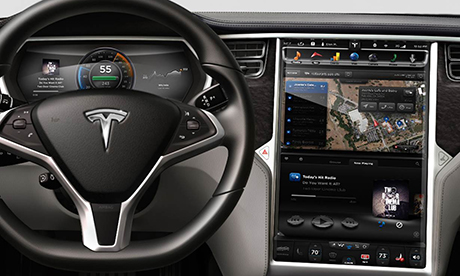
I met him at the Detroit Auto Show in January. While being buffeted by a growing mob of international photographers and reporters, Shapiro told me about the Nvidia processors equipping the gleaming white Tesla Model S sedan on display before us. Tegra processors help operate the all-digital instrument cluster, he said, and the 17-inch touch screen that acts as the vehicle interface – and also displays the navigation and traffic information.
All of the Volkswagen Group's brands are phasing in Nvidia processors, also known as graphics processing units or GPUs, to power navigation and entertainment systems in the high-end Bentley, Porsche, Lamborghini and Audi lines, as well as in mainstream cars like the VW Golf, and – in Europe – the Seat and Skoda.
What does all this have to do with sustainable design? For one thing, the same processors are used to help design efficient vehicle bodies and to improve the engineering under the hood.
For example, Shapiro says, engineers using the GPUs can change the design of a car's side-view mirror to reduce drag – or to determine how lighter-weight materials like carbon fiber and aluminum can be reinforced for safety – thereby creating lighter, more aerodynamic and ultimately more fuel-efficient vehicles.
They also are used to take those vehicles through virtual crash, wind tunnel and traction control evaluations before the real-life tests, saving time and money.
Moreover, they are helping make vehicles more upgradable, which could ultimately make them more durable – potentially reducing consumption and waste.
Modular hardware, remotely updatable software
Nvidia took a page from the PC industry, using a modular approach with its GPUs so they can be easily switched out in different vehicles.
"Systems do not have to be re-created from scratch each time, a process which traditionally took five to seven years in the automotive world," Shapiro said. "Now we are enabling car makers to update the hardware in new cars each model year. Our visual computing module system is as easy as sliding in a new component and updating the software."
The software, meanwhile, allows automakers to update, enhance or customize a car's systems long after that vehicle has left the showroom – without drivers having to return to the dealer.
Software can even be used to make some performance changes. Last year, several Tesla Model S cars caught fire, reportedly after running over road debris that punctured or otherwise damaged the car's underside battery pack.
In November, Tesla CEO Elon Musk blogged that the company was issuing an "over-air-update" to all Model S cars. That wireless command modifies the cars' air suspension when it travels at highway speeds, giving the vehicle greater ground clearance and in turn reducing "the chances of underbody impact damage". That command was given remotely.
Tom Libby, an analyst at IHS Automotive, believes we're at the start of a series of major advances that will dramatically change the automotive industry and the way consumers purchase and drive cars.
The quality and durability of cars, he notes, has "vastly improved" over the last 25 years to the point where the average car driving on a US road is now 11.4 years old, the oldest ever.
Apps for cars
Part of the reason for the aging of US cars may be that some Americans have held off on big-ticket purchases in an uneven economic recovery.
But Libby says new car technologies have had a cascading effect, allowing consumers to keep their vehicles longer, while improving the relationships – and speeding up communications – between car manufacturers and producers. Innovative adaptations – such as wireless, remote vehicular improvements to a car still parked in its owner's garage – have saved time, money and fuel.
Nvidia isn't the only company working on these improvements, of course. It partners with companies such as Autodesk and Dassault, which make design software that runs on Nvidia hardware.
And it faces competition from companies such as Qualcomm,
Samsung and Intel.
Nvidia also faces its share of challenges: the company expects revenues from its Tegra processors to decline significantly for the fiscal year as it phases out Tegra 3 products and delays the launch of its Tegra 4.
Nonetheless, Libby emphasizes that the innovations Nvidia and its rivals have brought to the automotive industry are both historic and transformative.
"We're going to see the physical vehicle become almost secondary because it's going to be almost like having a smartphone on wheels," he says. "Without the need to physically go into the dealership, you change the whole ballgame."