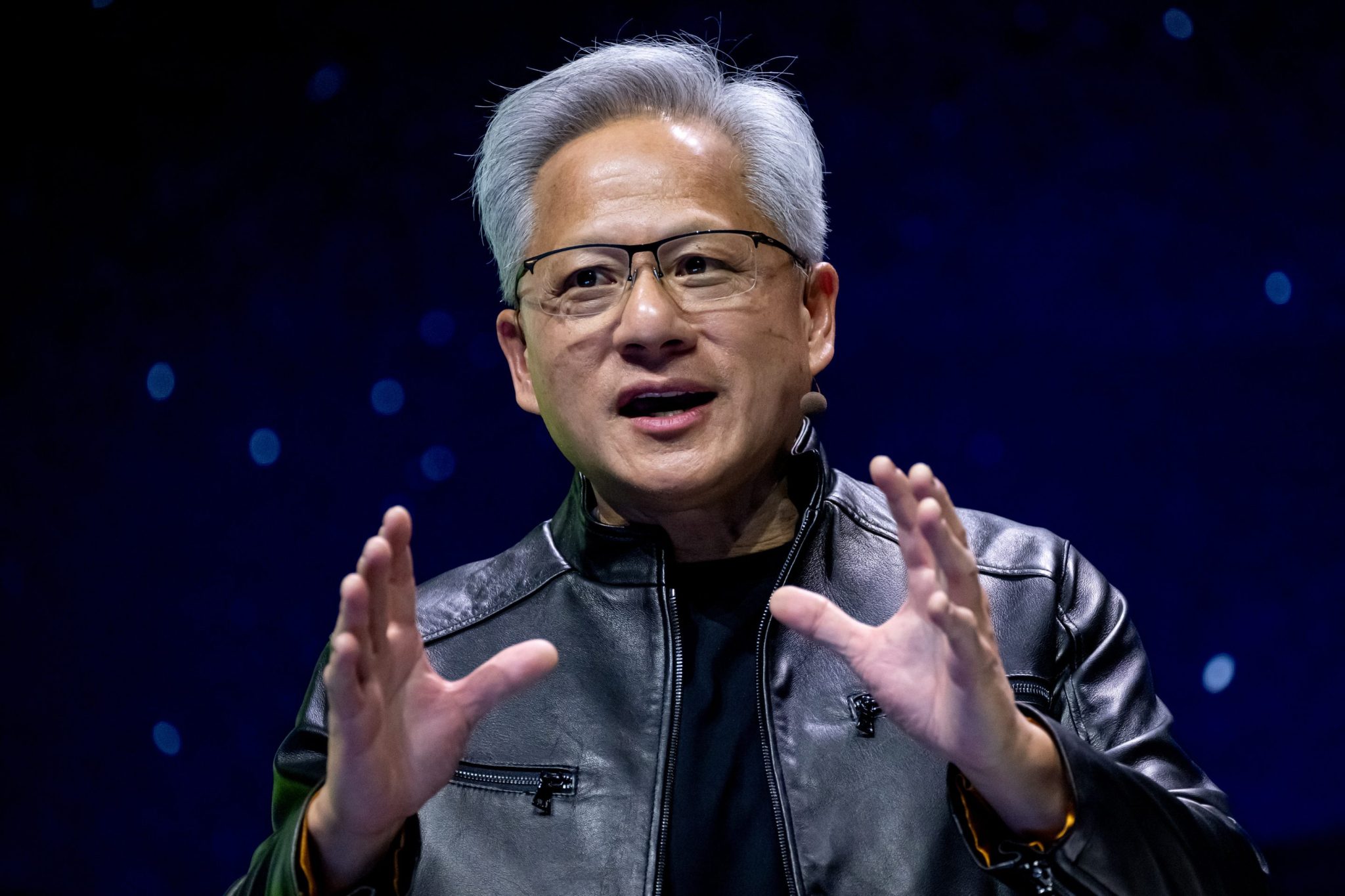
Tech leaders are split on how AI will shake up the world of work. While some CEOs are staunch believers that a white-collar jobs Armageddon is imminent, others say it it will supercharge humans in their professional lives. Jensen Huang, chief executive of $4.8 trillion giant Nvidia, believes AI agents will act more like overbearing managers rather than job destroyers.
“Your [AI] agents are harassing you, micromanaging you, and you’re busier than ever,” Huang said during a recent panel at Stanford Graduate School of Business. “We’re doing things faster; we’re doing it at a larger scale; we’re thinking about doing things that we never imagined.”
Huang has been outspoken against the narrative that AI will trigger a jobs wipeout and hurt America. And the 63-year-old entrepreneur worth $167 billion has been at the forefront of the shift; his GPU-accelerated computing business has rode the tech revolution to become one of the biggest companies in the world.
But while Nvidia and other tech empires reap success from the AI boom, the everyday worker is hand-wringing over the fate of their careers. Chatbots and AI agents can already write code, manage schedules, and crunch numbers—but Huang maintains that the tech opens a window for greater human work, not less of it.
“The fact that we now have AI assistants [to] help us, we could explore more space, do better work, do things at a greater scale, do things more cost-effectively, do things better,” the Nvidia CEO continued.
The tech pioneer conceded that some jobs will be made redundant in the tech revolution, but is optimistic overall that humans will make it out the other side with better prospects.
“My belief is we’re gonna create more jobs in the end,” Huang said. “There’ll be more people working at the end of this industrial revolution than at the beginning of it.”
Huang’s advice to AI-wary workers: Don’t confuse your job with the tools
Workers are understandably on edge, watching new job opportunities come to a screeching halt and companies drastically downsize in the name of AI.
The U.S.’s shaky labor market has left many feeling helpless; only one in five workers felt their jobs were safe from elimination in 2025, according to a recent report from ADP Research. And some are actively rebelling against the technology shift altogether in hopes of changing the tide. Around 29% of employees admitted to sabotaging their company’s AI agenda—largely out of fear of becoming obsolete—according to a recent report from AI agent firm Writer and research business Workplace Intelligence.
And they may have picked up on an impending dilemma: About 44% of CFOs at U.S. companies say they plan on some AI-related job cuts in 2026, according to a working paper from the National Bureau of Economic Research published earlier this year. The authors of the analysis found that 0.4% of jobs, or about 502,000 roles, are expected to be cut by year’s end—a ninefold increase from the 55,000 AI-related layoffs reported in 2025.
Despite doomsday predictions and climbing job cuts attributed to AI, Huang offers some words of reassurance to AI-anxious people. The Nvidia leader believes that this tech transformation will be like any other—including the Industrial Revolution—and humans will actually be better off in the long run. Workers just need to understand that AI agents and chatbots are simply instruments to help get their jobs done. After all, no tool has been able to replace him throughout his four-decade career in tech.
“[What] I want to make sure we all do, is to recognize that people are really worried about their jobs,” Huang said on the Lex Fridman Podcast last month. “I just want to remind them that the purpose of your job, and the tasks and tools that you use to do your job, are related, not the same.
“I’m the longest-running tech CEO in the world: 34 years,” he continued. “The tools that I’ve used to do my job have changed continuously in the last 34 years, and sometimes quite dramatically.”