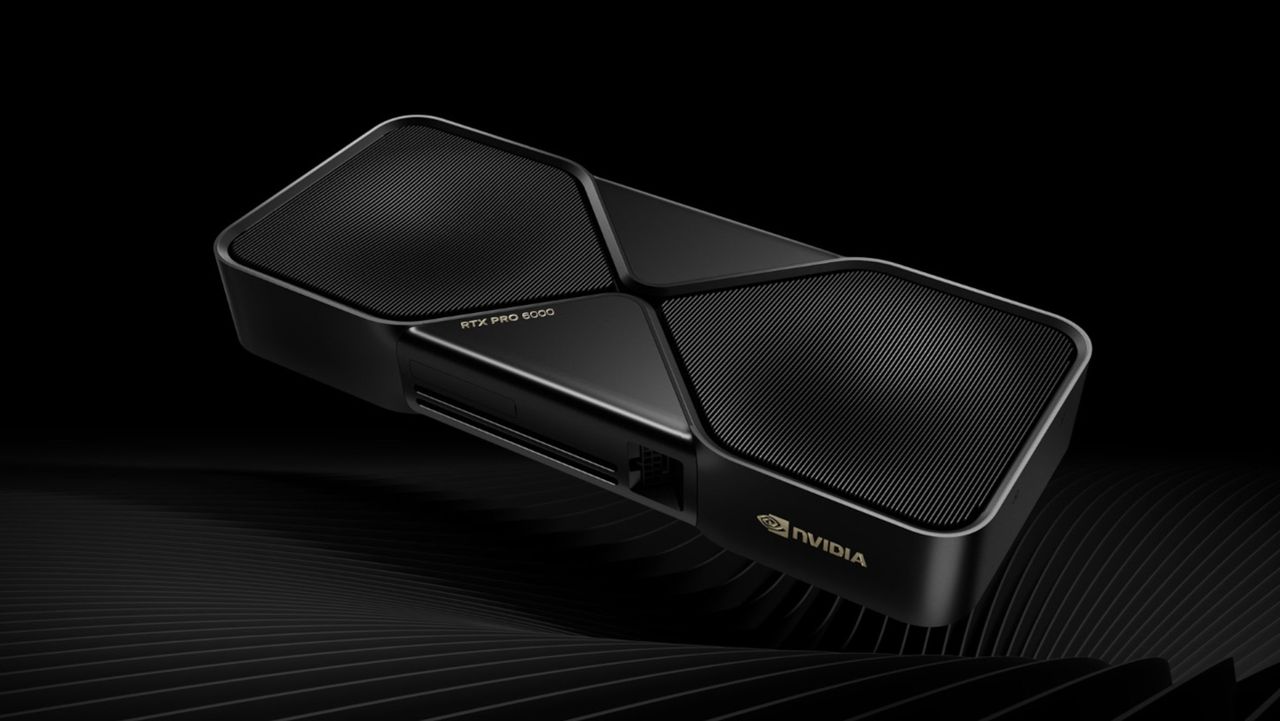
Just as it did with the RTX 5090 and RTX 4090, Nvidia created a China-exclusive variant of the RTX Pro 6000, the RTX 6000D, only for the Cyberspace Administration of China to ban the product and encourage adoption of homegrown AI accelerators.
Despite those restrictions, someone has benchmarked the now contraband 6000D in Geekbench 6.5, GPU boasting an OpenCL score just ahead of the RTX 5090D V2 and just below the RTX Pro 6000.
The RTX 6000D scored 390,656 points in Geekbench 6.5's OpenCL benchmark. The card's performance is a mere 1% higher than Nvidia's RTX 5090D V2, which boasts an OpenCL score of 386,710 points. The 6000D is also roughly 5% slower than its bigger brother, the RTX Pro 6000 server edition, which boasts a score of 410,605 points.
GPU |
Geekbench OpenCL |
RTX Pro 6000 (server edition) |
410,605 |
RTX 6000D |
390,656 |
RTX 5090D V2 |
386,710 |
RTX 5090D |
383,317 |
RTX 5090 |
382,285 |
RTX Pro 6000 (workstation edition |
373,979 |
That's not a big gap, especially considering the spec difference between the two RTX 6000 series GPUs. The RTX Pro 6000 comes with 96GB of GDDR7 operating on a 512-bit interface, spread over 32 chips with 3GB of capacity each. The GPU also comes with 24,064 CUDA cores split across 188 SMs.
The RTX 6000D comes with 14% less memory and memory bandwidth, along with 20% fewer CUDA cores. It has 84GB of GDDR7 memory connected to a 448-bit bus and 19,968 CUDA cores spread across 156 SMs.
Geekbench's OpenCL benchmark represents just one workload, so take these performance results with a pinch of salt. Shader compute performance usually takes the smallest hit on Nvidia's neutered China-exclusive GPUs. AI performance usually takes a much larger hit, and it's that workload that the USA's export controls care about. (These D-series GPUs are designed to comply with the U.S. government's China-specific export regulations on GPUs.)
The RTX 6000D's favorable performance against the RTX Pro 6000 could have been compelling for customers if the price was right, and the card was launched in the right context. The RTX 6000D couldn't have launched into a less favorable environment. Not only did the Chinese government ban the card months after launch—it also purportedly faced tough competition from Chinese GPU manufacturers.
Against those headwinds, the RTX Pro 6000D's story is likely to become a footnote of what might have been in the annals of GPU history, regardless of its objective performance.

Follow Tom's Hardware on Google News, or add us as a preferred source, to get our latest news, analysis, & reviews in your feeds.