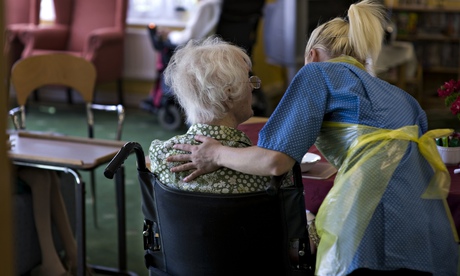
Nurse shortages, and the cost of plugging yawning gaps in staff rotas, have rightly leapt to public attention. But where are shortages worst? Neonatal wards? A&E? Mental health? No – it’s care homes.
Almost 60,000 registered nurses, approaching one in 10, work in the social care sector. A home providing nursing care typically needs up to three nurses during the day and one at night, per patient, although about 60% of hands-on care is delivered by care assistants.
Figures published today find that nurse vacancy rates in social care are running at 9%, compared to 7% in the NHS. Over the past two years, the largest nursing home groups report an average increase of 55% in use of agency workers to fill the gaps.
With hospital trusts reportedly paying up to £2,200 a shift for agency staff, NHS England chief executive Simon Stevens has vowed to clamp down on agencies “ripping off the NHS”. For care homes, operating, at best, on a fine profit margin when it comes to fees paid for state-funded residents, agency rates are now a crunch issue.
According to today’s analysis by consultants Christie + Co, staff costs at 12 leading nursing home companies have risen in two years from just over 59% of turnover to 61% – an increase impacting directly on operating margins. The recruitment problem in care homes is exacerbated by the fact that their nurses are older than the average: whereas 13% of NHS nurses in England are 55 or over, the proportion in care homes is 30%. This means that proportionally more are retiring, or are close to doing so, at a time when some 4,000 fewer newly qualified nurses are leaving university than in 2013 because of cuts in training places.
Too bad, say critics. If the independent care sector put its hand in its pocket to train its own nurses, rather than leach off the NHS, it wouldn’t be in such straits. In the past, that has undoubtedly been fair comment. But more innovative care home groups are now taking steps to “grow their own” – if not yet their own nurses. At Barchester Healthcare, for instance, an initial 150 senior care workers are being trained for a new “care practitioner” role which, subject to regulatory approval, could mean them taking on some nursing tasks and substituting for one of the three day-shift nurses in a typical home.
The ultimate solution to nurse shortages surely lies in creating a proper career pathway for care assistants to progress into nursing. Politicians are always guaranteed warm applause if they declare that it was a mistake to abolish the former state enrolled nurse (SEN) when the profession moved to graduate entry in the 1990s. The SEN had two years’ training, rather than three, and supported registered nurse colleagues.
The case for bringing back an SEN-type role – perhaps making something like Barchester’s care practitioner a stepping-stone to registered nurse qualification – is now being taken up more widely. Even the Royal College of Nursing’s own general secretary, Peter Carter, says it has become his personal view. Speaking the other day to a conference organised jointly by the college and Care England, which represents care home groups, Carter said: “My wish would be that we have something like a one-year statutory training, on an apprenticeship-based model, where you educate people in the fundamentals of care. If you did that in both the independent and statutory sectors, you would go a long way to ameliorating the difficulties we face.”
Carter went on to tell a heartwarming story of a letter he had recently received from a nurse about a resident of the care home where she works. The resident was also a nurse when she was younger, having been born six years before the death of Florence Nightingale and having qualified in 1926. She will shortly celebrate her 111th birthday. As a result of the letter, the college will make sure there is a cake and a bit of a fuss on the day. But with people now living into a 12th decade, can there be any doubt that we need nursing homes – and that nursing homes need nurses?