A growing number of elderly people infected with the novel coronavirus in nursing homes have been forced to stay at the facilities to recuperate because there are not enough hospital beds. Nursing home staff are devoting themselves to caring for infected people despite the fear that they may be infected as well and that the patients may take a sudden turn for the worse. "The situation is near its limit," is a cry shared by many employees.
-- Underlying diseases
"We don't have enough medical equipment, and there's always a fear that an infected person's symptoms will change all of a sudden," said nurse Akie Kimoto, 58, wearily. She cares for 10 people infected with the virus at a nursing home in Katsushika Ward, Tokyo, where a cluster broke out on Feb. 4.
The facility provides elderly day care on the first floor and has a group home for people with dementia on the second and third floors.
The first case of infection at the facility was detected on Jan. 12. The infected person was a female day center user in her 80s. According to the Katsushika Ward government, the infection cluster at the facility included a total of 26 people as of Feb. 4 -- 17 elderly and nine employees.
The nursing home asked the local public health center to admit the infected people to hospital, but only five in a serious condition have been hospitalized. The public health center told the care facility that hospitals tend to shy away from accepting patients with dementia because it is difficult to care for them.
"Many of the [infected] people who remain at the facilities also have underlying diseases. If their condition deteriorates suddenly, their lives will be in danger. The selection of one life over another has already begun," Kimoto said, raising her voice.
To prepare for a sudden change in a patient's health, the facility has asked the families of those in the most serious condition whether they want them to receive life-prolonging treatment. The facility heard from the public health center that it is difficult to find hospitals for people who wish to receive such treatment because they need artificial respirators and other equipment. If they have no such wish, it is easier to find them a hospital.
"It distresses me that patients cannot get the necessary treatment because of a shortage of hospital beds," Kimoto said.
-- Rapid deterioration feared
The nursing home has increased the number of daily health checks from one to three, measuring each person's temperature and blood oxygen levels each time. The infected patients are all elderly people with dementia. Some of them leave their rooms and try to approach the area for users who have tested negative for the virus, while others' motor function deteriorates rapidly and they become unable to go to the bathroom on their own.
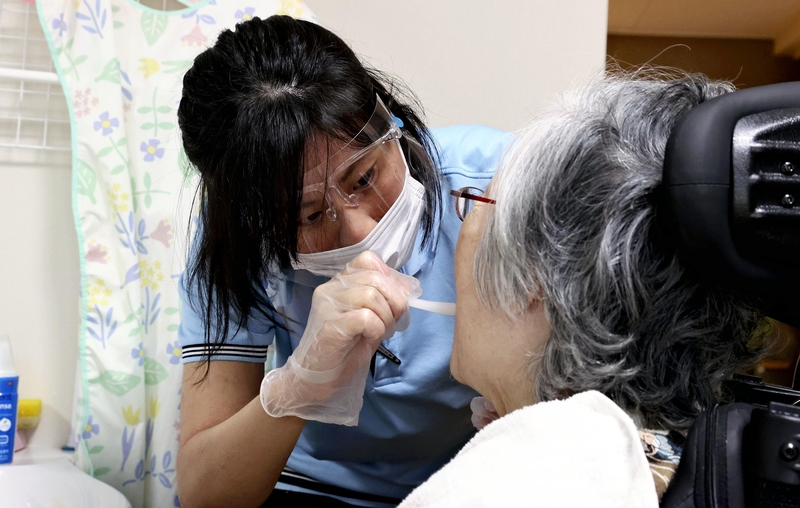
Care workers wear protective gear including gloves and a face shield over double face masks. Yet it is still a big burden on them to have close contact while assisting elderly patients.
On Jan. 28, Kimoto visited the room of a man in his 80s. His temperature was 37.8 C, and he could not finish eating all his lunch. The man was becoming desperate and told Kimoto, "I don't care if I die." Kimoto said to him: "You make me sad when you say such a thing. Let's live happily with everyone," and patiently told him to take a fever reducer.
Kimoto is one of five support workers who have been dispatched to the care facility from its operating company and affiliates.
"We the employees are working really hard to deal with the situation. But there's a limit to what we can do at a care facility in the long term," she said.
-- No family visits
Nursing homes without infection clusters are on alert as well.
At Shibuya-ku Tsubame no Sato Honmachi Higashi in Shibuya Ward, Tokyo, staff members change their gloves and disinfect the surroundings whenever they finish helping residents brush their teeth or eat a meal. Boxes of 100 gloves quickly become empty one after another each day.
Since last spring, the nursing home has been allowing residents to meet their families online only. Although many families told the facility that they wanted to meet their relatives in person at least for the year-end and New Year holidays, the care home granted no exceptions, putting priority on reducing the risk of infection.
Yu Saito, who works at the nursing home, has only traveled back and forth between her workplace and home since April last year.
"It's been very stressful, but this is essential work, so I'd like to keep on doing my best," Saito, 30, said.
Read more from The Japan News at https://japannews.yomiuri.co.jp/