The number of zero hour contracts in the UK labour market rose by around 100,000 last year according to the Office for National Statistics.
The agency reported that in its latest survey of firms there were 1.8 million contracts that did not guarantee a minimum numbers of hours in the year to November 2017. The equivalent number in November 2016 was 1.7 million.
However, as a share of all contracts, the proportion of zero hours contracts was unchanged at 6 per cent.
The ONS also said the survey that produced the data changed from being voluntary to compulsory between the two periods, meaning that the year-on-year comparison should be “treated with caution”.
The highest number of zero hour contracts recorded by the survey was 2.1 million in Mar 2015, when they accounted for 7 per cent of contracts.
The agency also reported that the number of people employed on such contracts in their main job in the three months to December 2017 was 901,000, around 2.8 per cent of all people in employment.
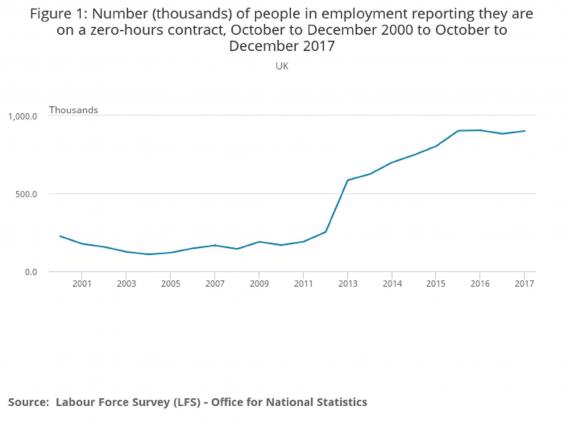
This latest estimate, based on a separate survey of employees, was 4,000 lower than the three months to December 2016, when the 905,000 zero hours workers also represented 2.8 per cent of the labour force.
According to the employees survey the number of people on zero hours contracts shot up from just 190,000 in 2011, although the statisticians say a proportion of this increase might be related to an increasing number of people recognising they were on such contracts after they were broadly publicised in the media.
The rise in zero hour contracts has been of growing concern for politicians in recent years.
The independent Taylor review, commissioned by Theresa May, recommended last year that the Low Pay Commission consider introducing a higher rate of minimum wage for zero hours workers and said the government should bring forward legislation to allow agency workers on zero hours contracts to formalise their status.
In its response, the government committed only to providing a “right to request a more predictable contract”.
Stephen Clarke of the Resolution Foundation said that the tightening of the labour market in recent years appeared to be curbing the growth of zero hours contracts.
“Nonetheless, around 900,000 workers are on a zero hours contract, including one in twelve young people,” he said.
“And while some workers appreciate the flexibility they bring, for others they bring insecurity and lower pay.”
The ONS employees survey showed that a quarter of people on zero hours contracts wanted more hours in their current job. They are also more likely to be aged 16-24, working part-time, or women, than those on regular contracts.
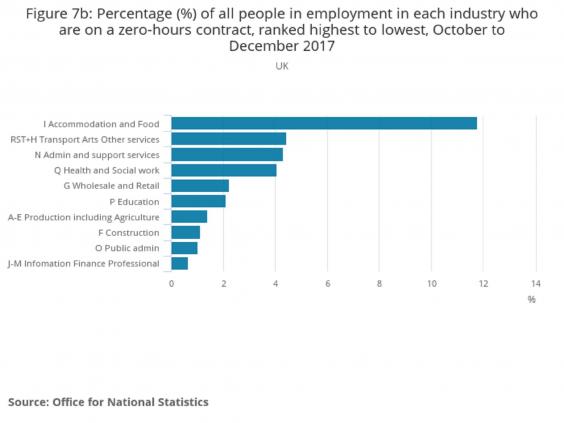
The industry sectors with the largest shares of workers on zero hours are accommodation and food (11.8 per cent), followed by health and social work, transport and administration (all on around 4 per cent).