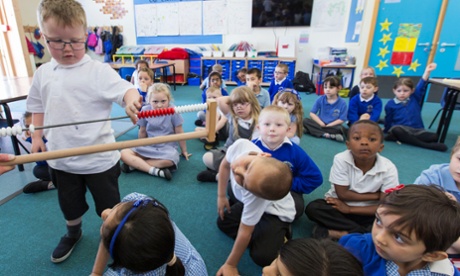
More than 100,000 infants are being taught in primary school classes larger than the statutory maximum, as state schools take advantage of rules allowing them to get around the cap. More than one in 20 infant school classes are above the ceiling, according to new figures, with most able to bust the legal limit because of exemptions to the maximum of 30 children.
The 2015 school census reveals that the number of primary school pupils has risen by 2% in England, with the extra 94,000 pupils equivalent to a rise of six pupils in each of the 16,800 state primary schools.
Labour was quick to pounce on the class size data, pointing out that in 2010 just 31,000 pupils were taught in classes larger than 30, compared with 101,000 in 2015. “The growing pressures on primary school class sizes should compel the government to rethink how it is allocating funding for schools,” said Tristram Hunt, the shadow education secretary. “It cannot make sense for the government to continue to prioritise money for new free schools in areas with surplus school places when we have more than 100,000 primary pupils being taught in classes of more than 30.”
A spokesperson for the Department for Education pointed out that 95% of the infant classes with more than 30 pupils had only one or two pupils above the cap. “To help schools respond to rising pupil numbers, the government invested £5bn between 2011 and 2015 to support local authorities – creating almost half a million new places,” the DfE said. “On top of that, we have committed to invest a further £7bn in new school places over the next six years, to support the new school places needed all the way up to September 2021.
“The government has also opened over 250 free schools since 2010 and we are committed to creating at least 500 more during this parliament, creating over 400,000 new school places and ensuring even more parents have access to a good local school for their child.”
According to the data, released as an appendix to the school census, the number of reception, year one and year two pupils in “lawfully large” classes jumped from 76,000 in 2014 to 96,000 this year, a rise from nearly 5% of all pupils to nearly 6%. But while the number of lawful classes with more than 30 pupils rose from 2,400 in 2014 to nearly 3,100, the average infant class size was unchanged at 27.4 pupils. That was helped in part by a drop in the number of classes that illegally breached the limit, suggesting that schools have become more adept at winning legal exemptions for larger classes.
Legislation passed by the Labour government in 1998 fixed the statutory class size at 30 per teacher. But the coalition government in 2012 brought in exemptions to the limit, such as allowing a twin to join a class that would otherwise hit the cap.
The first effects of the recent baby boom are starting to be felt in state secondary schools, which saw a slight rise in pupil numbers for the first time since 2010. Nearly 63% of secondary school pupils are now taught in academies or free schools. The figures also recorded a drop in the number of pupils claiming free school meals, from 16.3% in 2014 to 15.2% this year. Although the proportion of infants claiming free school meals fell marginally more rapidly, the government statisticians said it did not appear affected by the introduction of universal free school meals for the age group.
The number of pupils in independent schools also rose slightly to 570,000, nearly 7% of 8.3m full-time pupils in England. The total attending private schools is below its recent peak in 2004, although the figure has changed little.
Minority ethnic pupils made up 71% of the increase in the number of pupils in state primary schools, according to the figures, with white British accounting for the remainder. In secondaries, 27% of pupils were from minority ethnic backgrounds, compared with 25 in the same survey last year.