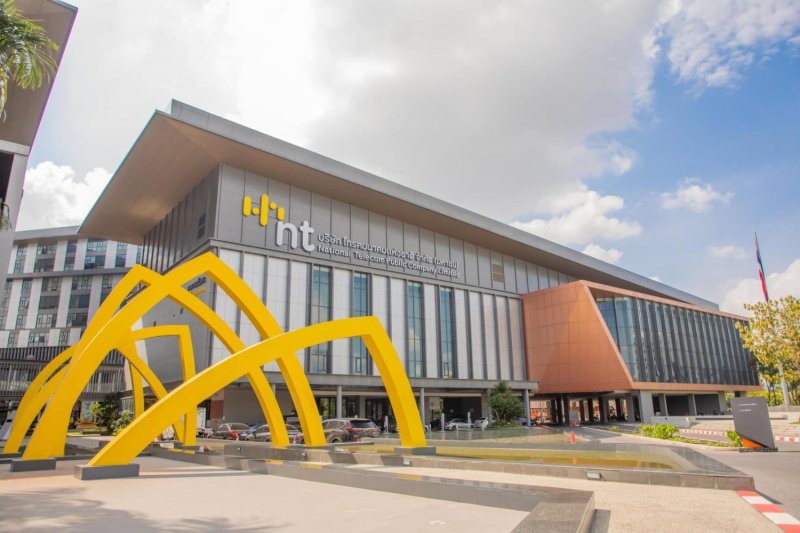
National Telecom (NT) is racing against a year-end deadline to determine the fate of its rights over its 126-degree East orbital slot, as the state-owned enterprise weighs a multi-billion-baht investment in a satellite for the slot against national security mandates.
According to NT president Colonel Sanpachai Huvanandana, the company's newly appointed board is scheduled to review the project's feasibility in June.
This follows a directive from the previous board, which commissioned a comprehensive study -- valued at 20–40 million baht -- to assess the viability of the space economy project and the 126°E orbital slot.
NT will have to finalise the decision by the end of this year to ensure proper coordination with the International Telecommunication Union (ITU), Col Sanpachai added.
The company secured the orbital slot rights through the auction by bidding around 8 million baht, but the cost of constructing and launching a geostationary Earth orbit (GEO) satellite for the slot is estimated at more than 1 billion baht.
This significant capital expenditure has sparked internal debate over whether the project remains commercially viable.
Col Sanpachai said the 126°E slot is currently classified as an "incomplete reservation" due to potential signal interference with neighbouring satellites at 125.5°E and 126.5°E, which are operated by China and South Korea respectively.
If NT chooses to proceed with using the slot, it must notify the ITU that it will conduct negotiations with both countries to mitigate technical interference.
"There are financial and strategic hurdles related to the plan," Col Sanpachai told the Bangkok Post.
SECURITY MANDATE
Despite the high costs, NT's project for the slot was originally initiated under a mandate from the National Space Policy Commission, driven primarily by national security interests.
At that time, the commission was chaired by Prawit Wongsuwan, then deputy prime minister.
Col Sanpachai said NT's current board is expected to seek further guidance from the National Space Policy Commission, now chaired by the prime minister or a designated representative, to confirm whether the national security requirement still holds.
Industry observers suggest that without clear support from security agencies, the board may find it difficult to justify the 3-billion-baht investment, especially given that NT secured the slot at a low price.
NT is expected to soon send a letter seeking the views of the National Space Policy Commission on the issue.
CHANGING LANDSCAPE
According to NT, the economics of building a new geostationary satellite have become increasingly challenging.
A new satellite is expected to require an investment exceeding 3 billion baht, while the market is rapidly shifting towards low-Earth-orbit (LEO) satellite constellations that offer lower deployment costs, greater flexibility and enhanced broadband capabilities.
Col Sanpachai said NT must adapt its strategy to remain competitive and align with changing customer demands and technological developments.
NT is pursuing partnerships with leading international satellite operators to expand service offerings while reducing capital expenditure and technological risks, he added.
The company's current satellite partnerships cover at least three satellite platforms, including two Chinese operators and one British operator, spanning both GEO and LEO satellite services.
Among them is Spacesail, a Chinese LEO satellite constellation project developed by Shanghai Spacecom Satellite Technology with support from the Shanghai municipal government and the Chinese Academy of Sciences.
The initiative aims to build a large-scale satellite internet network capable of competing with Starlink, the satellite broadband service operated by SpaceX.
The company has also partnered with China Satcom to introduce broadband services through ChinaSat-26, a high-throughput GEO satellite designed to provide nationwide connectivity across Thailand.
The platform supports both fixed and mobility applications, including maritime and aviation communications, while strengthening emergency communications resilience.
Commercial services from both Chinese partnerships are expected to commence during the first quarter of 2027.
NT has also collaborated with Eutelsat OneWeb, one of the world's leading LEO operators, to offer a satellite broadband service across the region.