Premiums in flood-prone areas will rise whether or not the Northern Territory government privatises the last state-owned insurance organisation in Australia, concerned residents were told on Thursday night.
Currently, premiums for homeowners with Territory Insurance Organisation (TIO) policies are the same regardless of where in the territory they live, as the commercially-operated organisation is guaranteed by the government.
Recent moves by the Country Liberal party (CLP) government to sell off TIO have sparked a wave of opposition among residents, unions, the opposition party, Palmer United party members and independents.
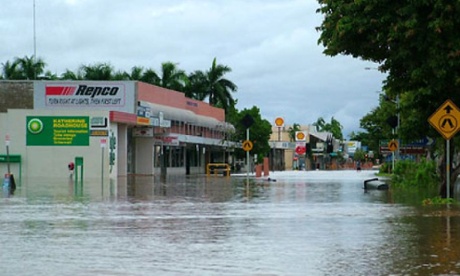
Premiums in flood-prone towns such as Katherine are expected to increase dramatically should the organisation be privatised, but Richard Harding, TIO chief executive, told a community meeting on Thursday night that it was likely to happen anyway.
Harding said the cost of re-insurance for flood had increased “significantly” since the 2011 Queensland floods and current policy needed to change regardless of whether the sale went through.
“Insurers are now pricing flood far more specifically and that creates a competition problem for us,” he said.
“If we continue to price the way we are then the prices of non-flood areas will be too high and so we won’t win that business.”
The NT chief minister, Adam Giles, did not attend the meeting organised by independent MLA Gerry Wood, claiming it had been hijacked by unions, the ABC reported.
Earlier on Thursday he had urged opponents of the sale to stay away from the meeting in the interests of allowing a “mature debate”.
Last week the CLP-majority parliament endorsed the selloff. Giles has said the government is just responding to TIO’s calls for help with liquidity, but remarks from Harding on Thursday suggest the government may be driving the sale.
“My job is to ensure the best outcome for our shareholder, and if the shareholder has made that decision [to sell], we support it and drive it forward for them,” he said.
The board of TIO opposed a sale in 2006 when the then-Labor government put it forward, but supports it now after several years of growth.
The opposition leader, Delia Lawrie, accused the government of pushing through the sale without giving Territorians a say.
“The government of the day has a responsibility to the people to protect public assets, particularly where monopolies exist in small jurisdictions,” Lawrie said in a statement.
“Public assets like TIO belong to Territorians, not the government. If a government has a case to sell a public asset in the best interests of the community, where there has been a cost-benefit analysis, they should make that case to the voting public and win their mandate to sell.
“The CLP have failed to consult with the public and they are arrogantly pursuing a behind-closed-doors sell-out of assets that belong to Territorians.”
Lawrie also called for the government to reveal if the selloff plans included any clause which would prevent the federal government setting up a TIO style insurer in the territory in the future.
The NT chamber of commerce found 51% of its members opposed the selloff, and just 24% supported it.
Their main concerns were around the potential for increased premiums, particularly for small businesses, the chamber of commerce’s chief executive, Greg Bicknell, told Guardian Australia.
Bicknell said the members “accepted that the government has very few assets available to take advantage of the asset recycling scheme offered by the federal government” and Harding’s revelations that the equalisation policy was going to “disappear anyway” might alter opinions.
“People are very concerned about the rises that are being experienced in north Queensland and that we would have the same thing happen here,” he said.
“But it’s a different market. We’re not as exposed with population centres along the coast that north Queensland has.”
He said after Thursday’s meeting, the chamber of commerce was now going back to members with the new information.
“I would expect that that would change the way some of our members would look at it,” he said.
Earlier on Thursday, Giles released a discussion paper for a potential new infrastructure development fund that would use a proportion of revenue from any public asset sales to be reinvested.
It appeared to be a move to ease the public into the idea of a sale in advance of a cabinet meeting on Tuesday that will consider final offers.
If the government decides to sell it would do so quickly because of “liquidity issues” with the insurer, Giles said.
It will suspend standing orders during the November sittings to introduce and pass the legislation in three days, circumventing the standard four-week public consultation period.