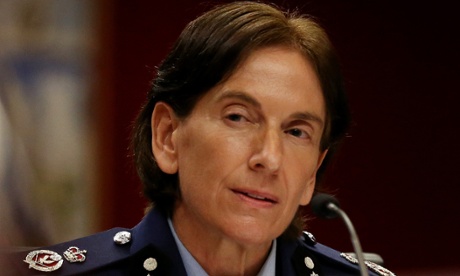
A New South Wales deputy police commissioner has admitted using a “very dishonest” informant in an operation in which more than 100 police officers, including her fellow deputy police commissioner, were bugged.
Catherine Burn faced a NSW parliamentary inquiry on Tuesday to answer further questions on Operation Mascot, an anti-corruption probe which bugged more than 100 police officers in 2000, including deputy police commissioner Nick Kaldas.
Burn was questioned about a key informant, code named M5, who allegedly committed perjury in the course of the operation.
“There is no doubt that M5 was a dishonest person,” Burn said, but defended the use of him in Operation Mascot, saying information from M5 led to 400 examples of police misconduct being exposed.
Asked if M5 was referred to authorities for perjury once police discovered M5 had lied under oath, Burn responded: “I do not know what happened to M5, I do not know.”
M5 approached Kaldas at least four times with a listening device on him during Operation Mascot.
Burn was a team leader of the special crime and internal affairs command unit (SCIA) which oversaw Operation Mascot, the subject of allegations of unauthorised buggings. The operation has been the subject of a probe by the ombudsman but was taken to a NSW parliamentary inquiry over concerns the ombudsman was taking too long.
Burn backtracked on evidence she previously gave that she still had unspecified suspicions about Kaldas.
She said suspicion of Kaldas in 2000 was reasonable at the time but she thought any issues had been resolved.
“I’m aware Mr Kaldas was promoted twice since I left and I would expect anyone being promoted would not have any outstanding matters,” she said. “I was satisfied [that] because he had been promoted the matter had been dealt with.”
Asked directly if she was the one who suggesting bugging Kaldas, Burn responded that she could not recall but the information would be easily available through the minutes of the meeting where it was decided.
During the 90-minute hearing Burn vented frustration at being asked questions which she said could “easily” be answered with access to a variety of documents, including meeting minutes.
“I’m being scrutinised and judged on incomplete and sometimes incorrect information, this is very dangerous,” she said.
She said the investigation was taking a toll on “all of us” and it was difficult for police to investigate other police, but it was the nature of their work.
“The police force of today is not the police force of the 1980s, 1990s and even early noughties … allegations of corruption have been dealt with,” she said, adding there had been reforms in the police force to prevent further corruption.
Operation Mascot also bugged journalists including Channel Seven journalist Steven Barrett and Daily Telegraph crime editor Mark Morri.
In previous testimony Kaldas has strongly criticised the conduct of Operation Mascot.