It has been a long time since the major parties have fought to prove their green credentials in Australian politics.
This week began with the Liberal environment minister Rob Stokes, the Labor opposition leader Luke Foley and the Greens environment spokeswoman Mehreen Faruqi trying to outdo each other at a forum in Parliament House.
There are several hot-button issues regarding the environment in this state election and there are several reasons the major parties are trying to paint the town green.
The issues include coal seam gas and coal mining approvals as well as the Native Vegetation Act, which restricts broadscale land clearing. To a lesser extent, but no less hotly contested by those in the field, are logging, biodiversity and threatened species.
Foley trails the premier, Mike Baird, by 55-45% on a two-party preferred basis and is running hard on environmental issues – so much so that the Daily Telegraph digitally dressed him in a koala suit on its front page and dubbed him Luke Foliage.

The opposition leader kept the environment portfolio when he took on the party’s leadership, perhaps because it made sense for a new leader thrown into the job just 10 weeks ago to hang on to a portfolio that he knows in a detailed way.
On the government side, there is some mixed messaging going on. While buying back coal seam gas licences and promising to implement the recommendations of the chief scientist’s report on that industry, Mike Baird declared on Thursday in the Australian Financial Review: “[Coal seam gas] will remain a big part of our economy and yes, it is part of our overall solution”.
Stokes has credentials as a lawyer and academic in environment and planning law. His mastery of environmental policy detail has been privately acknowledged by environmental groups in spite of their reservations about key policy areas in mining, logging and fishing.
Faruqi is a civil and environmental engineer and spokeswoman for the Greens. Which makes her pretty green.
All of which makes for the most interesting environmental election auction in years.

CSG and coal mining
Coal seam gas and mining approvals form one of the big issues threatening to put a dent in government seats in the north of the state, such as Tamworth, Ballina, Lismore and Tweed. The issue remains front and centre of voters’ concerns across the state in a motherhood kind of way.
In the Lonergan poll this week, 75% of voters reported concern about the effect of CSG on water and land while 62% were less likely to vote for a party that supported CSG. Whether it translates into swinging votes remains to be seen. Meanwhile, broadcaster Alan Jones is appearing for the anti-CSG/mining lobby in marginal seats such as Campbelltown.
Even though the previous state Labor government granted all of the present CSG licences, Foley has promised a statewide moratorium on CSG and a permanent ban in the northern rivers region – which happens to hold three of those northern coastal seats.
Baird, meanwhile, has been cancelling CSG licences under a voluntary buyback scheme. In the past two weeks, Baird and his planning minister, Anthony Roberts, announced the state government would buy back CSG licences issued by Labor across the state, including the northern rivers, north-west NSW, the central coast and the Sydney catchment. A total of 2,941,000 hectares have been released as a result of the buy-back scheme.
Baird has committed to implement the NSW chief scientist’s recommendations by the end of the year, which urged baseline real-time monitoring of water and industry insurance to safeguard against environmental damage. The Greens and the anti-mining lobby say such insurance cannot be done without funding for real-time monitoring.
Apart from CSG, some of the most controversial mines, such as the proposed open cut coalmine of the Chinese state-owned Shenhua company on the Liverpool Plains, remain ticked for approval by the Baird government.
The Greens oppose all coal seam gas exploration and mining across the state permanently.
Native Vegetation Act
This is the act that restricts landholders from wholesale clearing of native vegetation. It has caused opposition among sections of the farming community and their representatives, such as the NSW Farmers Association. The issue captured national attention when a landholder, Ian Turnbull, was charged with the murder of an environmental officer, Glen Turner, after an alleged dispute over land clearing. That court case is still pending.
The Baird government appointed an independent panel to review all biodiversity legislation and it recommended the repeal of the Native Vegetation Act, while bringing the powers into a great big biodiversity conservation act. The government has yet to respond to the panel’s recommendations but environmentalists fear it will provide a chance to water down land clearing laws.
The NSW National party has been vociferous in its opposition to the native vegetation laws, gaining support from the federal agriculture minister, Barnaby Joyce. However, in late 2014 the Baird government refused to support a motion by the Shooters and Fishers in the upper house that would have weakened the act.
This week, Stokes ruled out a return to broadscale land clearing and it is understood he has had heated battles in cabinet with the National party in the cabinet room.
“There cannot be a return to any broadscale land clearing,” Stokes promised environmental groups. “That’s not something we can go back to. What instead we need to focus on is landscape level conservation benefits.”
Stokes said there should be a significant increase in the funding going into biodiversity protection programs and an announcement is expected before the end of the campaign.
Foley committed to “no backward steps” on Labor’s Native Vegetation Act, which he credited with helping the state to contribute to Australia’s Kyoto targets.
Faruqi described the biodiversity review as “deeply concerning” and one that could lead to environmental protections being ripped up.
Logging in native forests
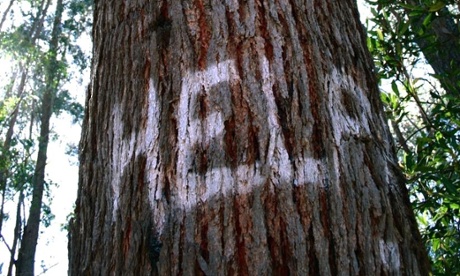
In the light of reports of cable logging trials in the northern part of the state, Stokes said he had no proposals for cable logging on his desk. He ruled out cable logging in any areas that weren’t “previously subject to logging”.
Stokes said he recognised the need to transition to plantation timber. He said the state would work with the federal government to identify tax incentives to invest in hardwood plantations. Stokes would like to see the federal government move to create tax incentives for hardwood plantations to stop the targeting of native hardwood species, such as blackbutt.
Labor has committed to an increase in national parks, including the “Great Koala” park in northern NSW covering 316,000 hectares, taking public forests in those areas out of timber production. Foley has also promised to increase penalties for illegal logging and would ban cable logging and reinstate prohibition of burning native forest material for electricity generation.
Faruqi would end all logging and mining in state native forests by 2016 and all high conservation state native forests would be converted into national parks, managed by the environment department instead of primary industry. The Greens would also commit $80m to help logging communities transition out of the industry.
Marine parks
The Greens support full protection for marine sanctuary zones, after protections were wound back by the O’Farrell government under a deal with the Shooters and Fishers party in the upper house.
The government also announced a five-year moratorium on any more marine parks under the deal and the existing sanctuary zones, where fishing is now allowed, are under review.
Stokes urged the audience to get involved in the rezoning review of sanctuary zones. He has promised a ban on microbeads in personal products by mid-2016, smoking in national parks (45% of coast) and a container deposit scheme.
Foley promised the creation of a Sydney marine park, full protection for marine sanctuary zones and to re-establish a coastal council and a healthy rivers commission.
“A sanctuary zone that doesn’t deliver full protection is not a sanctuary zone,” said Foley.
The ground is set
Of all of these issues, coal seam gas and mining have the biggest capacity to swing votes and already, the anti-mining campaign has achieved its end of pushing the issue to near the top of the political agenda for the 2015 campaign.
Given the likelihood that the Coalition will be returned to government, the space to watch will be the tussle between Stokes, if he remains in the environmental portfolio, and the National party, whose power depends on how many seats they retain on 28 March.