New South Wales will further restrict travel to regional areas, and tighten lockdown rules regarding the singles bubble, in an attempt to make enforcement easier for police after the state reported a record 390 local Delta cases.
The Berejiklian government is also expected to finally introduce a Covid test payment to ensure people isolate while waiting for a swab result rather than feeling pressured to work.
The NSW crisis cabinet met on Friday afternoon to decide on updated lockdown rules after receiving advice from the NSW police commissioner, Mick Fuller.
The government says officers have been frustrated when policing the rules due to loopholes and a lack of clarity on some restrictions, including the singles bubble and travel from greater Sydney to regional NSW.
The ABC reported singles in nominated local government areas of concern would need to nominate a specific bubble partner within 5km. A permit would also be needed to travel from greater Sydney into regional NSW and there would be a crackdown on people travelling to their holiday homes.
The changes come after police were forced to contact a large number of real estate agents in Byron Bay before they were able to charge two men, aged 52 and 19, with breaching health orders by travelling to the north coast town. The older man had claimed he was there to look at real estate, a permitted reason to travel.
At national cabinet earlier on Friday, the NSW premier, Gladys Berejiklian, faced pressure from other state leaders to stick with its suppression strategy. With all other states targeting zero cases of Covid, NSW was under pressure to tighten its lockdown and not ease up.
“It has been a fairly consistent position, that all premiers, myself as well, want to ensure that we constrain and suppress the outbreak in NSW as effectively as we can, and those issues were raised today,” the prime minister, Scott Morrison, said.
He described Friday’s discussions as being held in “good faith”.
There was a potential crisis looming in Indigenous communities in western NSW, with cases in Dubbo and Walgett now reported, as well as traces of the virus being located in sewage at Bourke and Parkes.
There were also concerns about possible spread to the south coast of NSW, with reports that people from the ACT, which went into lockdown on Thursday due to a new outbreak of the Delta variant, were moving to coastal towns.
There was also concern about the spread of cases in Blacktown and Mt Druitt.
“Unfortunately this trend will continue for at least the next few days. It means all of us have to work harder to make sure we start and follow the rules,” Berejiklian said.
But she denied authorities were looking at a statewide lockdown as early as Friday night.
She also indicated that NSW was fully supportive of the 70% and 80% thresholds for vaccination that were outlined in the Doherty report for relaxing restrictions and that opening hotels and clubs was unlikely before that time.
Of Friday’s local cases, 58 were infectious in the community, 43 were in isolation for part of their infectious period and the isolation status of 191 remained under investigation.
The Australian Manufacturing Workers Union, one of the state’s biggest unions covering many critical workers, said on Friday that blaming NSW residents was not the answer and they needed more support.
“An easily accessible ‘test and isolate’ payment would help stop the spread of Covid-19,” the acting state secretary, Robyn Fortescue, said.
“No worker should be forced to choose between losing income and potentially putting others at risk. We need a government response focused on clear public health messaging. Instead, we’ve got confusing restrictions and more police on the streets targeting minority communities that don’t have good relationships with law enforcement.”
But the immediate challenge was western NSW. Four schools had been closed in Dubbo and health authorities were rushing to establish more testing and vaccination clinics.
“Obviously there is a big challenge in north-western NSW because the townships and towns we’re talking about are principally places like Walgett,” the health minister, Brad Hazzard, said.
Walgett had about 3,500 people generally in town and 6,500 in the broader area, with a large percentage being Indigenous, he said.
“There is an Aboriginal medical service there, which does excellent work, a very large building and a reasonable number of staff. They manage in normal times but trying to manage if there is a major outbreak with a one-in-100-year virus is going to be a challenge for them,” he said.
The nearest base hospital was in Dubbo, but it too had very limited intensive care facilities and specialist staff, which meant Covid-19 cases would likely need to be taken to Orange or Sydney.
“Is it a serious issue for the local community? It is, very much so. The ICU in a hospital in a place like that is nowhere near what we would expect in Sydney. That is why the entire NSW health service is on high alert and is asking the community up there to definitely stay at home,” he said.
Hazzard said he had written to the federal health minister, Greg Hunt, saying NSW “would need them to step in and do work that they said they would be doing much earlier and that is to try and vaccinate as many people as was possible”.
He said Hunt responded within an hour or two and indicated they would have the appropriate teams in place and would get the Australian Defence Force mobilised as well.
But authorities were particularly concerned because of large households often including several generations and because Aboriginal people often had co-morbidities, such as diabetes.
There were also concerns about the growing number of children being infected with the Delta variant. A specialist school, Giant Steps at Gladesville which caters for autistic children, had seven cases among students, and families had been ordered to isolate.
“Certainly we are concerned about the number of younger people affected during this Delta outbreak, we look very closely at the infection rates in children,” the acting chief health officer, Dr Marianne Gale, said.
“Clearly, we are seeing more children affected by Covid this year compared to what we saw last year, and certainly we are discussing those issues with the Department of Education and other industries that look after children as to what are the right measures and settings.”
Across NSW, 128,000 tests were conducted on Thursday.
The premier said Sunday had been dubbed tradies day, to enable tradespeople in the hotspot areas to be vaccinated – a condition of their returning to work.
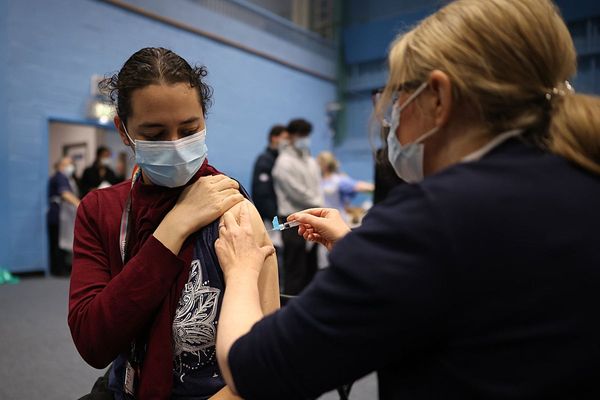
There was also a program to get 100,000 essential workers between the ages of 18 and 39 vaccinated next week.
Two people lost their lives overnight because of Covid, one woman in her 40s in south-western Sydney, who died at home and was not vaccinated. The case had been referred to the coroner.
The other death was a man in his late 90s who was in palliative care.