As the Australian federal government prepares to debate a bill on hate speech following the Bondi attack, behind closed doors a New South Wales inquiry is investigating banning a specific phrase: “globalise the intifada”.
The inquiry into “measures to prohibit slogans that incite hatred” closed to public submissions on Monday after just three weeks, and will not hold any public hearings before it hands its report to the Minns government at the end of the month.
Although it has been asked to review hate speech laws in general, the Labor-controlled committee has been specifically asked to consider a ban on the controversial phrase “globalise the intifada”. Intifada is an Arabic word meaning uprising or “shaking off”, used in reference to two Palestinian uprisings against Israel in 1987 and 2000.
The second intifada in particular was characterised by Israeli military attacks on Palestinian cities and towns, and multiple suicide bombings by Palestinians that killed civilians in Israeli cities.
Many in the Jewish community strongly associate the word intifada with indiscriminate acts of violence and terrorism.
In the UK, police have announced they will arrest protesters who call for intifada. The NSW inquiry’s terms of reference require it to consider “international best practice to combat the use of such slogans” – particularly in the UK.
Submissions against banning the phrase have warned about importing “repressive models” from overseas. Policing and legal experts have warned that UK practices could be incompatible with Australia’s constitution and inflame social tensions.
So what changes has the UK introduced and could they be coming to NSW?
What are the UK laws on ‘intifada’ slogans?
In December, the UK’s Metropolitan and Greater Manchester police announced they would arrest anyone chanting the words “globalise the intifada” or holding a placard with the phrase on it.
Sign up: AU Breaking News email
The heads of both forces said the country’s Crown Prosecution Service (CPS) had “consistently” advised them that “phrases causing fear in Jewish communities” didn’t meet prosecution thresholds, but following the Manchester synagogue and Bondi attacks, police had decided “the context has changed”.
Rather than banning the phrase outright, protesters have been arrested under the country’s existing Public Order Act, including five people for “racially aggravated public order offences” at a pro-Palestine protest in London last month.
But a significantly higher numbers of arrests relate to a change made in July, when the Labour government made it a criminal offence to be a member of or show support for the UK group Palestine Action after it was proscribed as a terrorist group.
The move was widely condemned by human rights groups including Amnesty International, who said it may breach obligations to uphold the rights to freedom of expression, and that UK terrorism laws were already “excessively broad and vaguely worded”.
Several people linked to the group, which has used direct action to target Israeli weapons factories and their supply chains, are now on hunger strike in prison. They are not affiliated with the Sydney Palestine Action Group (PAG).
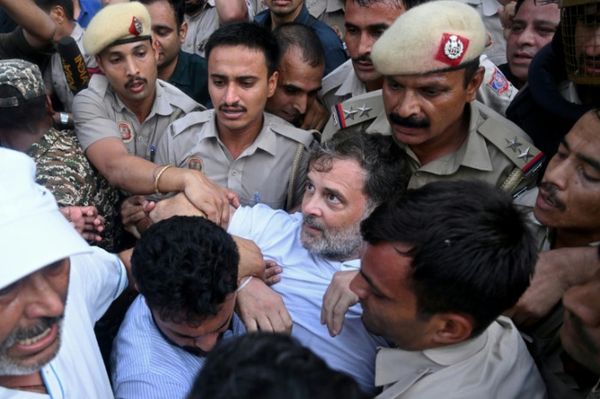
The BBC reported in October that more than 2,100 people had been arrested for showing support for Palestine Action since the change, many for carrying placards saying: “I oppose genocide, I support Palestine Action”. More than half of the more than 500 people arrested at a protest in London in August last year were aged 60 or above.
In November, the Metropolitan police said 254 people had been charged under the offence since July. The offence of showing support for the group attracts a maximum sentence of six months’ imprisonment.
Would a UK-style ‘intifada’ ban work in NSW?
Anne Twomey, a professor of constitutional law at the University of Sydney, said, unlike Australia, the UK did not have a constitutionally entrenched implied freedom of political communication, and bans could be more open to constitutional challenge in NSW.
“They don’t have the constitutional constraints that we do,” she said.
But Luke McNamara, a professor at the University of NSW law school, said using existing public order offences – including a newly created offence for inciting racial hatred (93ZAA in the NSW Crimes Act) – might be more successful than an outright ban on a phrase, which he said was more open to constitutional challenge.
“Leaving it to the discretion of the police in a particular context, to decide whether or not a given use of a slogan constitutes a criminal offence that already exists – I think that’s preferable than locking into a statute that that particular phrase or any other is involving intentional incitement of racial hatred,” he said.
“I think it’s pretty clear that [‘globalise the intifada’] means different things to different people.”
The Sydney Morning Herald reported that only two people have been charged under 93ZAA since it became law in August, with at least one of those charges withdrawn. A woman was arrested for allegedly wearing a jacket adorned with “globalise the intifada” at a protest in Sydney this month, but later released without charge.
The use of existing hate speech laws has been supported by the NSW opposition. The shadow attorney general, Damien Tudehope, described the parliamentary inquiry as “very rushed” and said he had “grave doubts” about the Minns government’s ability to outlaw “reams and reams of phrases or potential slogans” without a constitutional challenge.
“The UK has gone away from doing this sort of stuff. They use public order laws in respect of those sort of slogans, and that appears to me to be an approach which we should be taking.”
The inquiry’s chair, Labor MP Edmond Atalla, told Guardian Australia it was his personal position that the phrase should be banned.
“We will not be held back by the opposition. The priority for the government is to deal with this as soon as the government reconvenes in early February.”
Keiran Hardy, an associate professor at Griffith University and counter-terrorism law expert, said the powers used to proscribe Palestine Action as a terrorist group in the UK had an equivalent in the commonwealth Criminal Code Act in Australia.
But he said the Australian act’s definition of terrorism had a legal exemption for political protest which did not exist in the UK. “That’s partly why Palestine Action was able to be proscribed in the UK. I doubt that groups like that would be able to be proscribed in Australia.”
Hardy said it was too early to say if pro-Palestine groups could be proscribed as hate groups under the changes proposed in the federal government’s hate speech exposure bill, but said he thought it would be “a highly unpopular decision”.
How have groups and experts responded?
Submissions to the inquiry have explicitly condemned the idea of introducing UK practices to NSW. In its submission, PAG condemned the designation of the UK’s Palestine Action as a terrorist group, saying “the trajectory of civil liberties repression in the United Kingdom is of serious concern”.
In its submission, the Jewish Council of Australia (JCA) said the UK approach had not enhanced community safety, but showed how “the broad application of counter-terrorism frameworks to civil advocacy can lead to systemic legal overreach that damages democracy”.
It said the term “intifada” has been “associated with violent actions in some historical contexts”, but this was “one interpretation of the term, not its inherent or exclusive meaning”.
Other Jewish community organisations, including the Executive Council of Australian Jewry and the NSW Jewish Board of Deputies, who have both been granted an extension to make their submissions, have condemned the use of the phrase and expressed their support for a ban.
Dr Vince Hurley, a lecturer in criminology at Macquarie University and a former NSW police officer with 29 years’ experience, said British police had a history of responding to protests with “exceptional force”.
He said protests had yet to generate “the same degree of intensity in Australia,” but said bans on specific slogans could lead to scenes similar to the mass arrests seen in the UK.
“It’s a nightmare, I wouldn’t want to be policing it,” he said.