The New South Wales government has delivered a $2.5bn surplus, although the bulk of it was achieved by changing the way it lists some of its transport spending.
The treasurer, Gladys Berejiklian, announced the surplus in her first budget on Tuesday, saying the government had overcome “a bloated bureaucracy and an unsustainable budget” to deliver the result.
The underlying surplus is $713m, with the headline figure achieved by establishing the transport asset holding entity (Tahe), a commercial, public, non-financial organisation which allows the government to list part of its transport budget as a direct equity injection rather than a cost.
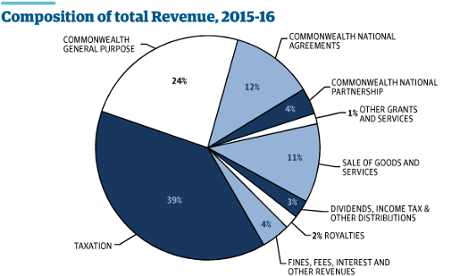
The Victorian and Queensland governments use a similar system.
The underlying surplus is forecast to be delivered over the next four years, increasing to $895m in 2018-19.
The NSW government used the budget to square up for a fight with the federal government over education and health spending. It revealed that if the commonwealth went ahead with its planned cuts, NSW schools would lose $1.3bn in 2018-19 and the health budget would lose $1.5bn over the two years to 2018-19.
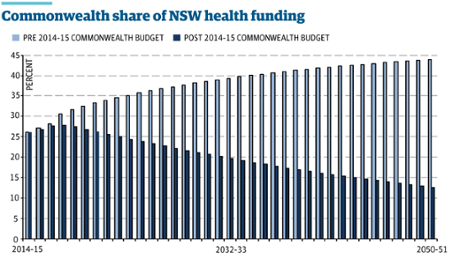
The updated estimate is a funding loss of about $26bn in the 10 years to 2024-25.
The budget papers revealed $68.6bn spending on infrastructure, which included $5.1bn on health. The government will go ahead with its Gonski commitment in education, spending $12.4bn on schools, and has committed $148.5m over four years to domestic violence programs.
The state’s net debt, which in 2011 was forecast to be $62.4bn by 2014-15, has been reduced to $38.2bn.
Berejiklian championed the government’s infrastructure spending, saying these years would be remembered decades from now as a “time of building”.
“Building a stronger economy through record investment in infrastructure and services, and improving the quality of life of every single person in this great state,” she said.
“A time when NSW reclaimed and cemented its position as the number one state in the nation. A time when we built stronger communities, and took care of the most vulnerable.”
But she forecast clouds on the economic horizon, warning that the budget being in the black did not mean the government could “rest on its laurels”.
“We must remember that as a service-led economy, we are a cog in a much broader national and global market, the outlook of which is mixed,” she said.
“Subdued growth in both the domestic and international economies will be felt through weakness in demand for our exports, and this will moderate our growth and, along with population growth, means we have to work harder to create more jobs.
“We are also exposed to varying commonwealth grants and to the volatility of stamp duty receipts. A government that failed to recognise the challenges of its budget in this way would be irresponsible.”
Referring to the looming fight with the federal government over the health and education cuts, Berejiklian said she looked forward to “positive interaction” with the commonwealth in talks about the funding as well as broader tax reform.
“This government has always tried to have a productive relationship with the federal government, no matter what their politics,” she said.
“We were the first state to sign up to the Gonski reforms, and the first state to sign up to the full rollout of the national disability insurance scheme. Our actions show that we will always put the interests of NSW first.”
The government’s proceeds from the planned privatisation of electricity assets were not included in the budget papers.
BUDGET AT A GLANCE
INFRASTRUCTURE AND ROADS
- $68.6bn allocated over four years for infrastructure, mainly on roads and health
- $1.7bn towards building Sydney’s WestConnex freeway
- $1.4bn to help duplicate Pacific Highway in northern NSW
- $977m to building the Sydney metro north-west rail line
- $51m to continue work on NorthConnex
- $1.5bn for roads and maritime assets maintenance. Includes bridge rebuilding and repairing footpaths
- $167m for road upgrades and expansions in western Sydney
PUBLIC TRANSPORT
- $99m to continue implementation of the Opal card electronic ticketing system
- $316m to improve access to public transport
- $521m for concession schemes for pensioners, students and people with disabilities
- $404m for rural and regional bus services
- $92m to help replace bus fleets and cope with the growth in service demands, particularly in Sydney
- $79m to improve pedestrian access to the western CBD and the multi-billion-dollar Barangaroo development (pedestrian access is listed under transport in the budget)
HEALTH
Forecast of $1.5bn loss to the budget by 2017-18 if the federal government goes ahead with planned cuts
- $19.6bn expense budget
- $2.6bn for emergency care
- More than $10bn for inpatient and outpatient care at hospitals
- $1.7bn for mental health services
- $1.6bn for rehabilitation and extended care
- $913m for primary and community-based services
EDUCATION
- $12.4bn for schools as the government delivers on its Gonski commitments
- $224m over four years for a mentoring and coaching program for teachers
- $167m over four years for extra school counsellors, flexible wellbeing resources and targeted support for Aboriginal and refugee students
- $348m for “enhanced support” in the early childhood education and care sector
DOMESTIC VIOLENCE
- $148.5m over four years on specialist programs for victims of domestic violence
- The pilot of the domestic violence disclosure scheme will be launched, allowing women to find out if their partner has ever had restraining orders imposed or has been to court on charges of domestic violence
- $33m over four years for the women’s domestic violence court advocacy program
- $10.4m over the next financial year to provide women with medium-term financial help as they leave violent partners