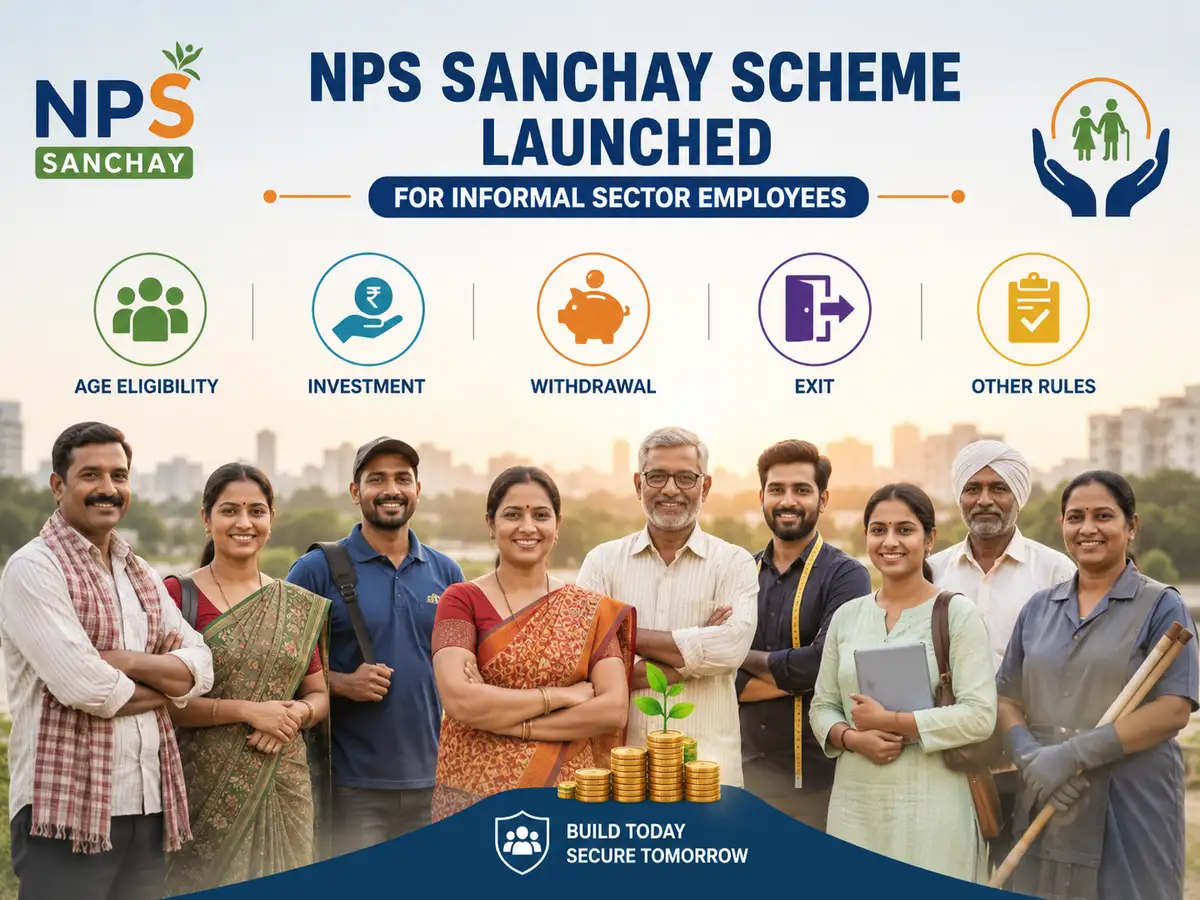
In order to support India’s informal sector employees who account for almost 90% of the total workforce, the Pension Fund Regulatory and Development Authority (PFRDA) has launched the NPS Sanchay.
NPS Sanchay, a simplified variant of National Pension System (NPS), falls under the All Citizen Model and MSF Framework. It aims to simplify the process of choosing investment options and figuring out asset allocation for the informal sector employees.
According to the PFRDA circular on May 6, 2026, “The default design of this scheme is intended to reduce complexities associated with selection of investment options and determination of asset allocation, while also addressing constraints arising from limited advisory support at the last-mile level.”
This circular will come into effect from today (May 6, 2026).
Who is eligible to invest in NPS Sanchay?
Focus on informal sector workers
KYC requirements for NPS Sanchay
What will be the investment pattern in NPS Sanchay?
The investment pattern for this scheme will be consistent with the existing investment guidelines for government sector schemes, such as Unified Pension Scheme (UPS)/NPS/Atal Pension Yojana (APY) schemes.
Minimum contribution rules aligned with existing schemes
NPS Sanchay: What are the exit and partial withdrawal rules?
NPS Sanchay charge structure
The charge structure applicable to NPS Sanchay will be the same as that prescribed for Point of Presence (PoP) services under the common schemes of NPS, including NPS (All Citizen), NPS Vatsalya and NPS Lite.
NPS Sanchay minimum contribution
MSF schemes allowed in NPS Sanchay
Pension funds can launch schemes under the Multi Scheme Framework (MSF), with investment patterns governed by this circular.
As per the PFRDA circular, “Pension Funds shall be permitted to launch schemes under the Multi Scheme Framework (MSF), as may be prescribed by the authority from time to time, subject to the condition that all terms and conditions governing such schemes shall remain identical in all respects to those applicable under the existing framework, save and except the investment pattern, which shall be governed exclusively by and construed in accordance with the provisions specified.”