Ahead of the Tokyo Olympics and Paralympics this summer, more schools and companies are holding sessions to get people to think about disabilities.
One particular focus is the idea that barriers are not caused by people with disabilities, but by society. Many of the classes cover this "social model of disability," which is also being incorporated into the training sessions for Olympic volunteers.
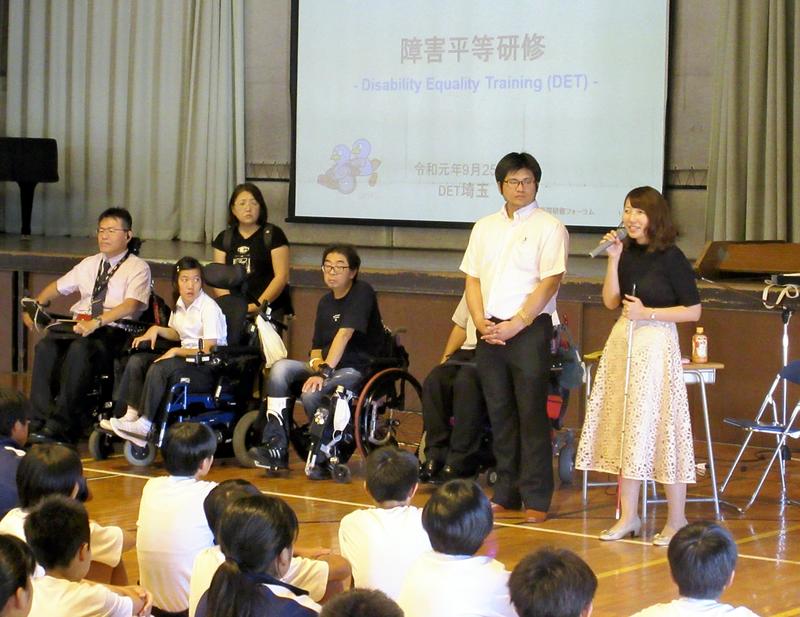
"What do you think disability means?" Ayami Azemoto, who was born with a visual impairment, asked about 220 second-year junior high school students gathered at a gymnasium in Tokorozawa, Saitama Prefecture, in late September 2019.
The students' answers included "a disabled body" and "inconvenience."
Azemoto, 30, then showed a drawing of a woman going shopping in a wheelchair. "Use a pen to circle where you think the disability is," she instructed the students.
The students circled things like stairs, the cramped store and other barriers that the woman found herself up against.
Next, Azemoto showed a video telling the story of an able-bodied person encountering problems in a world where many people have disabilities.
The story showed how it would feel to be discriminated against for not having a disability, such as being refused entry to a restaurant or being unable to ride a bus.
She then repeated her initial question: "What do you think disability means?"
This time the responses were different, such as "things that can be solved through compassion" and "things created by social environments."
This special class was put on by a cooperation entity of the Disability Equality Training Forum, a nonprofit organization based in Tokyo that specializes in explaining the social model of disability in classes taught by people who themselves have disabilities.
In the "individual model," barriers are seen as being due to an individual's physical or mental limitations. But in the "social model," they are caused by social factors and the society has a responsibility to remove the barriers.
The social model was included in the 2006 U.N. Convention on the Rights of Persons with Disabilities, as well as a 2017 Japanese government action plan for achieving a cohesive society.
The NPO was only involved in about 10 training sessions in fiscal 2014, but this rose to about 140 in fiscal 2018. In addition to more corporate sessions, its session was selected to help train the about 80,000 volunteers for the Tokyo Games.
"If the social model of disability permeates society, it will help create a world that is easier to live in not only for people with disabilities, but for everyone, including elderly people and foreigners," said Yasushi Nakano, a professor of disability psychology at Keio University.
Understanding of Paralympic competitions vital
To deepen understanding of Paralympic competitions, classes are provided on the front line of schools with a teaching resource called "I'm POSSIBLE," endorsed by the International Paralympic Committee.
The resource was created in 2017 and include the characteristics and history of the Paralympics as well as video footage on the theme.
For example, it introduces swimmers with visual impairments, who eliminate the fear of hitting the wall in a pool by being tapped with a pole as a signal that they are approaching it immediately before making a turn. That way, they can swim without concern.
The resource also includes content such as a quiz to make students consider ways in which people with disabilities can enjoy sports.
Miki Matheson, 46, a gold medalist in the 1998 Nagano Paralympics who was involved in the creation of the teaching resource, said: "Everyone stands at the same starting line. Amid mounting interest in Paralympic sports, there is now an opportunity to change attitudes [toward people with disabilities]."
Read more from The Japan News at https://japannews.yomiuri.co.jp/