PYEONGCHANG -- Early in the Pyeonchang Games, I visited the Gangneung Oval to report on the 10,000-meter race in men's speed skating. I met a young woman there from Japan who had never seen the event before; she said she was at the oval because she had time and a ticket was available.
Long-distance races have been a weak spot for Japan, but Ryosuke Tsuchiya was able to finish in 10th place with a new national record. "Wonderful!" the woman shouted, clapping her hands.
She was soon absorbed in the powerful skating of top long-distance racers from countries like Canada and the Netherlands. "How can they keep up their fast pace throughout this long race?" she asked. "It was really worth coming here today."
I went to many events that I was unfamiliar with during my time at the Games. I was surprised by the aggressiveness in short track skating, in which contact between skaters regularly occurs. I was also impressed by how each skater chooses their route during the race to overtake their rivals or stop others from overtaking them.
At the ski and snowboard halfpipe events, I gasped in amazement at the height and deftness of the athletes' tricks.
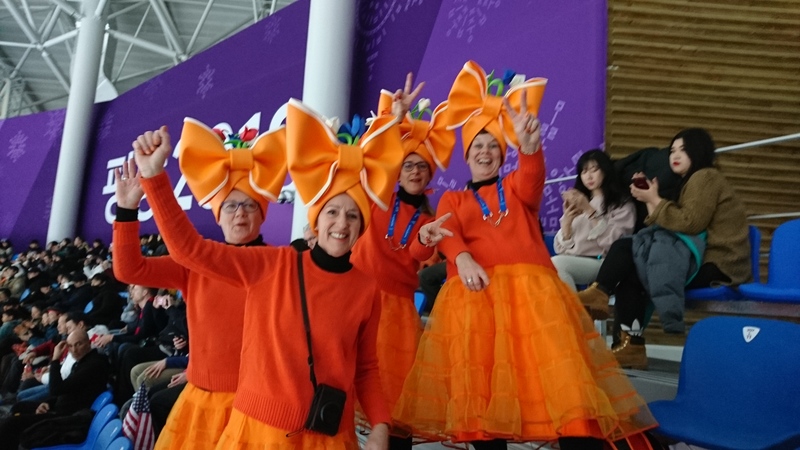
I met fans from many countries clad in various outfits. Fans from the Netherlands wore orange jackets, shirts, pants and skirts at speed skating events, and a group of women wore handmade tulip-motif hats, dancing cheerfully during intervals.
I couldn't believe my eyes when I saw fans from Germany drinking beer and singing songs at a freezing cold ski jumping venue. Fans from the United States were nearly everywhere, throwing their support behind their athletes.
I also have to stress the dedication of the volunteers. When I first arrived at a station in Pyeongchang, several volunteers quickly approached me to offer help. One spoke in Japanese, which she said she had just learned. I was anxious being in an unfamiliar place, but their help warmed my heart. During the Games, volunteers were almost everywhere -- literally -- at venues and stadiums, working from early in the morning to late at night, never forgetting to smile.
But I often encountered vacant seats at venues. There could be several reasons why people didn't go to the stadiums to watch events: For one thing, the freezing temperature may have made them reluctant to watch sports they were unfamiliar with in the cold, open air. Some events were also held late at night, which made it difficult for families with children to attend.
Foreign visitors also seemed to have a stronger presence than locals at the events. The Olympic Games is a golden opportunity for winter sports to gain popularity and build a following in a country.
Spread the love
Japan will soon host a series of big sporting events. First there's the 2019 Rugby Cup, followed by the 2020 Tokyo Olympics and Paralympics. Stadiums are likely be filled when Japanese athletes and teams appear, but what's important as the host country is how we can enliven the Games in which Japanese athletes are not scheduled to appear.
Setting reasonable ticket prices is important, as well as publicity activities by local municipalities that host venues.
But there's something else I think is important -- the venues at the Pyeongchang Games were all modern and clean, but I hardly got a sense of Pyeongchang as a town. The food sold at stadiums was all the same, and most of it was snack foods and retort pouches. When foreign visitors left South Korea, how deep an impression of Pyeongchang itself did they take away?
When Japan hosts big sporting events, ideas to fill the venues with a festival-like atmosphere will be important, such as stalls that sell local cuisine both inside and outside.
But most important of all will be the efforts of each individual -- to show an interest in sports and athletes they're unfamiliar with and go to stadiums to cheer on the athletes, like the Japanese woman I met in Pyeongchang. Efforts like this will be the biggest contribution to enliven events.
Let's support athletes with packed stadiums. Speed skater Nana Takagi, who won two gold medals at Pyeongchang, said she drew on the cheers from the crowd to power herself. Athletes will certainly respond to support from the audience and give their best performance.
Memories of the hard-fought battles will certainly leave a legacy for Japan's entire sporting community.
Read more from The Japan News at https://japannews.yomiuri.co.jp/