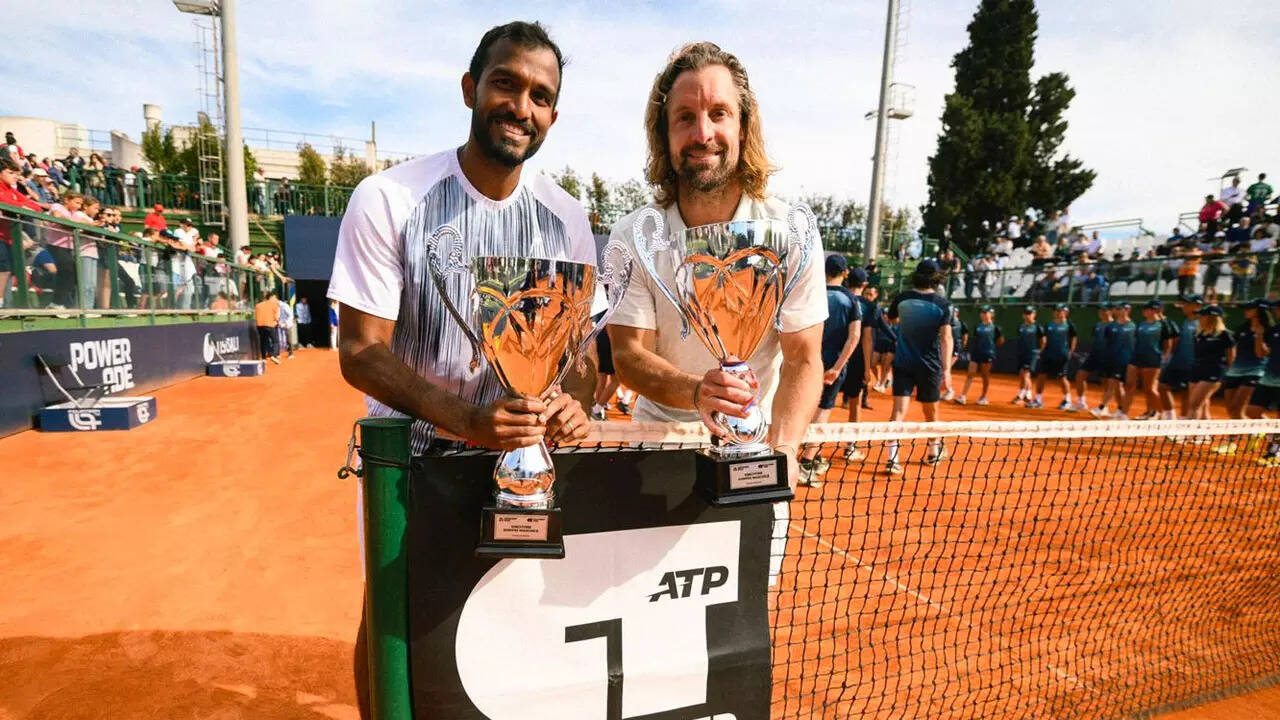
PUNE: It has already been an incredible journey as a professional tennis player for Sriram Balaji.
Having started comparatively late at the age of nine in the southern city of Coimbatore, the 34-year-old Balaji is now on the cusp of playing in the Olympics — as Grand Slam champion Rohan Bopanna’s doubles partner in Paris.
Only Nirupama Sanjeev from the city known for its textile and auto industry has wielded the racquet for India at the Summer Games before.
Yet, Balaji has come a long way, so much so that he is not ready to be satisfied by simply turning up in India colours, but go all the way and fetch the coveted medal.
“Last year I played couple of slams. I did have the game, but was not sharp enough. The last couple of months I have been playing much better tennis. Earlier I would question myself, now I believe in myself much more, my confidence level has gone up. Right now, I am not getting satisfied (with) just making the entry, I want to win the medal,” Balaji, world ranked at a career-high 62 in doubles, said.
Balaji conceded playing in the Olympics had not been his goal until recently.
“It is truly dream come true for me, thanks to Bops (Bopanna). Yuki (Bhambri) is 10 spots ahead of me in rankings,” said Balaji.
“When I started, wanted to take it step by step. First the Under-14s (for India), then the Davis Cup. Olympics was not in my thoughts."
The right-hander who began his tennis journey at Perks Tennis School near his home in Coimbatore under the guidance of Elango Ranganathan, whose daughter Madura was a women’s pro.
The first major step-up for Balaji was moving to Chennai at the age of 16 and beginning to work Hiten Joshi and Ilyas Hussain.
“They (Joshi and Hussain) told me 'don't play juniors' … so I started playing the men’s (circuit). I earned my first ATP ranking point when I was 16. They were the ones who put me on to (Alexander) Waske (in Germany),” he said.
Moving base to Europe was another steep learning curve for the Tamil Nadu lad as he had to adapt fast to the difference in culture and tennis.
“It was totally different. My ranking was 800 but I was not even getting into qualifying (of ITF men's events),” Balaji said.
“That's how tough it was, the standard was very high. It took me one year (to start winning) ... I lost all my matches. I went there in 2010, it was only in 2011 summer that I started getting into qualifying and winning.
“It was also mentally very difficult. It makes you think, 'what am I doing here?' I got a lot of help from the coaches and my parents. They never let me down. They pushed me, they believed in me.”
Balaji encountered another speed bump a few years later when his game began to stagnate at between 300 and 400 in world rankings. He was at a crossroads and needed to choose his path — continue to pursue success in singles or switch to doubles.
“I did have limitations in my game. It was 2017 and I had to make a choice. That was also my best year,” he said of winning nine doubles titles, including his maiden Challenger, with Vishnu Vardhan.
The preceding year the duo had won seven ITF titles.
“My belief in singles was less. I believed I could get to top-200, but to get inside top-100 ... I could see that I had limitations, and I knew that in doubles I was capable of top-50.
“So the choice was whether to go for top-200 in singles or top-20 in doubles. I chose top-20 doubles.”
Almost immediately his ambitions suffered a setback as Vardhan decided to stop playing full schedule.
“I didn't have a set partner after that. Every four-five weeks I had a different partner. In 2022, I started playing with Jeevan, in 2023 we did well and then he wanted to take a break,” Balaji said.
But the tide began to turn when he started forging a partnership last year with Andre Begemann, a 39-year-old German who had ranked 36 in 2015 and won four ATP Tour titles.
The Indo-German combination won three Challengers with Balaji getting into the top-100 in rankings for the first time and Begemann returning to the elite bracket too.
“Both of us play in the German league, so I knew him already. It is only in the slams I play with a different partner since we don't get in. Otherwise in Challengers I play with Andre,” said Balaji who had beaten Rajeev Ram and Scott Lipsky in the company of Jeeven Nedunchezhiyan at the Chennai ATP Tour event in 2012.
Balaji credited the ‘Doubles Dream of India’ programme for supporting the top-200 ranked players in the country.
“It makes a lot of difference. Having a coach through the whole year is not affordable, especially with the less prize money in doubles,” he said.
“Someone watching from outside can tell you what you cannot absorb when you are playing.
“Providing a coach and a trainer during the matches in doubles, you don't find that in many countries. We have eight players in the top-200 ... without this (programme), players would have a lot of struggle.”
This year’s French Open was a sort of dress rehearsal for the Olympics tennis competition, which will be held at the Roland Garros.
Balaji had made it to the second round last year, and went one step further this year in tandem with Mexican Miguel-Angel Reyes-Varela. The pair lost to none other than Bopanna and Aussie Matthew Ebden.
The fortnight proved to be a rewarding one in many ways for the Indian.
“I was not in the tournament to begin with, we were sixth out,” Balaji said.
“Rohan also has been mentoring me, telling which tournaments I should be playing. This time I told him I want to come to Paris, it's ok if I miss a Challenger.
“I decided I was going to take my chances and signed in. The other thing is you also get to practise with the top players during the Grand Slam.
“Finally we got in, thanks to the (inclement) weather also, as the singles players pulled out.”
The match against the Australian Open winners in the third round was a difficult one but also brought out the best in Balaji and Begemann.
“It was not an easy match, it was really hard (to play against Bopanna),” Balaji said.
“I look up to him, he is like a mentor to me. I felt I handled it well.”