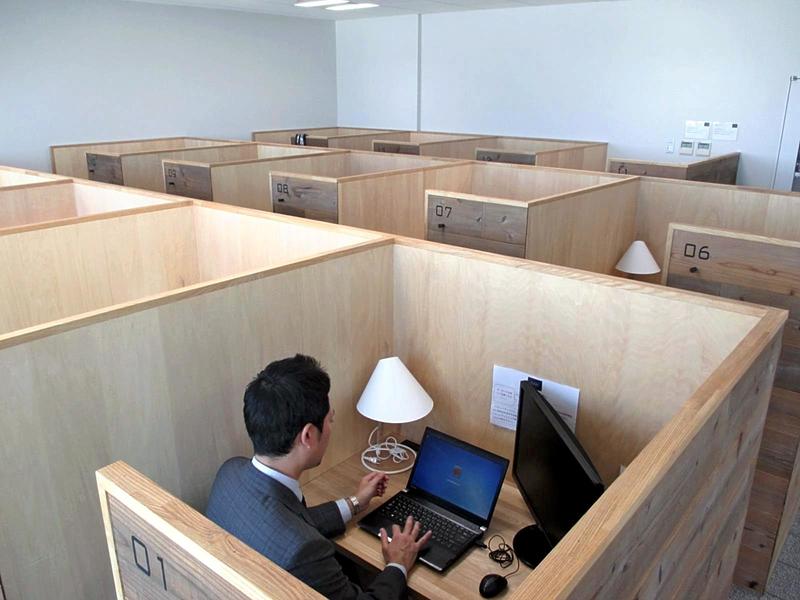
Once a week, a 37-year-old man living in Yokohama "commutes" to a building near JR Yokohama Station, instead of traveling to his office at an IT company in central Tokyo. The building's 16th floor houses a facility with 66 seats, a multifunction printer, wireless LAN and other workplace necessities.
Called NewWork, the office sharing service has been offered by Tokyu Corp. since 2016. Various price options are available, including a basic monthly charge of 5,000 yen to use the facility for eight hours a month.
"I can work at home, but when I do I find myself playing with my child or doing household chores instead," the Yokohama man said. "It's easier to come here than to commute to my office in central Tokyo, and I can concentrate on work."
NewWork is one of several services offering places to work outside the home or office, at a time when the central government is promoting telework, in which people use information technology to work remotely, as part of work style reforms.
Tokyu provides the service partly to ease the rush-hour crush on railways it operates. In fiscal 2016, the congestion rate during rush hour stood at 184 percent between Ikejiriohashi and Shibuya stations on the Tokyu Denentoshi Line, and 170 percent between Yutenji and Nakameguro stations on the Toyoko Line. (A 100 percent congestion rate is defined as the maximum number of people being able to sit on a seat or hold on to a strap or pole near a door. At 180 percent, a passenger can, with some difficulty, hold and read a folded newspaper.)
Tokyu plans to provide office sharing services at 200 locations by fiscal 2020, including those to be operated by business partners. "We hope to have people telework about once a week," Tokyu official Shinichi Nagatsuka said.
According to a survey conducted in 2016 by the Internal Affairs and Communications Ministry, 13.3 percent of respondents with 100 or more employees had introduced telework. The government aims to increase this ratio to over 30 percent by the 2020 Tokyo Olympics, in response to the success that London had in easing traffic congestion during the 2012 Games, when about 80 percent of local companies adopted the scheme.
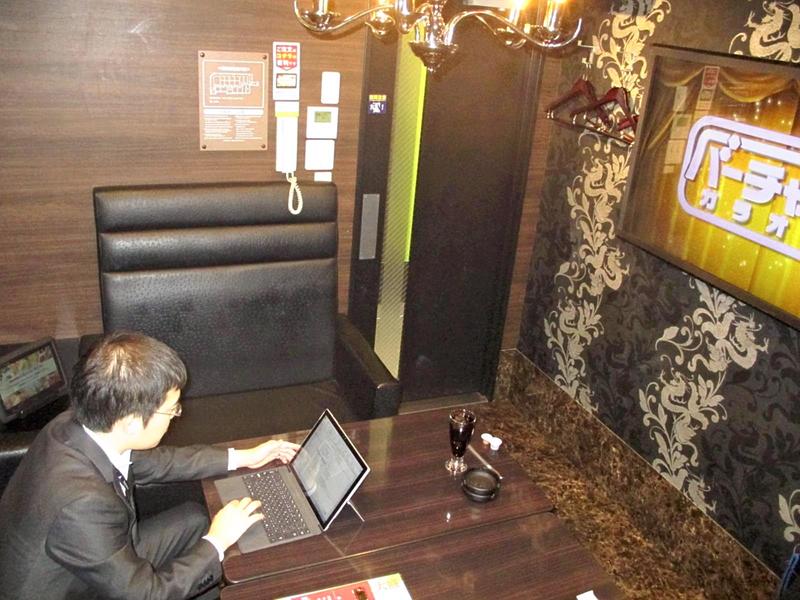
In April 2017, karaoke chain Big Echo launched a service to allow customers to work in private rooms. It offers the service from opening time to dusk, when karaoke rooms are relatively unoccupied. Customers can use a private room equipped with wireless LAN and a power source for 600 yen per hour before tax. More than 30 Big Echo shops offer the service in the Tokyo metropolitan area, Sapporo, Sendai and other cities.
"It's convenient because I don't need to make a reservation in advance," said a 35-year-old male company employee who often uses the service when working outside his office. "Also, the place is so quiet I can focus on work."
Takayuki Suzuki of Daiichikosho Co., the operator of the karaoke chain, said the service has an advantage because users "can work away from the eyes of others."
V-cube, Inc., a major Tokyo-based provider of video conferencing systems, has developed Telecube, a work space that resembles a phone booth and is equipped with a flat panel display, power source and desk and chair among other things for one person. It also has advanced sound insulation.
The company designed the work space to be compact enough to be installed at public facilities, stations and other places.
Chiaki Imaizumi, a senior researcher at the Japan Telework Association, said so-called third spaces outside homes and offices were once mainly used by freelancers and self-employed workers. "However, more and more employees at regular companies are now using them," he said. "This type of workplace will be more widely available in the future at various locations, such as stations and commercial complexes."
Read more from The Japan News at https://japannews.yomiuri.co.jp/