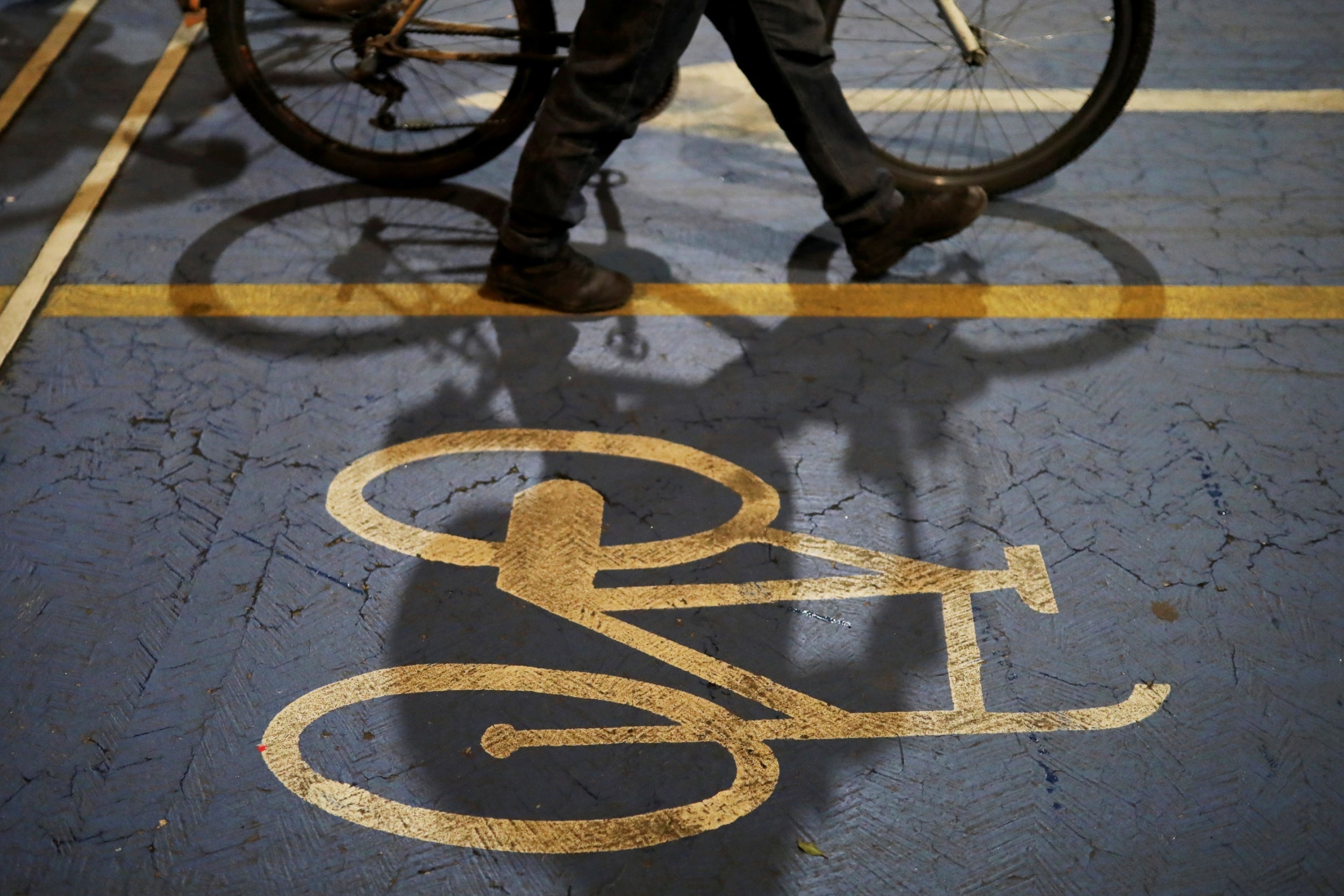
Norway's government has announced that it will spend a billion dollars building a new network of cycle lanes in a bid to cut the country's greenhouse gas emissions.
The Scandinavian state's new national transport plan allocates 8 billion Norwegian Kroner (£724 million) for construction of the network of protected cycleways - which are already proven in countries like the Netherlands.
The infrastructure plan is aimed at raising the proportion of journeys taken by bike to as high as 20 per cent by 2030, putting it on a par with its neighbours like Denmark, where cycling is a popular mode of transport thanks to a comprehensive network of lanes.
The lanes, which will be protected from motor traffic by a kerb line, are planned to run alongside commuter routes and be designed to support speeds of up to 25 miles per hour in a bid to shift workers out cars.
The focus will be on connecting city and employment centres with suburbs and residential areas - the most highly trafficked routes.
The country's transport minister Jon Georg Dale also said earlier this month that the government is examining changing road rules to allow cyclists to turn right at a red light, to give them a head-start over cars. Other European countries such as Denmark, Germany, and the Netherlands have similar rules.
Norway's mountainous terrain and cold weather presents a number of challenges for establishing a cycling culture. Some local politicians have also already suggested that the cycle paths might only be used in summer, while the country's transport minister has suggested that many Norwegians might choose to make use of electric bikes to tackle routes with steep gradients.
Despite being a major exporter of North Sea oil Norway has invested heavily in green schemes in recent years. The country is the largest market for electric cars, with almost 60 per cent of new cars sold in March this year entirely electric powered.
Segregated cycle lanes have seen a renaissance across Europe and North America in recent years, with city planners from London to Paris to New York increasingly learning from countries with high rates of cycling like Denmark and the Netherlands, where such infrastruture is ubiqutous.