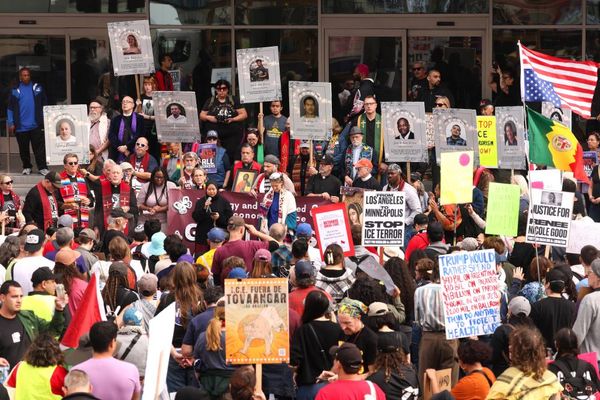
A mining minister in the Northern Territory was forced to abandon a speech to a protest today after he was shouted down by residents – many on horseback – angry at a lack of consultation, regulation and safeguards around hydraulic fracturing for shale gas on their land.
More than 200 people from across the NT’s remote communities and pastoral leases, including about two dozen on horses, marched and rode through Darwin’s central business district on Tuesday morning before holding a rally on the steps of parliament house.
Daniel Tapp, co-organiser of the rally and owner of the Big River Station, currently under application by Santos, said they wanted the government to “put the brakes” on the shale gas industry in the territory, and move towards renewable energy.
“Water is our most crucial asset, liquid gold,” Tapp said to the minister for mines and energy, David Tollner. “This is a direct threat to our water, our lives, our future, our food.”
Tollner had come out of parliament to address the rally but was shouted down by agitated protesters.
“Everything in the Northern Territory that’s good and worthwhile comes from our environment,” Tollner told the crowd.

“Whether it’s mining, whether it’s agriculture, whether it’s tourism, our natural environment drives a lot of that. As a government we are absolutely committed to not killing the goose that lays the golden egg.”
The crowd responded with boos, jeers and accusations of corruption, despite some attempts by organisers to calm the situation.
“You cannot protect the environment without managing a strong economy. You cannot build a school without managing a strong economy” Tollner continued.
“As a government we recognise the huge potential benefits there are in a gas based future and the opportunities that gas drilling presents to the Northern Territory.”
Larrakia elder, June Mills, shouted that the government was hurting “the most impoverished people in the world for money.”
Tollner ended by saying “it was absolutely fantastic to see you all here” and he was happy to take their petition into parliament.
Mining – and more recently fracking – remains a controversial issue in the NT, with frequent claims of environmental damage caused by operators.
The McArthur river zinc mine in Borroloola, where some of Tuesday’s protesters travelled from, was this month linked to elevated lead levels in fish and cattle. A proposed gas pipeline between the NT and the eastern seaboard will be delayed after it was decided an environmental impact assessment was needed.
In his short address Tollner said the government had “hit the go slow button” and he pointed to the government-commissioned Hawke review, which rejected a push for a moratorium in February, saying environmental risks could be managed effectively with robust regulation in place.

The NT government is currently enacting changes to its petroleum regulation, but David Morris, principal lawyer for the NT environmental defenders’ office, called for a ban on current explorations until it was through.
Tasmania announced its own moratorium on the day the Hawke inquiry was released, and Morris pointed to the NSW Liberal government’s “pause, reset, recommence approach” which saw a ban on fracking while an inquiry was underway.
Morris said the largest concern in the NT is “how few rights Aboriginal people have to say no” to mining on their land.
“The great unfairness I believe in the Aboriginal land rights act, which only gives them the right to say no at the exploration stage,” he told Guardian Australia.
“There’s a huge amount of misunderstanding about what they’re saying yes to at that early stage, and giving up that veto right.”
Morris added there is also concern about “the incredibly high reliance on fracking operators doing the right thing … and the vast number of deficiencies in our law that are a long way from best practise.”
Colleen Williams came to Darwin from the remote Arnhem Land community of Maningrida with family to protest against offshore gas drilling.
“I don’t want my home to be destroyed by the government, by fracking. I’ve got my dreaming site out at the sea,” Williams told Guardian Australia.
“Take your stuff out of our country. We don’t need it, we don’t want it, we don’t like it.” she said.
Andrew Dowadi, a senior elder from Maningrida and traditional owner of Yilan outstation, said the government and the mining industry needed to show respect by talking to traditional owners.
“Fair talk, not hiding in secret way, and sending letters. We don’t understand that way,” Dowadi told Guardian Australia.
“We can get together and say we agree together. People want an answer from me, and we say no. We asking them to respect that,” he said.
“Why can’t they respect us? Why can’t they listen to us?”
“That’s what all you Balanda are teaching us – to look after ourselves. That’s why we go to school – to learn and talk to each other in friendly ways, not to just come and push us away.”
Kezia Purick, the CLP-turned-independent NT speaker, told the crowd she had warned the government to “get out on the front foot” and consult widely with the community, but she was told no.
“The consequence of not listening to the people is why you’re here today,” she said.
Purick, whose background includes work in the mining industry, said she “didn’t know enough about it” to pledge support or opposition to fracking, but “if you have genuine concerns it’s beholden on myself and others to listen to you. Just keep fighting it.”