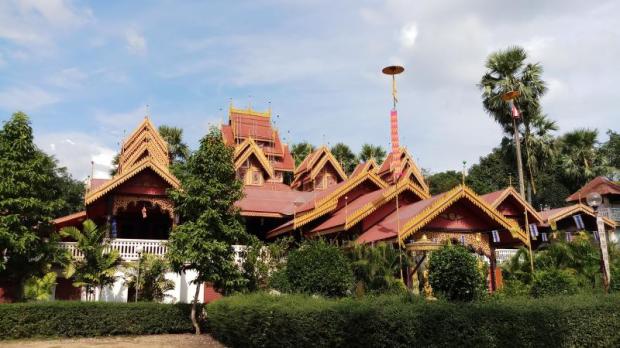
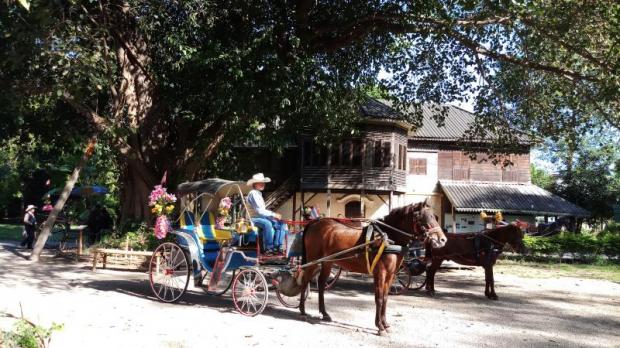
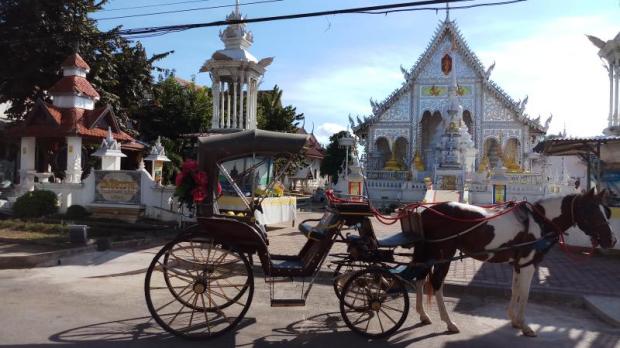
Riding on a horse-drawn carriage around the downtown of Lampang province is like travelling back in time. Nonetheless, this "town of horse-drawn carriages" is famous not only for the old-style travel mode, temples and bowls with chicken motifs. It has just begun to promote its community tourism, artistic, romantic and challenging destinations and street festivals under the new campaign "Lampang: Dream Destination".
"Lampang has high potential in terms of culture, tradition and eco-tourism, but is visited by not many tourists -- only about 900,000 a year. It may lack public relations and marketing. People just pass by Lampang when travelling north. The Tourism Authority of Thailand has positioned Lampang as a time capsule, although the town is not just limited to slow life and temples. So we came up with the one-year campaign 'Lampang: Dream Destination'," Lampang governor Songpol Sawastham remarked.
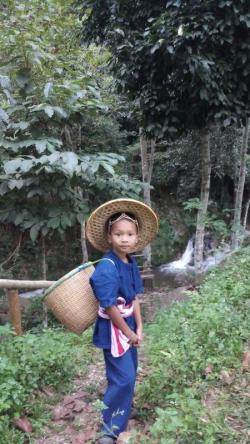
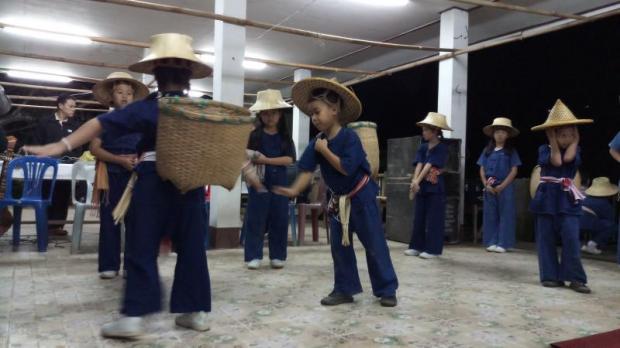
Ban Pa Miang is located in tambon Chae Son, Muang Pan, about 90km north of Muang Lampang. It was named after the miang grown by most families there. Visitors can visit tea (miang) and Arabica coffee plantations and see local villagers collecting miang leaves, tying and steaming the leaves in an old style from May until December. Each villager can collect between 10 and 30kg of miang leaves per day. Each small pack of steamed miang leaves is sold for 20 baht. Tourists can observe coffee collection from November until January. Popular souvenirs from Ban Pa Miang are miang tea, miang soap, miang-leaf pillows and coffee beans. From February until mid-March, the village will be seen standing in a white valley filled with blooming dok sieo (orchid tree flowers).
According to the governor, the campaign will transform Lampang from a transit point to a destination for all types of tourists, including those who like to take and share pictures, adventure seekers, romantic people, movie fans, shoppers, temple-goers, art lovers, the elderly who like to travel and use social media, and those who like to travel and learn new things.
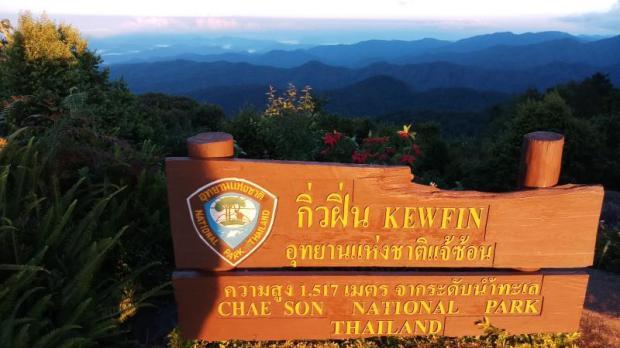
Nature lovers should not miss Kiu Fin, the top of the mountain, where the stunning views of sunrise over the sea of mist can be enjoyed. The mountain can be accessed from both Chiang Mai's Mae On district and Lampang's Muang Pan district. Also in Muang Pan is Ban Pa Miang, a small community which has long grown Assam tea and produced miang (fermented tea leaves) for traditional chewing. The village offers million-dollar mountain views as well as homestay accommodation for tourists.
Movie fans can follow characters of the popular drama series Rak Nakhara, which was filmed at a few local temples, such as Wat Si Rong Muang and Wat Sutthawat. Meanwhile, bookworms may want to visit Kiu Lom Dam, where fun stories about work at the dam were told by novelist Mananya in the popular novel Chao Khuen (Dam People).
Health-concerned tourists can soak themselves in warm spring water at the Chae Son National Park in Muang Pan. Another popular activity there is boiling eggs in hot spring water. Not far away is Chae Son Grass Farm, where tourists can sip freshly brewed jar-roasted coffee.
Art lovers can enjoy street art and sculptures, such as along the Wang River near Rassadaphisek Bridge, the cultural street and even at Ban Pa Miang. Among the interesting street-art pieces are a sculpture called Mr Chicken and paintings of the town's symbols, including elephants, horses and chickens. Another must-see is the chicken-bowl making at Dhanabadee Ceramic Museum in Muang district.
"Lampang is a town of arts and crafts, especially for ceramics and wood carving. Local people make wooden toys for worldwide export. Tourists can visit Ban Luk, which we want to open as a centre of wooden products like Ban Thawai in Chiang Mai. Chicken bowls from Lampang are very famous," the governor said.
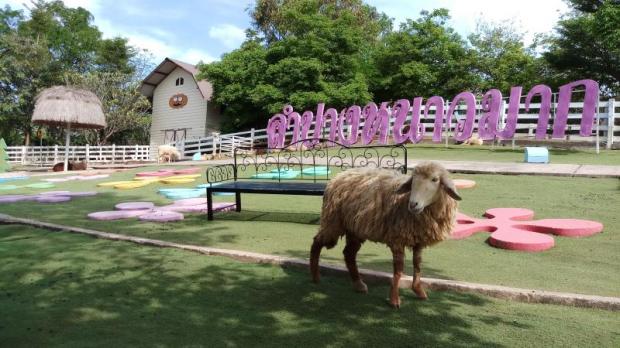
The province is also outstanding for growing temperate crops and flowers, such as strawberries, avocado and persimmon. A community called Muang Tan is a source of vegetables sold to royal projects and one of the country's biggest sukiyaki restaurant chains. Tourists can enjoy selfies at Hug You sheep farm as well as vineyards and strawberry farms in tambon Chae Hom.
The governor and his team are confident in their mission to make tourism in Lampang grow sustainably while conserving its local cultural uniqueness, citing their experiences and success in promoting tourism in Nakhon Si Thammarat, Krabi and Songkhla when he was a governor there.
According to him, his team can adjust strategies and marketing to meet tourists' needs. The province will increase social media check-in spots, train more tour guides and tourism personnel, create events and promote two-in-one tour (travel and food) packages. It will highlight Ban Pa Miang and Chae Son by improving roads and services.
It hopes for more tourists from South Asia, including India. Currently, more Chinese tourists visit Lampang to see street art while European tourists appreciate the local way of life.
"We set a goal to attract 2 million tourists per year within two years," the governor said. "We plan for the Dok Sieo Ban [Blooming Orchid Tree Flowers] Festival at Ban Pa Miang and festivals at Kiu Lom Dam and Doi Fa Ngam."
To know Lampang better, all are invited to the Lampang Street Festival on the banks of the Wang River in Muang Lampang on Saturday and Sunday, and the Lampang Open House fair at CentralWorld, Bangkok, from Feb 19-21. This is when the tourism, artistic, gastronomic, agricultural and health aspects of the northern province will be unveiled.
TRAVEL INFO
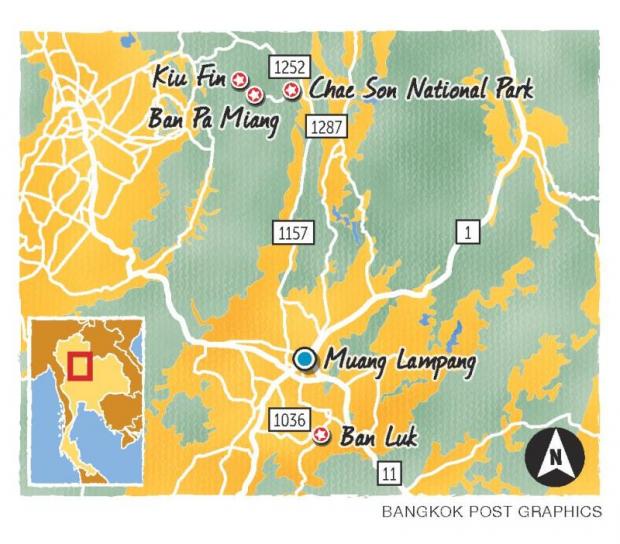
- Located about 600km north of Bangkok, Lampang is accessible by car, bus, train and plane. To travel in downtown Lampang, take songthaew buses, which cost 10-20 baht per head per trip on a sharing basis. To get to Ban Luk, Ban Pa Miang and faraway destinations, a van with a driver can be hired from local tour agents.
- Contact Ban Pa Miang Homestay Group at 063-124-1850 or 082-172-4661.
- Contact the Tourism Authority of Thailand (TAT) Contact Centre at 1672.