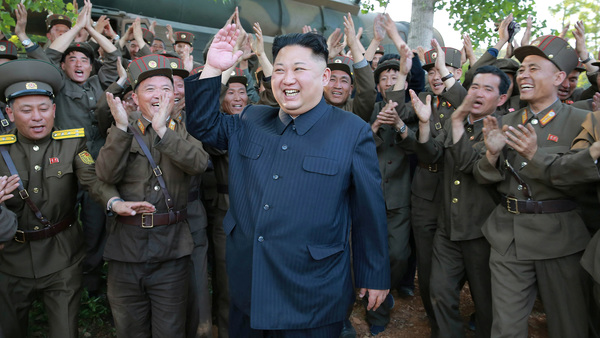
BEIJING _ North Korea's claim that it had successfully tested a hydrogen bomb raised the stakes Sunday in its escalating confrontation with neighbors across northeast Asia, and with a U.S. administration that is increasingly running out of good options.
Japan and South Korea's leaders condemned the latest sign that North Korean leader Kim Jong Un, unfazed by strict United Nations sanctions and international condemnation, has accelerated the country's nuclear and missile development with astonishing success.
President Donald Trump denounced it as "very hostile and dangerous to the United States."
But Chinese officials met an even more sobering reality _ that Beijing, Pyongyang's top ally and trading partner, has also become a target of its wrath.
At noon Sunday in Pyongyang, North Korea executed its sixth nuclear weapon test _ its first since Trump's inauguration, and its most powerful to date. The device had an estimated explosive yield of 120 kilotons, making it eight times more powerful than the bomb that destroyed Hiroshima, according to NORSAR, a Norwegian earthquake monitoring agency.
North Korean state media claimed that it was a hydrogen bomb and could be attached to a missile capable of reaching the mainland U.S. It called the test a "perfect success."
Experts say the test puts both China and the U.S. in a bind. It occurred just hours before Chinese President Xi Jinping's introductory speech at the summit of BRICS �� an association comprising Brazil, Russia, India, China and South Africa ��in the southeast China city of Xiamen. The forum _ attended by several heads of state, including Russian President Vladimir Putin _ was Xi's chance to show China's growing leadership role in the developing world, and the test was a striking intrusion.
Residents of Chinese cities and towns bordering North Korea reported feeling shock waves from the blast.
"It's long been suspected that the North Koreans were designing this (nuclear and missile) program not only to keep the Americans out, but also to send signals to the Chinese," said Robert Kelly, a North Korea expert and professor at Pusan National University in South Korea.
"They don't want to become a satellite state, like East Germany," he said. "When the Soviets pulled the plug on East Germany, East Germany disappeared within 11 months. And North Korea just doesn't want to be that dependent on China."
North Korea has for decades endangered its neighbors Japan and South Korea. In a military conflict, its conventional weapons could kill thousands in Tokyo and Seoul. Yet it has been diplomatically and economically close to China since the 1950s. China accounts for 90 percent of North Korea's trade volume; its leaders fear that instability in Pyongyang could precipitate a refugee crisis along the two countries' shared border.
The nuclear test was a vivid show of defiance against Trump, who said last month he'd bring "fire and fury" against the rogue nation if it continued to threaten the U.S.
Kim's latest move presents one of the greatest challenges yet to the administration, which has issued muddled messages about its policy toward North Korea. Secretary of State Rex Tillerson has said the U.S. is open to negotiations with the country, while Trump last week said "talking is not the answer."
Trump, in a Twitter post Sunday morning, suggested he still felt that way.
"South Korea is finding, as I have told them, that their talk of appeasement with North Korea will not work, they only understand one thing!"
The administration has found itself with the same dismal options as its predecessors. Any attack could lead to full-scale war on the Korean Peninsula and cost millions of lives. But sanctions have not worked, and China may go only so far.
Trump, who has alternately chastised China for its limited response and praised it, said Sunday on Twitter that North Korea "has become a great threat and embarrassment to China, which is trying to help but with little success."
The escalating North Korea tensions come as Trump is weighing pulling out from a free-trade pact with South Korea. One of Trump's key campaign issues was to scrap or renegotiate what he considers bad trade deals, but critics, including Sen. Jeff Flake, R-Ariz., say withdrawing from the trade agreement with South Korea would be a bad move.
"I don't think that would be good in any circumstances _ now is particularly troubling," Flake, a frequent Trump critic, said on CNN's "State of the Union."
Kim's repeated nuclear and missile tests have clearly worn Beijing's patience. An underground nuclear test in January 2016 came on the eve of the Chinese New Year and after Xi's government had explicitly asked Pyongyang to refrain from such actions.
Several weeks of talks between China and the Obama administration finally led to a unanimous United Nations Security Council vote on March 2, 2016, for sanctions against North Korea.
Those sanctions, which included mandatory cargo inspections and a ban on exports of most natural resources, were called at the time the toughest to date. China's agreement on the sanctions was seen as crucial, and a reflection of its anger with North Korea's behavior. China again supported a new and even more restrictive package of U.N. sanctions last month.
China's ministry of foreign affairs, in an unusually strongly worded statement on Sunday, expressed "resolute opposition" to the test and urged North Korea to "stop taking actions that worsen the situation" and "return to the channel of dialogue."
Yet there are signs that China will remain cautious. Its position that stability in Korea is a top priority remains in place. In his speech Sunday, Xi did not mention North Korea, and Chinese state media has focused more on the BRICS conference than the nuclear test. In a sign that Beijing is intent on trying to control the messaging, the term "North Korea nuclear test" has become unsearchable on Sina Weibo, apparently blocked by censors.
South Korean President Moon Jae-in called the nuclear test "severely disappointing," but added that South Korea would continue to seek peace talks with the North.
Japanese Prime Minister Shinzo Abe said North Korea's nuclear and missile programs were "grave and urgent" threats to his country that had entered a new stage.
����
(Special correspondents Gaochao Zhang and Nicole Liu in Beijing, Matt Stiles in Seoul, and staff writers Tracy Wilkinson and Laura King in Washington contributed to this report.)