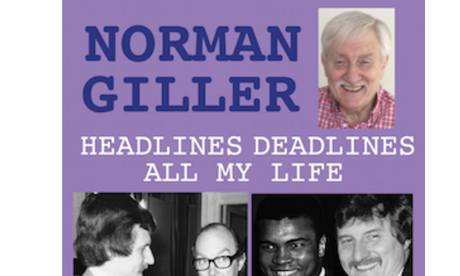
As a former scriptwriter on television’s long-running This Is Your Life, Norman Giller would like to have heard its most famous presenter, Eamonn Andrews, intoning his list of achievements:
“Football reporter, ghostwriter, publicist, scriptwriter, producer, puzzle compiler, quiz setter, sports historian, author, blogger, joker, storyteller, jazz fan, drinker and teetotaller... this is your life.”
Eamonn is no longer with us. But the indefatigible writer that is Norman Giller most certainly still is. And, at 75, he has written an autobiography. Well, a sort of autobiography. Headlines, Deadlines, All My Life* is what he calls a skip-and-dip book where readers can easily avoid “all the boring bits”.
I refused to skip, however, choosing instead to take long breaks between chapters to catch my breath. (It’s a book you can put down).
But Norman has perfected the art of self-deprecation, so all the obvious criticisms, such as the relentless namedropping and the artless self-promotion, are redundant because he cheerfully admits to them all.
Norman was born in London’s East End, in Cable Street, almost 50 years before Rupert Murdoch set up his famous Wapping fortress in the area. His family were poor but he was a bright lad and managed to get into a grammar school, which he left was he was just 14.
His first job was at the London Evening News as a copyboy. Two years later, the sports-mad Norman was a junior reporter on the Stratford Express, a weekly paper in West Ham that was something of a forcing house for Fleet Street.
He didn’t stay long - he has never stayed long at one task - and managed to land a job as a sub-editor on the Boxing News for a couple of years before returning to Stratford as its sports editor.
That didn’t last because he soon moved on to the London Evening Standard and just as quickly to the Daily Herald before he joined the Daily Express in 1964 as chief football reporter.
Over the following nine years, Norman met every famous footballer and football manager of the era. No, he didn’t just meet them or report on them. He befriended them. He was mates with Bobby Moore and Jimmy Greaves, Spurs manager Bill Nicholson, West Ham’s Ron Greenwood and Liverpool’s Bill Shankly. He liked them and they liked him.
They trusted him and shared secrets with him in a way that modern sports writers and football stars would find inconceivable.
Once he became a freelance, aged 33, and then started to write books, aged 38, he became the voice of his footballing friends, winning a reputation as the maestro of ghostwriting.
For nine years he also ghosted sports columns for the comedian Eric Morecambe who took to introducing him to friends as “Norma, who I have known since long before the operation.”
He turned his hand, and his nimble mind, to a host of projects. He wrote scripts for several television series; he devised and produced TV programmes; he provided the Sun with sports quizzes for a decade; he acted as PR to several boxing promoters and boxers (remember Frank Bruno?); and was even interviewed for the job of PR to the Kray twins (a gig he is glad he failed to get).
Along the way he churned out books by the score. He claims to have “had more words published than Shakespeare and Dickens combined.” His autobiography is his 100th publication.
After the TV success of the Royle Family, he teamed up with one of its stars, Ricky Tomlinson, to write four books based on his character’s catchphrase, “My arse.”
It is Tomlinson who has written the foreword to Headlines, Deadlines, which begins:
“I have known and avoided Norman Giller for many years, and have agreed to write this introduction to his life story just to get him off my back.”
Amid the light-hearted banter and the namedropping there are odd tender moments in this book, and none more so than his recounting of how he and Jimmy Greaves overcame their drinking habit.
In February 1978, the two boozers, having returned from the funeral of a friend who had died at just 57, were in maudlin humour while sharing a coffee. Norman takes up the tale:
“I raised my cup and said to Jim: ‘Let’s go and get sober out of our minds.’
‘What a great toast,’ Greavsie said. ‘Yes, let’s go and get sober out of our minds.’
Neither of us has had an alcoholic drink since.”
I have to admit I did raise my eyes at his single reference to me as being from “the Dagenham-raised school of writers.” What school is that? Who are the others?
All in all, a remarkable book by a remarkable man. And I wouldn’t be surprised if he isn’t already writing his 101st tome at this moment.
*Headlines, Deadlines, All My Life by Norman Giller (published by Norman Giller and available on Norman Giller’s website)
.jpg?w=600)