Mike Tyson once said that “everyone has a plan until they get punched in the face”. But do they? Some people may plot out their lives, but for many of us life can feel like one of those moments during a long drive down a motorway when you suddenly realise you haven’t noticed the last 10 miles passing.
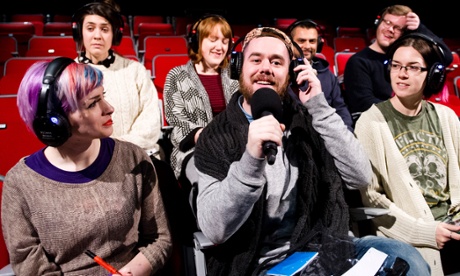
For the audience at Mountaineering, the latest interactive show from Non Zero One, the question will be: how did they end up in this particular show on this particular night? How did all their previous choices lead to this moment, and how might it influence the decisions they make next? Taking its title from Neil Gaiman’s address at the University of the Arts, Philadelphia, in 2012, Mountaineering uses the conceit of a late-night radio show, a long drive and filmed interviews with adults and children to tease out an audience response.
“We’ve never wanted to be storytellers; we’ve always wanted to be people who asked questions,” says John Hunter, one of the six former Royal Holloway students whose graduate show, Would Like to Meet, was picked up by the Barbican in 2010. Sheer luck? Or part of a cunning plan? Like most things in life, probably a bit of both. The company took a considered punt on the interactive headphone-based show they had made and hired Southwark Playhouse, where it was spotted by a Barbican producer. After that the offers came flooding in, including commissions to create This Is Where We Got to When You Came In, an affecting adieu to the Bush theatre’s old premises, and You’ll See Me (Sailing in Antarctica), which invited people to use memory to imagine the future, and was played out on the roof of the National Theatre in 2012.
Mountaineering is the most personal show to date for the company. Non Zero One’s Fran Miller says they are all “quite goal-driven and ambitious”, and beyond the company their working lives are spread across British theatre from Arts Admin to the West End, so they have learned every aspect of how the industry operates.
They were eager to investigate choice and commitment – their own as well as other people’s. The show offers a marker for the company; a reflective moment in which the original group consider whether they want to keep going with the flow or question more deeply how they make work, interact with audiences and function as a company.
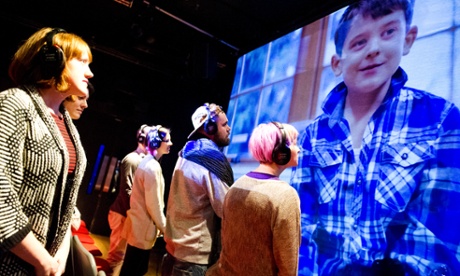
Hunter says: “We’ve taken to heart the idea that if we as a company are always asking something of audiences, then we have to give something of ourselves, too.” If there has been a criticism of Non Zero One’s past work it’s been that for all its intimacy, there is often something a little distant and emotionally uninvolving about it. “This one,” says Hunter, “is definitely more hearty than heady.”
It’s also a conscious decision to attract larger audiences. Aware that many regional theatres would love to take their shows but can’t afford pieces made for small audiences, Mountaineering will have the Non Zero One trademark headphones and a voice whispering in your ear, but is made for a traditional black-box studio space and an audience of close to 100 people at a time. The company admits that initially the idea of a piece for a bigger audience led to some “big fights” as people argued over whether there had to be artistic compromise between a “great idea, but one that nobody or very few people will see” and a show for a bigger audience. Only four of the company’s original six members are involved in this project.
“It’s been an artistic and logistical challenge,” agrees Miller. “Keeping the intimacy but changing the format to include 94 [audience members] means that we’ve had to question every choice we make and make sure that we aren’t making decisions for logistical and pragmatic reasons but for artistic reasons. It’s why it’s taken such a long time.”
A key moment was an early tryout at Salisbury Playhouse, one of the project’s co-producers, when the lack of an audience meant that 30 eight- to 12-year-olds from the theatre’s youth group were drafted in as a last-minute test audience, with no time to rewrite the script to accommodate their youth. But in fact, having to ask a group of eight-year-olds whether they agreed with the statement “compromise is good” benefited the show, and made Non Zero One understand its dynamic and how it can work for an audience whose desire, ability and willingness to interact may vary enormously.
Non Zero One always clearly market their work as interactive, but they’re aware that can be offputting to some. “I think we might finally have created something my mum won’t feel scared about coming to see,” says Hunter. “If you come along and [are] really are not up for anything interactive, this gives you a choice about how far you want to engage, whether you want to have a microphone stuck in your face or whether you just want to sit quietly and listen and reflect. Hopefully people will take up some of the offers we are making, but if they don’t, there are some great songs, some terrific gags and they’ll get to eat a packet of crisps.”
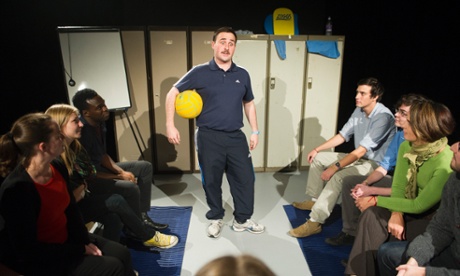
While choosing which flavour crisps you’d like is hardly life-changing, all the tiny choices we make each day do cumulatively impact upon our lives. It’s good to take the time to ruminate upon them. So is Non Zero One’s work, and particularly Mountaineering, theatre or a form of therapy?
“Therapy is not what we ever set out to be. Therapy is about outcomes and changing behaviour,” says Sarah Butcher firmly. “Audiences are not sent away from one of our shows with a list of actions. But we’re not running away from the fact that they may have a therapeutic value for some people, because they offer room for reflection and have an introspectiv
e quality.”
“We never imagine,” says Miller, “that people are going to change their lives because of one of our pieces. But sometimes they do. After You’ll See Me, when we asked people to envisage something they might do in the future, one man imagined himself living by a river or canal, and because of the piece he went out and did just that.”
• Mountaineering is at the Roundhouse, London, from 3-15 February. Box office: 0300-6789 222. Then at Salisbury Playhouse from 5-7 March. Box office: 01722 320 333.