“The Commonwealth of Independent States competed at the European Championships in 1992,” remarked Philip Farrell. “Apart from the four constituent parts of the United Kingdom; is this the only example of a non-nation state participating at a major tournament?”
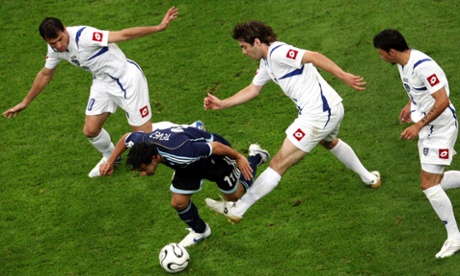
To kick us off, here is Alex Rothwell: “In 1938 the Dutch East Indies (modern-day Indonesia) competed at the World Cup a full seven years before they gained independence. They lost their first game to 6-0 to Hungary, were knocked out and have never appeared again in either guise. As recently as 2006, Serbia and Montenegro appeared at the World Cup losing all three games in that year’s Group of Death (a terrible draw against Holland, Argentina and Ivory Coast). However, Montenegro had declared independence on 3 June 2006, a full eight days before their first match. The defeat to Ivory Coast on 21 June was the final appearance for Serbia and Montenegro with the nations competing separately thereafter.”
There are other examples, but let us define our parameters first of all. A “major tournament” shall include the World Cup and each of the international competitions run by the six Fifa confederations. That being agreed upon, where better to begin than the Concacaf Gold Cup? The keen-eyed will see an anomaly on the list of competitors from its last incarnation, in 2013: what, you might ask, are Martinique doing among the 12 hopefuls?
Martinique is an overseas department of France, and as such is not a member of Fifa, but holds Concacaf membership and, along with the region’s other French territories, is permitted to compete in the tournament. That privilege depends on their performance in the lesser Caribbean Cup, from which the top four teams make it to the Gold Cup. The 2013 event was their fourth and, despite bowing out after the group stage, they acquitted themselves fairly well, dramatically beating Canada in the opening game. That was revenge for the Canadians’ interruption of their best-ever performance in the competition, in 2002, when their quarter-final was decided on penalties.
Guadeloupe are another French territory with a convincing history in the competition. They reached the semi-finals in 2007 after a superb run that saw them defeat Honduras in the last eight before narrowly losing to Mexico. Two years later they reached the quarter-finals again but lost 5-1 to Costa Rica. Sadly no overseas departments have qualified for this year’s edition of the Gold Cup – French Guiana losing a play-off with Honduras – but their presence is always a welcome curiosity when it occurs.
A similar situation presents itself in the OFC Nations Cup, the Oceania tournament whose weight has lessened somewhat since Australia’s defection to Asia. As recently as 2012, when it was last staged, French territory New Caledonia (technically now a “French collectivity”) were runners-up for the second time in a row, losing to Tahiti in the final. They also finished third in 1973 and 1980. Tahiti competed in the former while still under France’s wing and American Samoa, an unincorporated territory of the USA, has been a regular participant.
There are, of course, numerous examples of non-nation states playing in major tournaments’ qualifying rounds. Faroe Islands and Gibraltar count among them in Uefa, while the likes of Curaçao, Aruba, the US Virgin Islands and the British Virgin Islands have all played in World Cup qualifiers in the Concacaf region in recent weeks and months.
DOUBLE TOP
“Glenn Murray is likely going to be top league goalscorer for both Reading and Crystal Palace this year,” predicted Paul Rumble seven days ago. “Has this happened before and what are the highest totals recorded?”
Murray is indeed on the brink of that accolade, his six goals for Palace seeing him a single strike ahead of both Yannick Bolasie and Mile Jedinak. No Reading player exceeded his eight goals during his earlier loan spell, although it is fair to point out that Simon Cox did equal that tally. That total of 14 goals makes him top scorer for two sides does not say all that much for either Reading or Palace.
Adam Harcus has a rival claimant: “Kris Boyd managed to be the top scorer for two separate teams in the same season, having moved from Kilmarnock to Rangers in January 2006. He ended the season with 17 goals for Killie and 20 for Rangers that season, which was good enough to be top scorer for both teams.
That blows Murray out of the water somewhat, a late-season goal extravaganza permitting. As does this only slightly more modest achievement, again involving Rangers, flagged up by Joseph Barnsley: “As an Everton fan, I remember Nikica Jelavic being top scorer for both us and Rangers in the 2011-12 season after his fantastic start at Goodison, bagging 11 goals from joining in January to the end of the season to add to the 17 he had for Rangers.”
SPOT THE INCREDIBLY VAST DIFFERENCE
Leo Addor asked us: “I’ve just looked at the bottom of the Scottish Championship table (yes I am that bored, sadly), and noticed the astounding goal difference difference between 10th-placed Cowdenbeath and Alloa in ninth place. Alloa have a goal difference of -22, Cowdenbeath a goal difference of -55 – a goal difference difference of 33 for two teams placed adjacent to each other in the league table. My question: is this the greatest goal difference difference ever among teams sitting right next to each other on a major professional league table at the end of the season?”
As we dealt with a not dissimilar question relating to points disparities a couple of weeks ago we will keep this brief-ish, but it would be remiss of us not to acknowledge the painstaking research undertaken by one Bernd Wilms, who looked through the Spanish, English, German, Italian and Dutch top flights and – via some exhaustive workings – sent us his conclusions:
“The records among several of the major European leagues that I surveyed would seem to be:
1) La Liga 2011-12, 70 goals: Barcelona (2nd, +85) over Valencia (3rd, +15)
2) Eredivisie 1962-63, 56 goals: Willem II (15th, -15) over De Volewijckers (16th, -71)
3) Eredivisie 1989-90, 53 goals: PSV (2nd, +58) over Twente (3rd, +5)
4) Bundesliga 1969-70, 52 goals: 1. FC Köln (4th, +45) over Borussia Dortmund (5th, -7)
5) Eredivisie 1987-88, 51 goals: PSV (1st, +89) over Ajax (2nd, +38)”
Interestingly, the second season on that list – 1962-63 in Holland ‑ was contested over just 30 games, meaning that basement side De Volewijckers were conceding almost two goals a game more than the team directly above them.
The biggest margin in the Premier League era, incidentally, was sixth-placed Chelsea (+28) finishing 37 goals ahead of seventh-placed West Ham (a remarkable -9) in 2001-02.
Slightly lower down the food chain, we also have this from Navin Patel: “I’d like to submit the 2012-13 Scottish third division table (I know that this is stretching the definition of major league, but given that the original question name-checked the Scottish Championship, I think it is allowable). If you remember, Rangers had been demoted a few divisions that year for some shenanigans or another, and were consigned to play the likes of Elgin City and East Stirlingshire. They duly won the league that year, thrashing most – they won 10 of their 36 games that season by three goals or more. They finished with a goal difference of +58, which compares to Peterhead’s of +24 in second place. A difference of 34 and beating Leo’s figure by one.”
And finally, Ian Williams sent in a number of examples from South Africa, with one clear winner. In 1992, Manning Rangers – from Durban – finished second-bottom of the top flight with a goal difference of -18. That was chicken feed compared to the deficit accrued by hapless Dangerous Darkies, a short-lived outfit from Nelspruit, who finished on -95 after 42 games. The difference between the differences? 77.
KNOWLEDGE ARCHIVE
“After the José Pinto episode during the half-time scuffle during the first leg of Real Madrid v Barcelona in the Champions League semi-final, who’s the person with the most obscure role to be sent off during a football match, other than ball boys?” asked Matthew Britton four years ago this week.
He may only have been on the bench as Barcelona’s substitute goalkeeper, but José Pinto’s role in proceedings was pivotal compared to some of the ridiculously peripheral figures to have received their marching orders from irate referees at football matches. “On 30 April 2007, Kingsley Royal, mascot for Reading, was sent off by Mike Dean during a match against Newcastle United,” writes John O’Brien. “He was alleged to have strayed too close to the pitch and confused the officials, who apparently couldn’t easily distinguish between a professional footballer and a bloke in a lion costume. Despite the loss of such a key performer, Reading clung on to their 1-0 lead to take all three points.
“During his next home match, Kingsley wore a T-shirt that proclaimed he was “INNOCENT” under his kit and revealed it during a pretend goal celebration.”
There have been other incidents of misbehaving mascots falling foul of officialdom, with Bury FC’s Robbie The Bobby – a policeman – managing to notch up three dismissals in as many months back in 2001, once for his part in a touchline brawl with his Cardiff City counterpart Barclay The Bluebird and twice for mooning supporters.
Meanwhile in Scotland, Mark McEwan would like to refer readers to the 2009 Battle of Douglas Park, a post-match tunnel brawl between the players and backroom teams of Hearts and Hamilton which resulted in Jambos masseur Alan Robson being shown the red card along with three players. Hearts players Michael Stewart and Ismael Bouzid had been sent for early baths during the match. A few weeks previously, Hamilton’s elderly kitman, Danny Cunning, earned himself a two-match ban having been sent to the stands for “unacceptable conduct” 10 minutes into the second half of a 2-2 draw between the Accies and Motherwell. “There was a time in the game when we felt frustrated and that we were not getting too much out of the game, and I think it boiled over a wee bit,” said the Hamilton manager, Billy Reid.
And finally, to America, where this report by Arnold Irish from the St Louis Post-Dispatch details the sending-off of the PA announcer at a Major Indoor Soccer League game, for swinging a haymaker at a member of the visiting team. Kevin Slaten, for it was he, take a bow.
• For thousands more questions and answers take a trip through the Knowledge archive.
CAN YOU HELP?
Phil Pierce asks: “Derby dropped out of the top six in the Championship on the last day of the season after being top in February and in the top six continuously since September, and I was wondering if any team has screwed up such an advantageous position quite as spectacularly as the Rams?”
“It struck me that this season has been the year of the Bs in English football,” Ben Riley offers. “The champions of the leagues moving up the tiers are Bromley (Conf South), Barrow (Conf North), Barnet (Conf), Burton (L2), the mighty Bristol City (L1) and Bournemouth (Champ). Only Burnley rather disappointingly let the Bs down by not winning the Premier League. My question is has there ever been a season where the champions of all the leagues have started with the same letter? I think its an interesting one but maybe I’m just a little strange!” You, reader, can be the judge.
“Has a former striker ever become a goalkeeping coach (or vice versa)?” asks ‘Phil’. We’d be especially impressed if you can find a “vice versa”, but be our guest …
Sam Carney wants to know: “In his short top-flight career, QPR defender Steven Caulker has played for four different clubs in four different seasons: Swansea (2011-12), Tottenham (2012-13), Cardiff (2013-14) and now the Hoops, with whom he has just been relegated. Should Rangers decide to cash in on their more lucrative talents, and if Caulker were to join another Premier League club, that would make it five clubs in five seasons for the centre-back. Surely, this has never been done before?”
“Rotherham sent all three sides down in the Championship. Have any other clubs singlehandedly filled all the relegation spots?” tweets HungryHatter.
• Send your questions and answers to knowledge@theguardian.com.