A few weeks ago – back when we used to teach and research rather than stand at picket-lines challenging the marketisation of the university – we discovered that we share something in common. As international staff our right to strike and participate in peaceful, collective action is limited by our employer. This commonality (unlike the commonality of having food-based surnames: Cinnamon, Bagelman) does not amuse us.
Days before the UK-wide strike at some universities we were anonymously slipped the following information, printed off and photocopied from the University and College Union (UCU) website:
For staff employed under a Tier 2 visa, you should be aware that your sponsor is required to report unauthorised absence (such as strike action) if it continues for more than ten consecutive days … your sponsor is required to report unauthorised absences to the Home Office.
The Home Office considers industrial or strike action as an unauthorised absence. So if you take industrial action for more than ten consecutive days, or if you miss ten or more ‘expected contacts’ without permission, your sponsor must report this to the Home Office, and your sponsorship will be revoked.
Receiving this news in the form of an anonymous note was unsettling. We discussed it with fellow colleagues, asked who might have done this, and what could their intentions be – malevolence, intimidation, or, perhaps, care?
In any case, the content of the note was far more unnerving. For us, it raised concerns about how our workplace is entwined with border enforcement. Here, we explore how the university collaborates with the state in monitoring and restricting international staff and students more generally, a process at odds with the “internationalisation” strategies that are now firmly embedded in the business plans of contemporary UK universities. And, we consider how to challenge these dangerous trends.
Border guards
In some respects, we already knew that universities – like hospitals, schools, cities – participate in active border control. A requirement of our jobs as academics, for instance, is to monitor the attendance of students, including our overseas students. The data we compile is shared with the Home Office and UK Border Agency.
As a 2012 London Metropolitan University case revealed, failure to comply with this monitoring process means that universities risk losing their “Highly Trusted Sponsor” status which allows them to sponsor international student visas. But complying with this request means that academics are effectively becoming border guards.
We are ashamed to say that as “good little academics” we participated in this, seemingly banal, bureaucracy that renders people with precarious citizenship status even more precarious. We are ashamed to admit that it took us being subjected to these very mechanisms of surveillance and data sharing to truly pause.

Rather than dwell on feelings of shame, though, our hope is to promote conversation and solidarity between staff (academic, support and those on zero-hour contracts) as well as students in forging change. We do not have clear answers. But, in academic style, we do have some questions to incite this collective work:
- How can we become less deferential to strategies that champion “internationalisation”, when our own international colleagues feel unsafe in the places they work?
- Rather than selling narratives of the “Global University” (at open days and to our colleagues abroad with whom we are asked to network) what about addressing the realities of the impending foreigner exodus over pension disputes and (ahem) Brexit?
- How can we create safe places to host collective conversations about vital issues like our right to remain? (As we write, academic friends from Durham University face deportation.)
A tool for resistance
For us, this strike has done more than remind us of own tenuous legal status (which is still relatively privileged) as international academic staff in this country. It has identified much more than dodgy pension schemes. For us, this strike exposes the intractable tensions that underpin the logic of our universities.
Unlike those in senior management roles, we have intimate knowledge of these tensions for we live them everyday. We feel these tensions when we are asked to complete more tasks in less time. Or when we witness student anxiety mount as we employ the very metrics that contribute to our own mental health crisis. Or when we watch our vice-chancellors slash our pensions with one hand and pat our head for moving up in league tables with the other. And this strike has demonstrated that these tensions are simply untenable.
That we experience these tensions so intimately is both – as Derrida might say – a cure and curse. It is a curse, of course, because existing in such a state is wearying. It is so exhausting that many are choosing to leave universities altogether or limp along, no longer able to take joy in the production and sharing of knowledge.
But, it is possibly also a cure because these lived experiences give us expertise that might be mobilised to identify where and how the system is broken. From our collective experience we can point out where contradictions lie (often to be found in ironic-sounding corporate strategies like “Making the Exceptional Happen”).
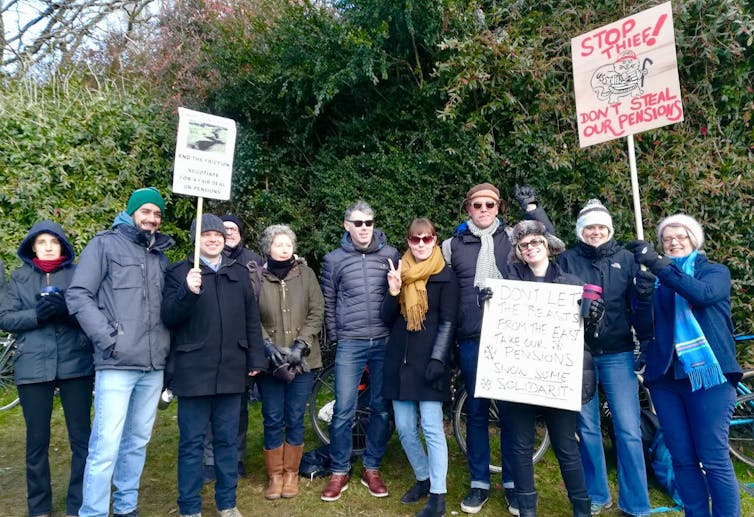
Refusing to optimistically live with these cruel tensions and instead expose them for what they are seems like an important political step. It is a step we witness our colleagues taking (with bells, whistles and Lego) on the picket line, and it is a step we hope to keep taking together – so long as we are not deported back to Canada.
Read more: University lecturer explains why academics are striking over pension cuts

The authors do not work for, consult, own shares in or receive funding from any company or organisation that would benefit from this article, and have disclosed no relevant affiliations beyond their academic appointment.
This article was originally published on The Conversation. Read the original article.