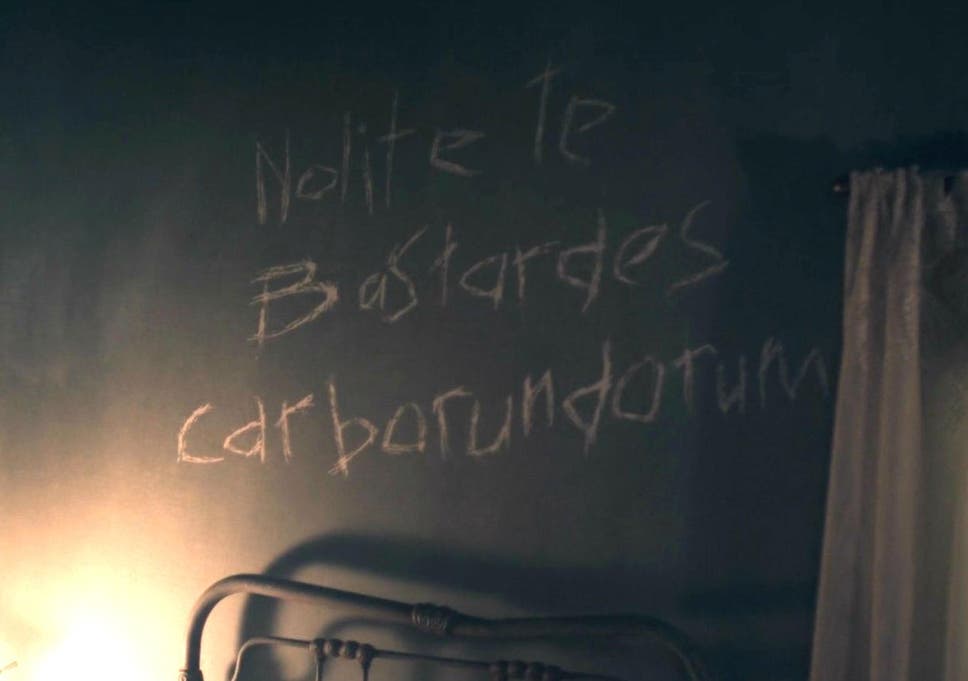
You can be forgiven for not understanding the phrase June scratched into the wall of her room in the Waterford house before fleeing it in The Handmaid's Tale season 2 episode 13, as it requires either remembering a brief exchange 19 episode ago or else a knowledge of both Latin and gibberish.
'Nolite Te Bastardes Carborundorum' was the title of the fourth episode of season 1 and the phrase June discovered in the closet, inscribed by a previous handmaid (who we know ended up committing suicide).
Over a tense game of scrabble, she later asks Fred what it means, to which he replies: "Don't let the bastards grind you down."
The significance of the phrase and it later being writ large over June's bed is clear, but its origin is less so.
"Nolite Te Bastardes Carborundorum" has become a sort of rallying cry for feminism and is oft-tattooed - popularised by Margaret Atwood's The Handmaid's Tale novel but not invented by the author.
“I’ll tell you the weird thing about it,” Atwood previously told Time. “It was a joke in our Latin classes. So this thing from my childhood is permanently on people’s bodies.”
Cornell University classics professor Michael Fontaine subsequently described the phrase to Vanity Fair as "looking like someone tried to put the English into Google Translate for Latin," and estimated that it was first used between 1890 and 1900.
'Nolite' ('don't) and 'te' ('you') are indeed Latin words, but 'bastardes' is just 'bastards' made to sound like Latin (the actual word would be 'spurius' or 'nothos'), while 'carborundorum' is, according to the Oxford English Dictionary, an industrial product used as an abrasive (hence the wearing or 'grinding' down).
The phrase's faux Latin origins don't take anything away from it, of course, and the fact that carborundum was a "trade name", according to Fontaine, is quite fitting given the way in which handmaids are passed between households in Gilead.