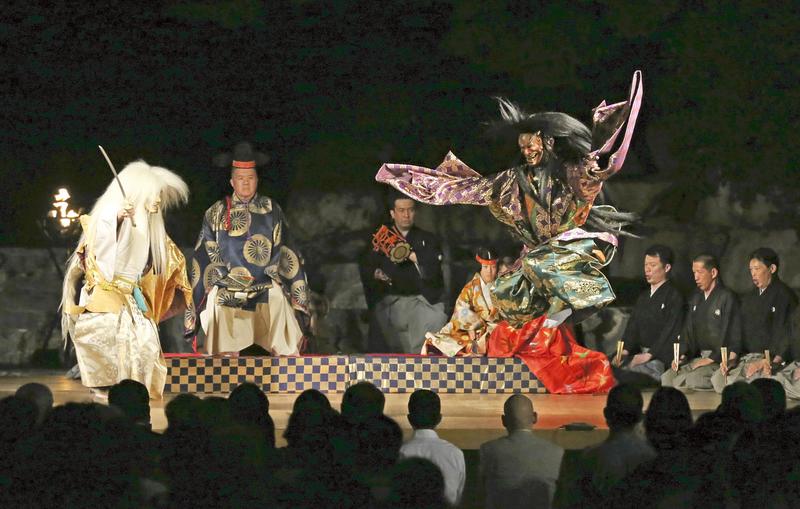
Noh and kyogen, theater forms with 650-year histories, used to be performed on outdoor stages called noh butai. But in developments since the Meiji era (1868-1912), the stages came to be sheltered inside buildings that keep off the wind and rain and enable the use of lighting. The buildings are called nohgakudo.
The change is similar to that of the dohyo ring in sumo today. Dohyo and noh butai have a common characteristic in that -- even though they are indoors -- roof structures are seen over them. The structures are a vestige of the past, when they used to be outdoors.
As a side note, pillars stand at four corners of noh butai stages, but dohyo rings of sumo today do not have pillars. Instead, the roof structures are suspended from the ceilings of buildings.
This difference stems from whether the pillars are necessary or not.
In sumo, the pillars have disappeared so that spectators can easily watch matches and to improve safety for the wrestlers.
However, noh performers playing the roles of "shite" -- main characters -- wear masks, and thus their range of vision on the stage is extremely narrow. A shite performer confirms his position on the stage by looking for the pillars.
Therefore, pillars remain at the corners of noh stages, even though they make it difficult for some spectators to watch the performance.
In nohgakudo halls, tickets for seats with views impeded by pillars cost much less than tickets for other seats.
Even now, noh is often performed outdoors. At night, noh is performed by torchlight. At such "takigi noh," spectators can enjoy a dreamy atmosphere.
On the night of Sept. 21, I watched a takigi noh performance on a special stage set up in Higashi-Ikebukuro Chuo Koen park in Toshima Ward, Tokyo.
Kanze Yoshimasa, a 49-year-old middle-ranking noh performer, played the leading role in "Nohgaku Quest," a brand-new, omnibus-style noh production. It was highly unique and interesting.
The story combines highlight scenes from classic noh plays, including "Shojo," "Yokihi" and "Shakkyo."
Because the stage was in a park next to the 60-story Sunshine 60 building, a character of a local youth appeared in the noh show and told the history of the building in a voice tone particular to noh.
The story starts from Toshima Ward, where the park is located. Inari Myojin, a deity enshrined in Oji, a township near Toshima Ward, heads for Xian, China, to cure the illness of Yang Guifei, a legendary Chinese beauty, and vanquishes an evil star who does evil deeds.
When a character circled around the stage once, the setting of the stage instantly changed from Japan to ancient China.
Noh stimulates the imagination of the audience. Thus I was deeply impressed while thinking about how noh staging can freely manipulate time and space.
Another impressive aspect was the sound of the "hayashi" musicians. Inside nohgakudo buildings, sounds from tsuzumi drums and Japanese traditional flutes resonate within the walls of the building. However, because the music of a takigi noh play is performed outdoors, the sounds of the drums and flutes pass through the air in such a way that they are heard as if they are spreading out through space.
Though I can't say which way is better, the sounds were fresh for me.
Also, because it is now autumn, the comfortable chirping of bell-ringing crickets from the trees in the park harmonized with the sounds of the hayashi music. The combination of the sounds made me feel relaxed.
There is a smart phone app service with which spectators can see rough story lines and dialogue in four languages: Japanese, English, Chinese and Korean. It seemed that foreign spectators were also able to fully enjoy the performance.
-- Morishige covers traditional performing arts.
Read more from The Japan News at https://japannews.yomiuri.co.jp/