
For those who would like to see noh and kyogen plays but find it a bit daunting to attend a show, a performance aimed at beginners will be held at the Yomiuri Otemachi Hall in Chiyoda Ward, Tokyo, from 2 p.m. on March 23.
Titled "Otemachi de Noh o Tanoshimu: Sakura Sakura" (Noh and Kyogen performance under the theme of Sakura), the event will feature two works filled with a spring atmosphere: noh play "Yoshino Tennin" (The heavenly being of Yoshino) and kyogen play "Hanaori" (Picking blossoms).
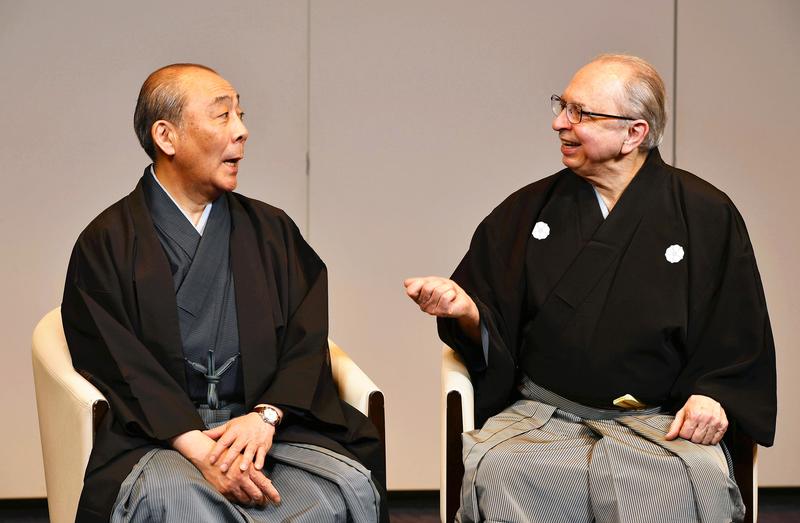
The plays will be preceded by a lecture from Musashino University Prof. Richard Emmert. He and Asami Shigeyoshi, who will take the lead role in "Yoshino Tennin," know each other very well.
Emmert is a noh scholar from the United States, who first came to Japan nearly half a century ago. Asami is a noh actor of the Kanze school of noh, who specializes in playing shite, or lead roles. In the past, they appeared in similar events abroad, with Emmert giving a lecture and Asami performing.
The story of "Yoshino Tennin" is simple. A man from the capital (Kyoto) goes to Mt. Yoshino with a friend to see cherry blossoms. He meets a local woman (the lead character played by Asami), who says she is in fact a celestial being and will dance for them. She retires from the stage, then returns as a heavenly being and starts dancing while playing around with cherry blossoms.
The play is enlivened by imitation cherry blossoms onstage. The version to be staged this time is called "Yoshino Tennin -- Tennin Zoroi," in which four tsure side characters appear all together -- which is unusual in noh -- as heavenly beings.
"Aimai [dancing by multiple performers with the same movements] is tough. We have to practice hard and move in unison as we agreed beforehand," Asami said.
When he wears a noh mask, he can only see things right in front of his eyes. So he records the rehearsals on video, and asks other people to watch the rehearsals to achieve unified movements in the dance.
"When you see another performer, albeit briefly, it disturbs your concentration and breaks the harmony. I dance with a belief that I am moving as agreed," Asami said.
Asked what someone watching a noh play for the first time should learn beforehand, he said: "This work requires no explanation. It's a heartwarming and refreshing piece. Please feel at ease when you watch it."
Emmert also said there is no fixed way to appreciate noh.
"Beautiful costumes and mask designs, the rhythms of jiutai chants, the ambience created by hayashikata musicians calling, and the exquisite movement of five performers onstage together, in this instance -- you don't need to understand all the details. It would be a good idea to watch the play while paying attention to one thing," he said.
The noh scholar hopes that those coming to see the performance will regard it as their first step toward viewing more noh.
"As you compare each production you see with others you've seen before, you gradually start understanding the extent of noh and finding it interesting," he said.
As the Tokyo Olympic and Paralympic Games will take place next year, more people from overseas are expected to come see noh. Asami and Emmert hope that Japanese people will watch noh before the Games and become able to explain it to visitors.
The performance of "Yoshino Tennin" will be preceded by the kyogen play "Hanaori," with Okura Yataro playing the protagonist. The comical story is set in a temple where cherry blossom viewing has been banned due to the unruly behavior of visitors coming to see the flowers. Visitors tries to sneak into the temple garden while the head priest is away. It would not be surprising if a similar incident took place in real life today.
Call (03) 6739-5838 for information.
Read more from The Japan News at https://japannews.yomiuri.co.jp/













