Moves to resume noh performances have grown gradually. The Nohgaku Performers' Association and the Japan Nohgaku Organization have decided to jointly hold the Nohgaku Festival at the National Noh Theater in Tokyo on July 27-31 and Aug. 3-7. In an interview with The Yomiuri Shimbun, Kanze Tetsunojo, chairman of the Nohgaku Performers' Association, spoke about his thoughts on the decision to hold the event.
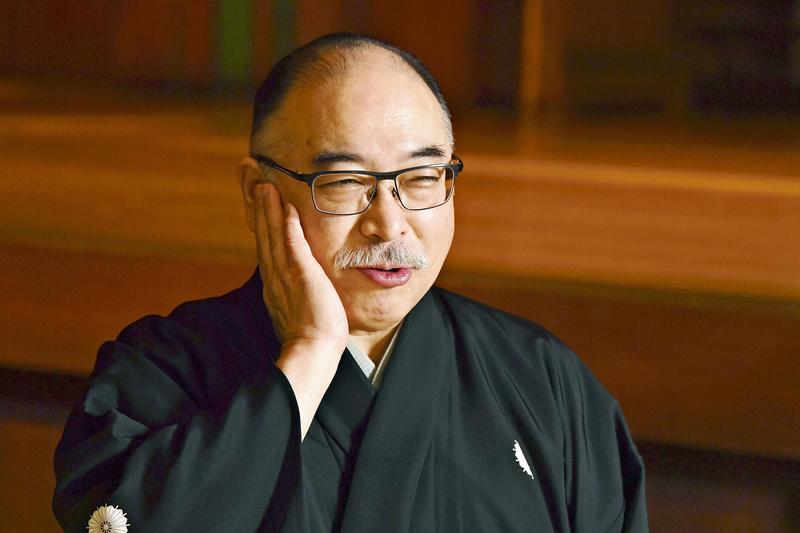
When Tetsunojo took off his mask, his mustache was revealed. "I let my facial hair grow while staying at home, and I wound up looking like Robinson Crusoe. I just left this part [the mustache]," Tetsunojo said shyly. "Of course, I'll shave before performances start."
Amid the coronavirus outbreak, Tetsunojo has been forced to respond to the situation as the head of the association, to which about 1,100 professional noh performers belong.
"I think the impact [of the pandemic] will probably last through next year. Even though the situation has not been brought fully under control, we have to make efforts to resume performances little by little," he said. "Online streaming is possible, but noh performances are not easy to understand unless you watch them live."
The upcoming event was supposed to be one of the largest festivals in the Japanese traditional performing art's history as it was initially scheduled to be held during the Tokyo Olympics and Paralympics and was expected to attract foreign visitors. While some people called for canceling the festival, Tetsunojo had discussions over and over with executive members of the association, saying: "We've spent five years preparing for the event. I want to hold it no matter what." He decided to go ahead with the festival as scheduled, even though changes would be required to the way noh performances are given, something that has been preserved for many years.
As a measure to prevent infections, the seating capacity at the venue for the event will be limited to maintain distance among audience members. In addition, the number of chorus singers will be reduced from eight to five, and performers who play supporting roles will leave the stage after speaking their lines. Tetsunojo said he is trying to persuade performers to take measures to prevent "crowds" on the stage as much as possible.
"Of course, I think there are some objections. But it was only some decades more than a century ago that the noh stage was set inside a roofed noh theater," he said. "The performing style must have changed also at that time."
During the 10-day festival, noh and kyogen masters, including living national treasures and heads of noh and kyogen schools, will perform. Tetsunojo, who is a heavyweight and principal performer of the Kanze school, is scheduled to play the main role of Benkei in the popular program "Ataka" on Aug. 4.
This program is the origin of the famous kabuki play "Kanjincho."
"This is a piece in which I perform without wearing a noh mask, but I tend to show my emotions in my face as I put too much of myself into my act," Tetsunojo said. "My goal is to maintain my composure as much as possible and keep my spirits up."
Usually, this program involves Benkei and nine other supporting characters, who are mountain priests, but the number of the performers will be cut to five for the festival.
"In the art of noh, there are not only songs praying for happiness, but also songs that could relieve people's sadness," Tetsunojo said. "People are now preoccupied with preventing infections, but I hope they will gradually free up their feelings and get back in touch with their senses by watching noh and kyogen performances."
Ahead of the festival, Tetsunojo will perform at a summer event at the Hosho Noh Gakudo theater in the Suidobashi area in Tokyo, which will start at 2 p.m. on July 17. In the event to be organized by the association's Tokyo chapter, he will play the role of Tsurukame.
"I've been practicing, but I'll probably tremble. That's not because I'll be moved, but scared," the noh master said solemnly about the stage on which he will stand as a principle performer for the first time in a while.
Read more from The Japan News at https://japannews.yomiuri.co.jp/