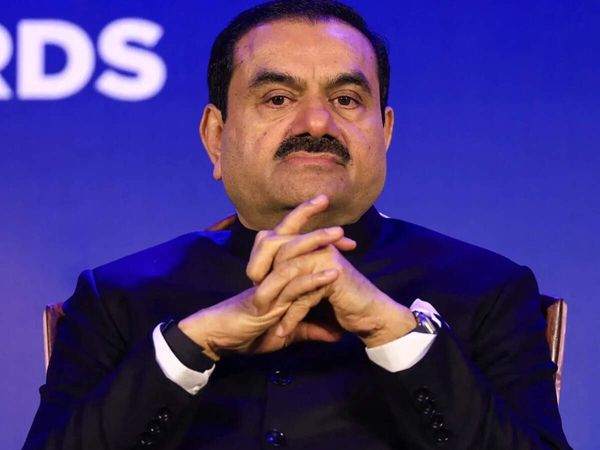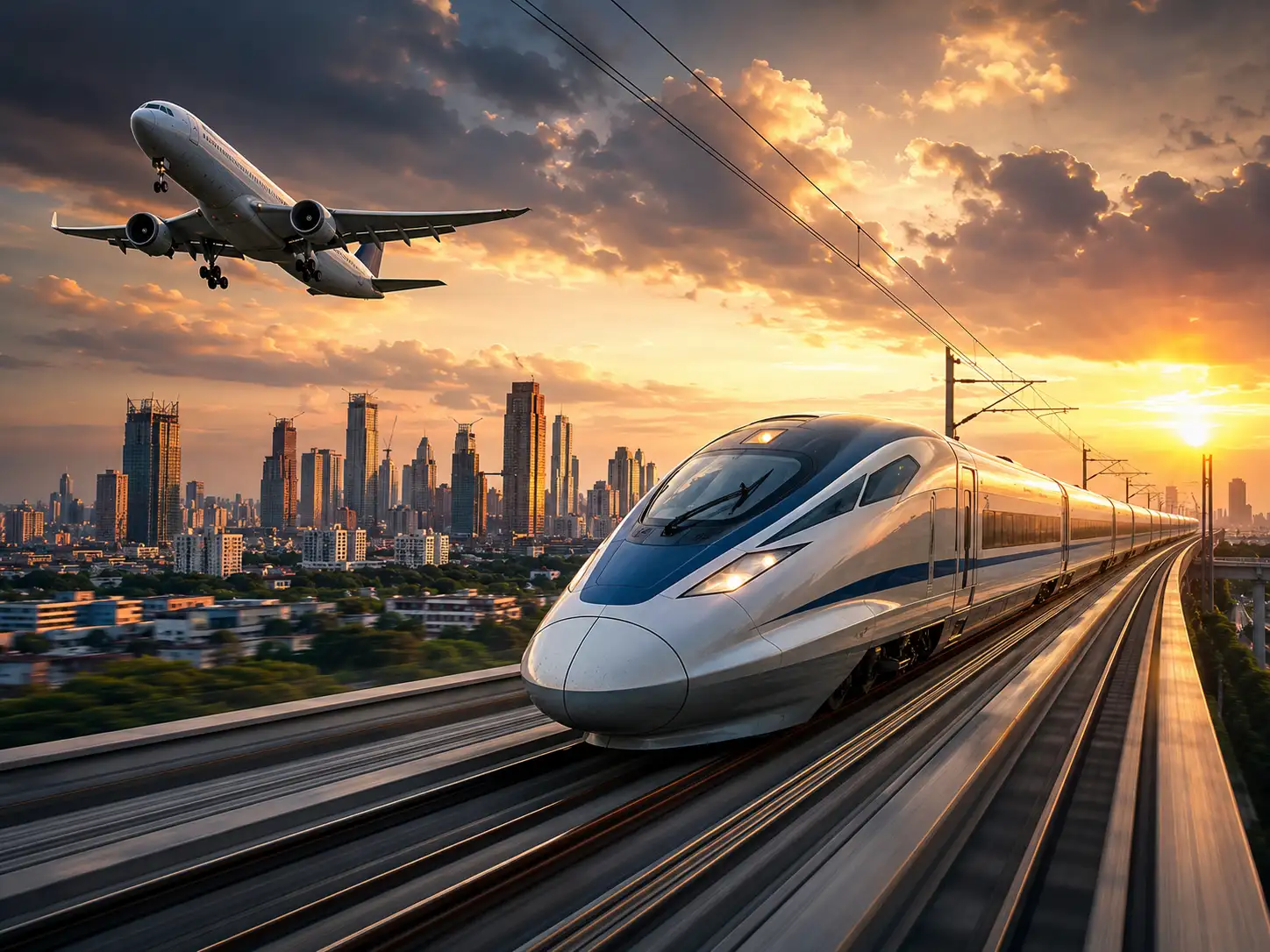
India’s aviation boom may be heading toward an unexpected collision with another rapidly expanding mode of transport -- high-speed rail. Railway Minister Ashwini Vaishnaw on Monday issued a stark warning to airline investors, arguing that India’s upcoming bullet train corridors would overwhelmingly dominate several high-density short-haul routes.
Speaking at the CII Business Summit, Vaishnaw said corridors such as Mumbai-Pune, Hyderabad-Bengaluru and Bengaluru-Chennai would eventually become “99% dominated by railways”, much like what happened in Japan, China and South Korea after the arrival of high-speed rail. He pointed to dramatic reductions in travel time under the planned network: Mumbai-Pune in 48 minutes, Hyderabad-Bengaluru in 2 hours 8 minutes and Bengaluru-Chennai in just 78 minutes. “Nobody will fly on these routes,” he said.
Also Read: Bullet trains will wipe out short-haul flights, Ashwini Vaishnaw warns
The statement is significant not merely because it came from the railway minister, but because it reflects a major shift in India’s transport strategy. For decades, the rise of aviation symbolised economic modernisation and mobility. Now the Modi government is betting that modern railways can capture a large share of premium intercity travel. The transformation is already visible through the expansion of Vande Bharat trains, station redevelopment, electrification, safety upgrades and dedicated freight corridors that have freed passenger capacity. The next phase is far more ambitious -- a nationwide high-speed rail network backed by nearly Rs 16 lakh crore in planned investment.
The larger question is no longer whether trains can compete with planes in India. The question is how many routes aviation may eventually lose to rail.
Why high-speed rail defeats airlines
The global evidence strongly supports Vaishnaw’s argument. Across Japan, China and parts of Europe, high-speed rail has steadily eroded airline traffic on short and medium-distance sectors. Once rail travel time falls below roughly three hours city-centre to city-centre, trains become overwhelmingly competitive.
Japan provides perhaps the clearest example. The Tokyo-Osaka Shinkansen corridor, one of the busiest high-speed rail routes in the world, drastically reduced domestic airline dominance over time. Rail commands the overwhelming majority share between Tokyo, Nagoya, Kyoto and Osaka because trains offer high frequency, punctuality and direct city-centre access. Airlines continue to operate but largely serve connecting or long-haul passengers.
Also Read: Constructing 15 kilometres bullet train track every month: Ashwini Vaishnaw
China’s experience has been even more dramatic. Since the launch of the world’s largest high-speed rail network, several domestic airline routes have either shrunk or disappeared altogether. Research has shown that Chinese high-speed rail significantly reduced airline market share on routes under 1,000 km. Airlines increasingly shifted toward longer-haul sectors where rail cannot compete effectively.
Spain and France witnessed similar patterns. Air France sharply reduced flights between Paris and cities linked by high-speed rail. Spain’s Madrid-Barcelona air corridor, once among Europe’s busiest, lost major market share after the AVE high-speed rail system expanded.
India’s planned bullet train corridors fit precisely into this global pattern.
India’s geography favours rail on dense corridors
India’s biggest intercity routes are uniquely suited for rail competition because of high population density, urban congestion and relatively short distances between economic hubs. Flying in India often involves hidden time costs. A one-hour flight between Bengaluru and Chennai can easily become a four-to-five-hour journey once airport transfers, security checks and boarding delays are included. By contrast, high-speed rail stations are centrally located and require shorter check-in windows.
This is why Vaishnaw’s travel-time projections are potentially disruptive. Bengaluru-Chennai in 78 minutes would fundamentally alter travel behaviour for business travellers. Mumbai-Pune in 48 minutes could reshape commuting patterns entirely. Hyderabad-Bengaluru in just over two hours would place rail directly inside aviation’s core competitive zone. India is already seeing an early version of this shift with semi-high-speed Vande Bharat trains.
Vande Bharat has already started changing travel behaviour
Even before bullet trains arrive, Vande Bharat services are beginning to challenge airlines on several corridors. The trains offer airline-style seating, onboard catering, faster acceleration and significantly improved punctuality compared with conventional Indian trains.
A few years ago, airlines had begun to feel the pressure to keep fares competitive on certain routes after Vande Bharat was launched. An ET report in 2023 cited estimates suggesting airlines lost 10-20% of passengers on some sectors following the introduction of premium rail alternatives.
An ICRA analysis stated in December 2024 that Vande Bharat trains were posing significant competition to regional airline routes under the government’s UDAN scheme. According to ICRA analysts, railways were increasingly attracting travellers on short-distance sectors where airports are relatively close and total travel time advantages for flying are limited.
The evidence is visible in passenger demand. Indian Railways is extending Vande Bharat train lengths because of sustained high occupancy levels. The Chennai-Bengaluru route has emerged as one of the clearest examples of modal shift. A recent Times of India report noted exceptionally strong demand on the Chennai corridor, with occupancy levels outperforming several newer routes.
The railways are also aggressively upgrading passenger experience. Vande Bharat sleeper trains, station redevelopment and improved catering are all designed to position trains not merely as affordable transport, but as premium mobility products. This psychological shift matters. For decades, flying symbolised aspiration in India while trains represented mass transit. That distinction is now beginning to blur.
The Modi govt’s railway strategy is reshaping mobility
The current railway push is an infrastructure programme within a broader economic and industrial strategy. Over the past decade, the government has sharply increased railway capital expenditure. Electrification has accelerated rapidly. Dedicated freight corridors are improving network efficiency. Kavach safety systems are being expanded. Hundreds of stations are being modernised under the Amrit Bharat scheme. Domestic manufacturing of coaches and signalling systems has also expanded substantially. According to government data, railway capital expenditure rose from around Rs 58,000 crore in 2014-15 to more than Rs 2.5 lakh crore annually in recent budgets. The focus is no longer just on adding trains. It is increasing speed, reliability, safety and passenger comfort.
High-speed rail is the logical culmination of this strategy. TOI reported in October last year that Indian Railways was planning nearly 7,000 km of high-speed passenger corridors with operational speeds potentially touching 320 kmph. Vande Bharat 4.0 and dedicated passenger corridors would redefine intercity travel. Vaishnaw’s remarks suggest the government now sees railways not merely as public transport infrastructure, but as a strategic competitor to domestic aviation.
Airlines may not lose overall
The rise of high-speed rail does not necessarily mean aviation will decline overall. Instead, the structure of India’s airline market may change significantly. The Modi government has simultaneously expanded airport infrastructure through the UDAN scheme and aggressive airport construction in smaller cities. India is expected to remain one of the world’s fastest-growing aviation markets over the next two decades, according to some forecasts. But aviation growth may increasingly shift toward long-haul routes, international sectors and underserved regional markets rather than dense metro-to-metro corridors.
This transition has precedent globally. In Japan and China, airlines gradually redeployed capacity from short intercity sectors toward longer routes where aircraft maintain a natural advantage. High-speed rail effectively took over travel patterns on heavily trafficked corridors while aviation expanded elsewhere. The same model may emerge in India. Flights between Bengaluru and Chennai or Mumbai and Pune could eventually become economically unattractive if high-speed rail achieves high frequency and competitive pricing. Airlines may instead focus on connecting tier-two and tier-three cities or expanding international operations. This could ultimately create a more specialised transport ecosystem where rail dominates dense intercity mobility while aviation concentrates on long-range connectivity.
High-speed rail will reshape India’s economy
India is still years away from building a nationwide bullet train network, but the economic implications of high-speed rail could extend far beyond faster travel. Around the world, bullet train systems have not merely replaced flights on short routes. They have fundamentally reorganised business geography, labour mobility and regional economic growth.
Japan’s Shinkansen network offers the clearest example. The bullet train dramatically shrank travel time between Tokyo, Osaka, Nagoya and other industrial centres, effectively integrating them into a single economic corridor. Business travel became faster, more predictable and less dependent on airports. Companies expanded supply chains across cities, professionals increasingly travelled for same-day meetings and secondary cities became more economically connected to major metropolitan hubs. Economists often describe the Shinkansen as one of the key infrastructure projects that accelerated Japan’s post-war economic integration.
China witnessed a similar transformation on an even larger scale. Over the past two decades, the country built the world’s largest high-speed rail network stretching over 45,000 km. Studies have found that high-speed rail improved productivity, boosted tourism, strengthened regional trade and increased business investment in cities connected by fast rail corridors. Chinese cities once considered peripheral became economically integrated with larger urban clusters after travel times dropped sharply.
The most important impact of high-speed rail is not speed alone but the compression of economic distance. When Mumbai and Pune become less than an hour apart, or Bengaluru and Chennai are connected in under 90 minutes, businesses will begin to operate differently. Companies can distribute offices across cities rather than concentrating entirely in one expensive metro. Professionals can attend meetings across states without overnight travel. Manufacturers gain quicker access to suppliers and markets. Even labour mobility improves because workers can commute across wider economic regions.
This could be particularly transformative for India because several of its largest economic hubs are located relatively close to one another. Mumbai-Pune, Bengaluru-Chennai and Hyderabad-Bengaluru are major business corridors linking IT, finance, manufacturing, logistics, startups and industrial supply chains. Faster movement between these cities could create larger integrated economic zones with stronger commercial linkages and higher productivity.
There are also broader macroeconomic implications. High-speed rail projects generate large-scale demand for steel, cement, signalling systems, electrical equipment and construction services. Vaishnaw said nearly the entire Rs 16 lakh crore planned investment would flow to Indian contractors and suppliers. If executed at scale, the programme could become one of India’s largest industrial multipliers over the next decade.
The shift could also reshape urbanisation patterns. In countries with advanced high-speed rail systems, businesses and residents often move toward smaller satellite cities where land and housing costs are lower while maintaining access to major commercial centres. India’s overcrowded metros could eventually witness similar decentralisation if high-speed connectivity becomes reliable and affordable.
This is why the debate over trains versus planes is ultimately about far more than transportation. The arrival of high-speed rail has the potential to alter how Indian cities grow, how businesses operate and how economic activity spreads across regions. In that sense, bullet trains are not simply a faster way to travel. They could become the backbone of India’s next phase of economic integration.