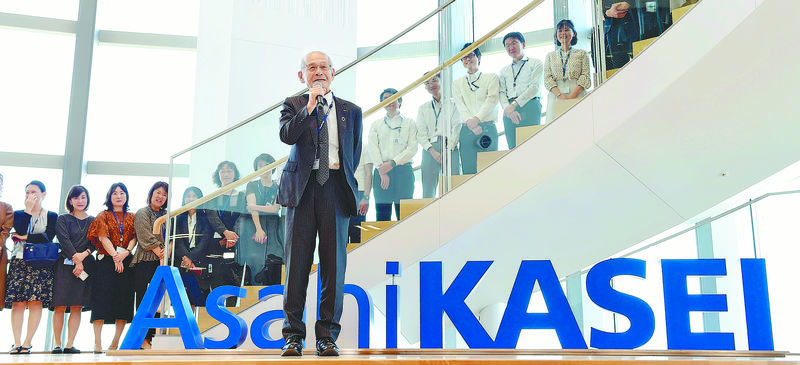
The day after winning this year's Nobel Prize in Chemistry, Akira Yoshino turned up for work Thursday at Asahi Kasei Corp.'s head office in Chiyoda Ward, Tokyo, where he was greeted by thunderous applause from several hundred employees.
An honorary fellow at Asahi Kasei, Yoshino won the prize for his development of lithium-ion batteries, which are integral components in smartphones and other mobile devices used in modern-day society.
"Looking 10 years ahead and solving problems is how new technologies are developed," Yoshino said. This strong resolve was the impetus for his innovation.
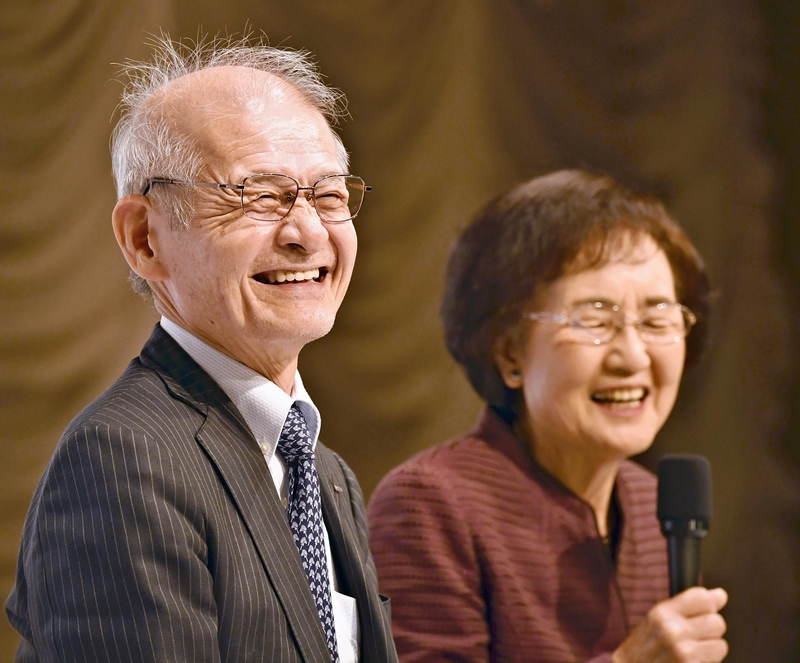
"The true thrill of research lies in the experiments," said Yoshino, 71. "Experiments are especially interesting when they produce unexpected results."
Soon after Yoshino joined Asahi Kasei in 1972, he spent all his time conducting research aimed at finding new uses for chemical compounds. He came up with various ideas, such as a film that would make glass harder to break and insulating materials that would not easily burn, but none led to a commercialized product.
A turning point came in the 10th year of Yoshino's steady research. He started considering whether polyacetylene, a polymer with high conductivity discovered by University of Tsukuba Professor Emeritus Hideki Shirakawa, who won the 2000 Nobel Prize in Chemistry, could be used as a material for batteries. This novel idea led to the development of a special carbon material that enabled batteries to be much smaller.
At a press conference on Wednesday evening, Yoshino explained the principles for being a good researcher.
"Researchers must be able to think flexibly. It may sound contradictory, but they also must have tenacity and never give up," Yoshino said.
Yoshino conducted many experiments to check whether such batteries would be safe.
"I wanted to make sure the batteries would be absolutely OK, no matter what happened," he recalled. At Asahi Kasei's testing site in Nobeoka, Miyazaki Prefecture, Yoshino fired bullets through batteries and slammed 5-kilogram iron ingots against them. But Yoshino's batteries didn't ignite even during these harsh tests.
"The success of the greatest field experiment of my life came at the moment lithium-ion batteries were created," Yoshino said.
Read more from The Japan News at https://japannews.yomiuri.co.jp/