And that's a wrap
There we have it. The 2016 Nobel prize in physics has gone to David Thouless, Duncan Haldane and Michael Kosterlitz for their work on exotic states of matter. The work helps explain why some materials have unexpected electrical properties, such as superconductivity, and in future the work could pave the way for quantum computers.
For more on today’s prize see our news story here. We’ll be back on Wednesday morning with our live coverage of the Nobel prize in chemistry. We expect to hear the winner or winners at 10.45am UK. Do join us if you can.
What's the deal with doughnuts and coffee cups?
For an electrical conductor, for instance copper, scientists can normally define a fixed relationship between how much electrical potential you put across a wire and how much current flows. However, when a material undergoes an electrical phase transition, this relationship goes out the window and the material abruptly takes on completely new electrical properties.
Mathematically, these transitions can be thought of as leaping from one topological form to another. A topological surface is partly defined by how many holes there are. So, in topological terms, a doughnut to a coffee cup (both have one hole) are the same. But a ball is different. These shapes just relate the maths used to describe the properties of a material - we’d like to stress that no physical objects are being magically transformed into doughnuts.
Prof Chris Phillips, of Imperial College London, says this year’s choice is “a real scientist’s prize”.
The prize is normally given to someone who has made their discoveries a long time ago and has led to lots of applications. This is really recognising a scientific impact. It’s always nice when you see your own heroes are celebrated. These are people we, in the field, have hugely respected for a long time and it’s great to see them recognised.”
Updated
Here’s some reaction from Steve Bramwell, a physics professor at the London Centre for Nanotechnology, who is working in the field:
I think the Nobel prize to Kosterlitz, Thouless and Haldane is richly deserved!
The behaviour of the materials around us is extremely complex - the job of physics is to identify simple principles by which we can understand the material world and predict new phenomena. This is a really difficult challenge because the average substance may contain a trillion trillion atoms, all interacting with each other.
The ingenuity of Kosterlitz, Thouless and Haldane has been to show how a large class of real materials - particularly films and chains of atoms - can be understood in terms of the simple mathematical principles of topology - that is how the atoms are connected (a doughnut and a teacup have the same topology as they each have a hole in them).
The breakthroughs of these three scientists allowed massive progress to be made in understanding and calculating the properties of many material systems.
I’m sure this Nobel prize will be cheered in many quarters!”
Updated
What are phase transitions?
Phase transitions refer to abrupt changes in the properties of a material - for instance the progression from ice to water to steam as the temperature is ramped up from freezing. However, as well as the traditional states of solid, liquid, gas, Thouless, Haldane and Kosterlitz (and others) showed that materials also make sudden transitions in their electrical properties. This might manifest itself as a sudden drop in the electrical resistance of a material as it is cooled down. So-called topological phase transitions were initially investigated in materials with thin layers, or ones that formed thin threads, but now scientists have shown that “exotic” electrical properties can be found in a wide range of materials.
Thouless, Haldane and Kosterlitz have investigated these phase transitions and also come up with important pieces of the theory that explains why these sudden changes happen.
Updated
How the prize is divvied up
One half of the prize has been awarded to David Thouless, with Duncan Haldane and Michael Kosterlitz sharing the other half. The prize has been given “for theoretical discoveries of topological phase transitions and topological phases of matter”. According to the committee, Thouless has been given a larger share because he made crucial contributions to both the advances (phase transitions and phases of matter) cited in the prize.
Updated
Here’s a member of the Nobel committee explaining physics through the medium of pastry:
Updated
Andrea Taroni, editor of the journal Nature Physics, has given us his take on the announcement:
This is a great Nobel prize. The Kosterlitz-Thouless transition is one of the great examples of topology affecting physical processes in a fundamentally topologically-driven way, and Haldane’s contributions are of a comparable magnitude. I am especially pleased for David Thouless – he is one of the gentlemen of theoretical physics, a true great!”
Updated
What is topology?
Topology, which was central to this year’s discoveries, explains why electrical conductivity inside thin layers changes in integer steps. Kosterlitz and Thouless studied the electrical behaviour of surfaces or inside extremely thin layers (physicists call these two-dimensional materials). Haldane studied matter that forms threads so thin they can be considered one-dimensional.
Professor Duncan Haldane is on the phone to the press conference. Asked about his reaction to the news, he says: “I was, as everyone else is, very surprised. And very gratified... A lot of tremendous new discoveries that are based on this original work are now happening.”
The Nobel Assembly speaker has brought out a cinnamon bun, a bagel and pretzel to explain what topology means. He says that if you are a topologist there is only one interesting way in which these pastries differ - the bun has no hole, the bagel has one and the pretzel has two. Well that makes everything crystal clear then.
The prize has gone to three physicists working in the field of condensed matter physics. They discovered totally unexpected behaviours of solid materials - and came up with a mathematical framework ( in the field of topology) to explain these weird properties. The discoveries have paved the way for designing new materials with all sorts of novel properties.
And the winner is
BREAKING NEWS #NobelPrize in Physics 2016 to David Thouless, Duncan Haldane and Michael Kosterlitz pic.twitter.com/5jw75GIjRv
— The Nobel Prize (@NobelPrize) October 4, 2016
#NobelFacts the youngest Physics Laureate ever is Lawrence Bragg, 25 yrs when he was awarded the 1915 Physics Prize together with his father pic.twitter.com/B6pAEvw3gI
— The Nobel Prize (@NobelPrize) October 4, 2016
Here’s the youngest ever Physics Laureate, William Lawrence Bragg. Probably helped that his father was the scientist William Henry Bragg.
The magic call
Nobel laureates don’t get much advance notice - a representative from the Nobel Assembly makes the call just minutes before the announcement. This means laureates are often caught off-guard. Barry Marshall got the call in an Australian pub, Amartya Sen heard the phone ringing at 5am and thought something tragic had happened; Günter Grass was due at the dentist. Peter Higgs was famously unreachable on the day he won, and finally found out from a former neighbour, who got out of her car to congratulate him.
Updated
The Nobel prize is currently worth 8m Swedish kronor (£720,000) - or a share of this if the prize is split. Our colleague Esther Addley, spoke to some past laureates about how they spent it.
Sir Andre Geim, who with Sir Konstantin Novoselov won the 2010 physics prize for their discovery of graphene, told her: “I don’t know any Nobel laureate who considers the monetary aspect of the prize to be worth even mentioning. However, I have met a few people who would sell their soul, leaving aside a granny or fortune, for the prize.”
Updated
Once the Nobel committee has made up its mind about the winner or winners, it is time to call the lucky recipients. It is one of the many less-then-optimal traditions of the Nobel prizes and of course it is pretty much guaranteed to wrong from time to time. Take 1989, when a physicist called Norman Ramsey won half the prize. The committee had a terrible time tracking him down. In the end they found a Norman Ramsey in Washington DC and called to offer him the prize. What could possibly go wrong?
Martin Rees, the Astronomer Royal and Cambridge astrophysicist, has given us his take on the Nobel Prize - he thinks that newer areas of science are being overlooked and that consortiums, like Ligo, deserve recognition as much as individuals.
It’s certainly true that the prizes fail to recognise achievements in huge swaths of science that have grown in importance in the century since they were set up.
Moreover, the limit to three winners is becoming less appropriate. Much of experimental and observational science (and even some theoretical work) involves a group effort. There have been several recent instances when singling out three (or less) winners has not only been unfair but has given the public a distorted perspective of how science is actually done.
Fortunately, there has in the last 10-20 years been a proliferation of other international prizes, some of which are prepared to make awards to groups (and to cover ‘Non-nobel’ subjects). One hopes that this will gradually erode the special prestige of the Nobels.”
Updated
#NobelPrize Medal for Physics: Nature - a goddess resembling Isis - and the veil is held up by the Genius of Science pic.twitter.com/XzqGiIE5ug
— The Nobel Prize (@NobelPrize) October 4, 2016
Here’s what the Nobel medal looks like up close. It’s made of 18 carat gold and weighs 175 g for all medals, except for the prize in economic sciences, which weighs 10g more (favouritism from the Nobel Foundation’s accounts department?).
The laureates won’t get their hands on the medal or cash prize until a ceremony in Stockholm in December. Brian Schmidt, who won the 2011 Nobel prize in physics for co-discovering dark energy, found transporting a big chunk of gold through airport security can be problematic. “They’re like, ‘Sir, there’s something in your bag’,” he told Scientific American.
Updated
Physics laureates are surprisingly youthful
#NobelFacts The Physics Laureates are in average the youngest of all Laureates, average age: 55 pic.twitter.com/WZsEQIASZe
— The Nobel Prize (@NobelPrize) October 4, 2016
Read the 2016 Nobel prize winners' major papers
Most Nobel prize winners have, at one time or other, published their work in journals run by Elsevier. The company has decided to make the major papers from this year’s winners available online, starting with those from Yoshinori Ohsumi, who received the medicine prize yesterday. You can read his Elsevier papers here. The site will be updated with papers from the forthcoming winners as they become known.
The Nobel prize in physics has only been awarded to two women so far. In 1903, Marie Curie shared the prize with her husband, Pierre, and Henri Becquerel. The Curies showed that pitchblende was more radioactive than uranium and went on to extract polonium and radium - two elements unknown at the time. Maria Goeppert Mayer was next to share the physics prize in 1963 for her work on the nuclear shell structure of atoms. So more than 50 years with no female winner. This year, some pundits have an eye on Vera Rubin for her work on dark matter. But with no detection of this invisible substance yet, there is still a possibility it doesn’t exist.
Updated
Last year, the Nobel Prize in physics went to Takaaki Kajita and Arthur McDonald for discovering that elusive subatomic particles called neutrinos weigh something more than nothing. At the time, the Nobel committee said the discovery had “changed our understanding of the innermost workings of matter and can prove crucial to our view of the universe”.
The secrecy of the Nobel committee’s decision-making process, combined with the need to whittle down any discovery to a maximum of three names, means the prize sometimes throws up controversy. Former colleagues of Willard Boyle and George Smith, who won the 2009 Nobel physics prize told media the two American scientists did not deserve the award. One told Canada’s Globe and Mail that their former collaborators at Bell Laboratories, who were recognised for inventing an image sensor, “wouldn’t know an imaging device if it stared them in the face”.
Tips from the pundits
Each year the analytics firm Thomson Reuters sifts through the Web of Science to produce a list of scientists that are deemed of “Nobel class”. Aside from the Drever- Thorne-Weiss trio, they also like the chances of Marvin Cohen, for theoretical studies of solid materials, and Celso Grebogi, Edward Ott and James Yorke - for work on chaotic systems.
Other contenders include William Borucki, PI on Nasa’s Kepler Space Telescope, which has spotted more than 1,000 planets outside our solar system and Vera Rubin, the American astronomer whose observations led to the theory of dark matter. Although no-ones knows what dark matter is, and there’s no proof it definitely exists, so that’s probably an outsider.
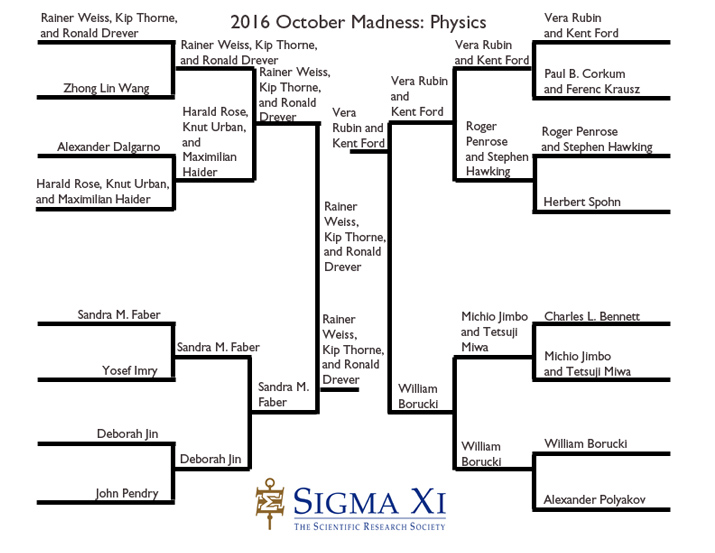
Some physicists over at Sigma XI have come up with a physics Nobel Death Match-style chart, which gives an idea of who is in the running (work from the outside of the chart towards the middle).
Ripples through the world of physics
By far the biggest physics story of 2016 was the first observation of gravitational waves, ripples in the fabric of space-time first predicted by Einstein.
If the discovery, announced at the start of February, came in time for the 31 January nominations deadline, this has to be a favourite. When the Higgs boson was discovered, the prize went to theorists, Peter Higgs and François Englert, rather than scientists at Cern.
For gravitational waves, the experimentalists, Ronald Drever, Kip Thorne, and Rainer Weiss (known in the field as The Troika) are probably the frontrunners. Drever and Weiss were central to designing the Laser Interferometer Gravitational-Wave Observatory (Ligo) and Thorne worked out what gravitational waves would look like to the detector.
Some argue that Ligo’s former director, Barry Barish, should also be in the running.
After yesterday’s award in medicine, this morning the Nobel Assembly will name the winner - or more likely winners - of the 2016 Nobel Prize in physics.
We’re expecting the announcement at 10.45am UK time, and it will be made at the Royal Swedish Academy of Sciences in Stockholm.
Do join us for the live announcements, explanations of the research, and reaction from the winners and others from the world of science.


.png?w=600)