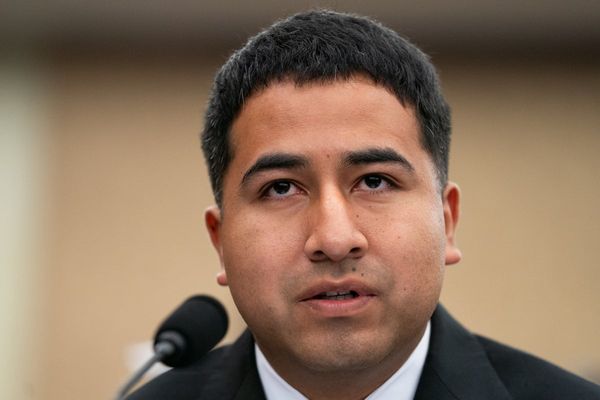
We’re bringing down the curtain on this live blog for now. See our latest story here, and we’re back tomorrow for the chemistry prize. Thanks for reading.
Some fulsome praise from Frank Wilczek, American theoretical physicist and himself a Nobel laureate.
% Tiny neutrino masses encouraging for unification, and clear the way for more exotic dark matter, i.e. axions @NobelPrize
— Frank Wilczek (@FrankWilczek) October 6, 2015
Congrats to Kajita, McDonald, NP in physics for neutrino oscillations. Awesomely beautiful experiments, fundamental result @NobelPrize
— Frank Wilczek (@FrankWilczek) October 6, 2015
It’s fair to say the reaction of Nobel winners on hearing the news is fairly predictable. But it’s nonetheless always heartwarming.
The first thing he did: "I gave my wife a hug!" Exclusive interview with Arthur B. McDonald coming up soon! #NobelPrize
— The Nobel Prize (@NobelPrize) October 6, 2015
For further reading, here’s a couple of previous Guardian pieces on neutrinos.
Still not 100% clear about neutrinos and their significance? Well, watch this 2010 lecture on the subject from the new Nobel laureate Arthur McDonald himself.
If you’ve not yet seen it, here’s our initial story about today’s prize.
Some Nobel prize/Canada trivia.
#NobelFacts Arthur B. McDonald awarded the 2015 #NobelPrize in Physics is the 17th Nobel Laureate born in Canada.
— The Nobel Prize (@NobelPrize) October 6, 2015
Not everyone is happy, namely the science writer and biographer Graham Farmelo.
So disappointing that the Nobel physics people didn't award a third share of this year's Prize to Vera Rubin, pioneer of dark matter.
— Graham Farmelo (@grahamfarmelo) October 6, 2015
Our other winner is not on the phone to answer questions, but unlike Tu Youyou with yesterday’s medicine prize, he has been contacted to learn the news.
The award ceremony and press conference is over.
"Kind of unbelievable" - Takaaki Kajita's reaction to the 2015 #NobelPrize in Physics. Interview coming up soon!
— The Nobel Prize (@NobelPrize) October 6, 2015
There’s now some brief video footage of McDonald answering a question.
Arthur B. McDonald explains the importance of the #NobelPrize awarded discoveries http://t.co/fsboR6CCH9
— The Nobel Prize (@NobelPrize) October 6, 2015
Our physics blogger, Professor Jon Butterworth from UCL, has this instant reaction:
Well that’s nice!
The discovery of neutrino oscillations is the only definite “Beyond the Standard Model” physics discovery to have happened during my career.
SuperKamiokande in Japan made beautiful observations of neutrinos produced in the upper atmosphere from cosmic rays. The Sudbury Neutrino Observatory solved the long standing “solar neutrino problem” which was one of the things we were taught as students as being a weird anomaly which wasn’t understood - not enough neutrinos coming from the Sun.
The conclusion of both experiments was that neutrinos change their nature as they travel, and they can only do this if they have mass - contrary to the Standard Model at the time.
The discovery opened up a whole field of neutrino physics which is still producing amazing science. See for example this.
Ian Sample has noted this key quote from McDonald:
There was a eureka moment when we were able to see that neutrinos appeared to change from one type to the other in travelling from the sun to the Earth.”
McDonald is asked by one reporter if his work on discovering neutrinos have mass might have any practical benefits.
He answers that some of the work involved neutrinos in the core of the sun, and thus understanding better the core of the sun, which could possible help processes like nuclear fusion.
In answer to a question about what it was like to get the pre-4am phone call, McDonald says he felt “pretty daunted” but was glad to share the prize with his colleagues.
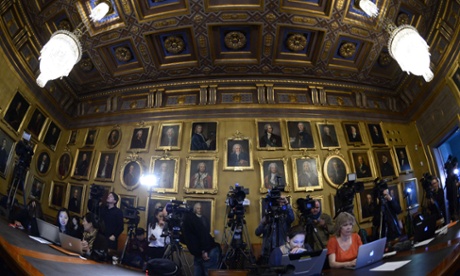
McDonald is on the phone to the press conference. It’s about 4am in Canada, and while he sounds a little sleepy, he says – understandably – that he didn’t mind being woken by the call from the committee 45 minutes ago. He expresses his profound thanks.
The Nobel Twitter feed is in full swing, with some lovely explanatory graphics.
Torn between identities - tau-, electron- or myon-neutrino? Neutrino means ”small neutral one” in Italian #NobelPrize pic.twitter.com/FIXl2GoB36
— The Nobel Prize (@NobelPrize) October 6, 2015
Super-Kamiokande, a detector built 1,000 metres below the Earth’s surface detecting atmospheric neutrinos #NobelPrize pic.twitter.com/WMErqjhKf6
— The Nobel Prize (@NobelPrize) October 6, 2015
Sudbury Neutrino Observatory detects neutrinos from the Sun. POPULAR INFO: http://t.co/1jMFRYgZWE #NobelPrize pic.twitter.com/qSSX8L6PoN
— The Nobel Prize (@NobelPrize) October 6, 2015
This is the formal prize citation:
The Nobel Prize in Physics 2015 recognises Takaaki Kajita in Japan and Arthur McDonald in Canada, for their key contributions to the experiments which demonstrated that neutrinos change identities. This metamorphosis requires that neutrinos have mass. The discovery has changed our understanding of the innermost workings of matter and can prove crucial to our view of the universe.
Around the turn of the millennium, Takaaki Kajita presented the discovery that neutrinos from the atmosphere switch between two identities on their way to the Super-Kamiokande detector in Japan.
Meanwhile, the research group in Canada led by Arthur McDonald could demonstrate that the neutrinos from the Sun were not disappearing on their way to Earth. Instead they were captured with a different identity when arriving to the Sudbury Neutrino Observatory.
A neutrino puzzle that physicists had wrestled with for decades had been resolved. Compared to theoretical calculations of the number of neutrinos, up to two thirds of the neutrinos were missing in measurements performed on Earth. Now, the two experiments discovered that the neutrinos had changed identities.
The discovery led to the far-reaching conclusion that neutrinos, which for a long time were considered massless, must have some mass, however small.
For particle physics this was a historic discovery. Its Standard Model of the innermost workings of matter had been incredibly successful, having resisted all experimental challenges for more than twenty years. However, as it requires neutrinos to be massless, the new observations had clearly showed that the Standard Model cannot be the complete theory of the fundamental constituents of the universe.
The discovery rewarded with this year’s Nobel Prize in Physics have yielded crucial insights into the all but hidden world of neutrinos. After photons, the particles of light, neutrinos are the most numerous in the entire cosmos. The Earth is constantly bombarded by them.
Many neutrinos are created in reactions between cosmic radiation and the Earth’s atmosphere. Others are produced in nuclear reactions inside the Sun. Thousands of billions of neutrinos are streaming through our bodies each second. Hardly anything can stop them passing; neutrinos are nature’s most elusive elementary particles.
Now the experiments continue and intense activity is underway worldwide in order to capture neutrinos and examine their properties. New discoveries about their deepest secrets are expected to change our current understanding of the history, structure and future fate of the universe.
Updated
This is Peter Walker, taking over again from Ian as he dashes off to write a story about the news. On the live feed from Stockholm one of the committee members, Olga Bottner, a professor of experimental elementary particle physics, is explaining the significance of the pair’s work on neutrinos, tiny subatomic particles which are all around us.
One good snippet: the three different types of neutrinos are known as “flavours”.
Here’s the Nobel committee’s description of the work that has been honoured:
The Nobel Prize in Physics 2015 recognises Takaaki Kajita in Japan and Arthur B. McDonald in Canada, for their key contributions to the experiments which demonstrated that neutrinos change identities. This metamorphosis requires that neutrinos have mass. The discovery has changed our understanding of the innermost workings of matter and can prove crucial to our view of the universe.
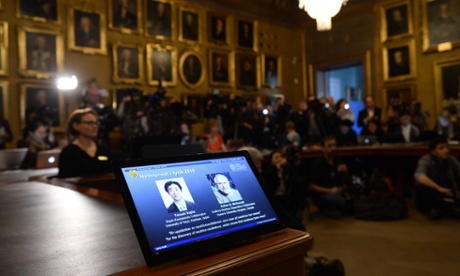
The winners of the 2015 Nobel prize in physics
And the winners are:
BREAKING NEWS The 2015 #NobelPrize in Physics to Takaaki Kajita @UTokyo_news_en and Arthur B. McDonald @queensu pic.twitter.com/ipvzm0EEFN
— The Nobel Prize (@NobelPrize) October 6, 2015
Here we go!
We’re expecting the committee to emerge from the back room and make the announcement any minute now.

Updated
How are physics Nobel laureates chosen?
How the Nobel Committee selects the Physics Laureates: #NobelPrize pic.twitter.com/njKybJArCw
— The Nobel Prize (@NobelPrize) October 6, 2015
More predictions here, this time from Physics World, and they know their fermionic onions.
Like Thomson Reuters, they like the look of Deborah Jin at University of Colorado, Boulder. And for a few years running now, they tip a trio of Alain Aspect, Anton Zeilinger and John Clauser for Bell’s inequality experiments, which established quantum entanglement.
No one - yet - has proposed Sheldon Cooper:
The average age of the physics prize winners is 55. But it’s not a Gaussian distribution, is it? Not one bit. So do we want the average age or the median age? Discuss.
#NobelPrize Percent and number of Physics Laureates in different age brackets: pic.twitter.com/1HdFvzClVc
— The Nobel Prize (@NobelPrize) October 6, 2015
Updated
This year's favourites
The people over at Thomson Reuters have put out their annual predictions of who might win based on the number of times scientists’ papers are cited. They are keen on Deborah S Jin at the University of Colorado, Boulder, who creates ultra-cold atomic gases, which could find applications in precision measurement and quantum computing.
Were Jin to win, she’d be only the third woman ever to bag the prize, and the first in more than half a century.
Other contenders, they say, are Paul Corkum at the University of Ottawa and Ferenc Krausz at the Max Planck Institute of Quantum Optics in Garching, for their work on attophysics, which uses lasers to watch molecular processes play out over quintillionths of a second.
Plenty of other scientists are in the running though. There’s John Pendry at Imperial College London for metamaterials, or invisibility cloaks as we like to call them. A trio of Alain Aspect, Yakir Aharonov and Michael Berry for their work on quantum mechanics. At some point, a prize might find its way to Didier Queloz and others for discovering planets beyond our solar systems. The list goes on and on.
Top physics Nobel trivia from the team at Physics World:
Learn some #NobelFacts ahead of this morning's physics #NobelPrize announcement pic.twitter.com/4DPREYdNXe
— Physics World (@PhysicsWorld) October 6, 2015
Only two women have ever won the Nobel physics prize. Marie Curie won in 1903 (with her hubby Pierre and Antoine Becquerel) for her work on radiation. The last woman to win was Maria Goeppert Mayer who won the prize in 1963 (along with J. Hans D. Jensen and Eugene Wigner) for her work on nuclear shell structure. It’s been more than half a century, then, with no female winner.
One person has won the physics prize twice. John Bardeen, the clever chap, won in 1956 with William Shockley for the transistor effect, and again in 1972 with Leon Cooper and John Schrieffer for their theory of superconductivity.
In 1989, the Nobel committee had a nightmare trying to get hold of Norman Ramsey, who was to share the prize with Wolfgang Paul and Hans Dehmelt, for his work on hydrogen masers (microwave lasers) and other atomic clocks. They couldn’t find his number, because his phone was registered in his wife’s name. And then they took a punt on him being in Washington DC. They found a number for a Norman Ramsey and called to offer the prize.
Here’s what happened:
The 2014 winners
Last year, the prize went to three scientists who worked out how to make blue LEDs. The invention enabled high-efficiency white lights which replaced old style lamps that use up more energy. The Royal Swedish Academy of Sciences said at just 20 years old, the invention had “already contributed to create white light in an entirely new manner to the benefit of us all”.

Updated
And now for the 2015 Nobel prize in physics
One down, two to go. For the sciences, at least.
Today it’s the turn of the physicists to cheer or cry, depending on what happens in the next hour or so. The Nobel Assembly will announce the winner or winners of the 2015 physics prize from Stockholm at 10.45am UK time, or thereabouts.
Yesterday, a Chinese pharmacologist, an Irish-born American biochemist and a Japanese microbiologist shared the Nobel prize in medicine or physiology for their work on two drugs that combat devastating parasitic diseases. Between them - and the larger teams they represent - YouYou Tu, William Campbell and Satoshi Omura improved the lives of millions.
But back to the physics prize. The list of previous winners reads like a roll call of those who’ve done most to describe how the cosmos works at the smallest and greatest scales. Einstein, Bohr, Heisenberg, Dirac, Fermi and Pauli are all in there. So too are the Curies, Becquerel, Planck and the Braggs. The names alone are enough to fling you back to secondary school, pudding bowl haircuts and Mr Hooper’s haphazard practicals.
I hope you can join me for the announcement, analysis and reaction from other scientists.