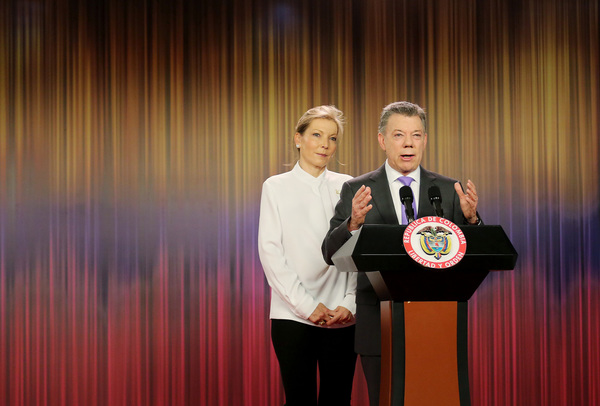
NEW YORK _ Colombian President Juan Manuel Santos has won the Nobel Peace Prize for his effort to end his country's 52-year conflict with left-wing rebels, one of the longest civil wars in modern times.
Santos had been an early favorite to win the prize, though a referendum on a landmark peace deal with the Revolutionary Armed Forces of Columbia, or FARC, was narrowly defeated in a referendum last weekend.
Members of the Oslo-based Nobel committee said in a statement Friday that they hoped the prize would encourage the 65-year-old Santos and "give him strength" to get a peace deal approved.
Successive Colombian governments have fought largely peasant armies of leftist guerrillas, who claimed they were fighting for a Cuban-style revolution to eliminate gross inequalities in land distribution and other areas of the economy.
The sole remaining armed conflict in Latin American has killed about 260,000 people. More than 6 million have been internally displaced. It was high voter turnout by family members of those victims for the Oct. 2 referendum that defeated the deal, which lost by a 50.2 percent majority.
"Striking a balance between the need for national reconciliation and ensuring justice for the victims will be a particularly difficult challenge. There are no simple answers to how this should be accomplished," the committee's statement said. "The referendum was not a vote for or against peace," it said. "What the 'No' side rejected was not the desire for peace, but a specific peace agreement."
Born in Bogota into one of Colombia's wealthiest families, Santos was educated at Harvard University. As defense minister, he was at the front lines of the struggle against the FARC, overseeing a cross-border raid into Ecuador that took out a top commander. The rejected peace deal he negotiated would have spared jail time for rebels who turn over their weapons and confess to war crimes. The FARC would also have gotten 10 seats in congress with the expectation they would transition into a political movement.
The Nobel committee made a point of limiting the award to Santos, leaving out the leader of the FARC, Rodrigo Londono, who had been the Colombian leader's counterpart in the arduous negotiations.
Santos had no immediate comment on the award. Norwegian television reported that it had tried to contact him after the announcement in Oslo, but it being 4 a.m, in Colombia, his guards refused to wake him.
In a trip to Washington earlier this year, Santos spoke of the challenges he faced persuading his people to accept a peace agreement.
"Most Colombians have never seen one day of peace," Santos said. "Colombia got accustomed to war. You ask people what they think about peace, and they are afraid. It is change."
The last time the prize went to someone from Latin America was in 1992, when it was awarded to Guatemalan human rights activist Rigoberta Menchu.
A record 376 candidates were nominated for this year's award.
Last year's prize went to Tunisia's National Dialogue Quartet for its efforts to build a pluralistic democracy.