Tasuku Honjo, winner of the 2018 Nobel Prize in Physiology or Medicine, has filed a lawsuit against Ono Pharmaceutical Co. over royalties concerning the cancer immunotherapeutic drug Opdivo, highlighting a prevalent battle between the academia world and the pharmaceutical industry.
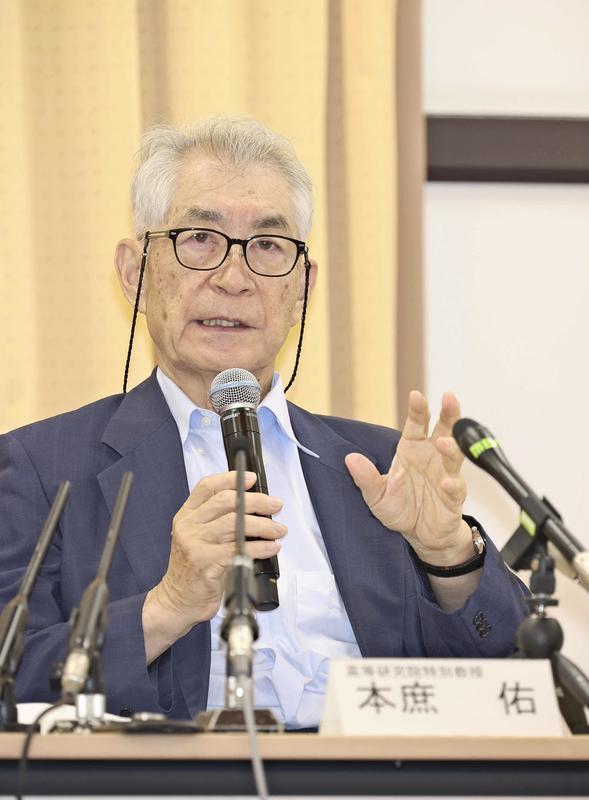
Honjo, a distinguished professor at Kyoto University, filed the damages suit with the Osaka District Court on June 19, demanding the drug maker pay about 22.6 billion yen. The dispute between the researcher, who contributed to the development of an epoch-making drug, and the pharmaceutical maker, underscores the difficulty of promoting industry-academia collaboration.
"I tried to resolve the matter through negotiations, but I haven't received a sincere reply, leaving no choice but to file a lawsuit," Honjo said during a news conference at Kyoto University.
Opdivo was developed by Ono Pharmaceutical Co. of Japan and Bristol Myers Squibb Co. (BMS) of the United States based on research results of Honjo, with its global sales totaling more than 1 trillion yen so far. Other pharmaceutical companies have developed similar drugs one after another. There is a projection that the worldwide market for cancer immunotherapeutic medicines is estimated to amount to 4.5 trillion yen in 2024.
In the lawsuit, Honjo calls for Ono Pharmaceutical to give him a fair share of patent royalties paid by major U.S. pharmaceutical maker Merck & Co. to Ono Pharmaceutical. Merck sells Keytruda, a drug similar to Opdivo.
In 2014, Ono Pharmaceutical and BMS sued Merck & Co. for patent infringement. During that time, there was an oral agreement under which Ono would pay 40% of the patent royalties it received from Merck & Co., according to the complaint filed by Honjo. The dispute between the Ono-BMS camp and Merck was settled in January 2017 with Honjo's wholehearted cooperation.
Ono Pharmaceutical admitted that it "mentioned 40%" but "withdrew it because Honjo did not accept it." In a notification of payment issued in August 2017, the percentage of patent royalties was claimed to have been reduced to 1%. Honjo said that the money he should have received until the end of last year topped 20 billion yen, so the 530 million yen paid was "an unreasonable figure."
Ono Pharmaceutical, on the other hand, is said to have explained its position during a shareholders' meeting held on June 18 that it "will argue for legitimacy of its case in court battles."
President Hiroshi Akimoto of Intellectual Property Strategy Network, Inc., who formerly served as a managing director of Takeda Pharmaceutical Co., said: "There is a possibility that [Ono Pharmaceutical] lost the case to Merck without the cooperation of Honjo. So, 40% could be a fair allotment of royalties. A bone of contention in court battles will be whether an oral promise can be as valid as a contract."
Aside from the suit filed this time, Honjo is calling for a raise in compensation to be paid according to the sales amount of Opdivo. The confrontation between Honjo and Ono Pharmaceutical originated in the contract concluded in 2006. The contract called for Ono Pharmaceutical to pay compensation equivalent to 0.75% of Opdivo sales, but negotiations broke down as Honjo called for raising the compensation, arguing that the percentage is "unreasonably low." The compensation to be paid has now amounted to a total of about 3.15 billion yen. Ono Pharmaceutical also proposed a plan to donate up to 30 billion yen to Kyoto University. Honjo has declined both monies.
Ono has its say, too. The probability of drugs under development going on the market is said to be 1 in 25,000 (0.004%) and there are cases in which development is called off due to side effects. As for the chance of success for Honjo's research, Ono Pharmaceutical pointed out that "there was no prospect of [his research results] being put into practical use" around 2006 because all domestic drug makers refused to develop drugs researched by Honjo. The compensation rate is thus set at a reasonable level, the drug maker said.
Lawyer Tomomi Ihara, who is well versed in intellectual property, said: "Even as the current lawsuit ends up with an out-of-court settlement, it will possibly lead to a revision of the 2006 contract. An ideal solution could be to resolve the overall confrontation all at once."
--Universities' ignorance blamed
Kyoto University's management of intellectual property was insufficient in 2006. Honjo, who had no choice but to conclude a contract on a personal basis at the time, criticized the pharmaceutical maker, saying: "I concluded the contract by trusting Ono Pharmaceutical, but the academia's [university's] ignorance was abused."
Technology licensing organization (TLO) firms, which takes charge of negotiating with businesses, have been increasingly established. Prof. Katsuya Tamai of the University of Tokyo, who specializes in intellectual property laws, said: "There are only a few university officials who can evaluate the values of a wide range of research fields. It is necessary to work out innovative measures to make maximum use of a university's intellectual property, including recruiting personnel capable of evaluating the values of research."
--Past cases of litigation
In Nobel Prize-class researches, there are many cases in which problems develop because of disagreements on patent royalties and compensation.
Satoshi Omura, distinguished emeritus professor of Kitasato University and winner of the 2015 Nobel Prize in Physiology or Medicine, developed the antiparasitic drug Ivermectin jointly with Merck & Co. Initially, Omura was asked to transfer the patent on Ivermectin to Merck at about 300 million yen. Omura negotiated tenaciously with Merck and concluded the contract under which he receives compensation according to the amount of earnings from drug sales. As a result, Omura has earned more than 20 billion yen.
Shuji Nakamura, who won the 2014 Nobel Prize in Physics, developed the blue light-emitting diode (LED) while he was working as a researcher at a Japanese firm. Nakamura sued his former employer, asking it to pay about 20 billion yen. Finally, he reached an agreement with the company and received about 840 million yen.
Legal battles over patent royalties have emerged in the United States, too. The genome editing technology called CRISPR-Cas9, which modifies genes efficiently, is cited as a leading candidate most likely to win the Nobel Prize in Physiology or Medicine. A team from the University of California, Berkley announced the development of the technology in 2012 while a team from the Broad Institute of MIT and Harvard demonstrated the following year that CRISPR-Cas9 could be used for human and mouse cells.
The U.S. Patent and Trademark Office approved patent rights for the Broad Institute in 2017 and the decision was upheld by the United States Court of Appeals for the Federal Circuit. But the University of California, Berkeley has challenged this decision. The Patent and Trademark Office announced in June last year that it would start reexamining the case.
Read more from The Japan News at https://japannews.yomiuri.co.jp/