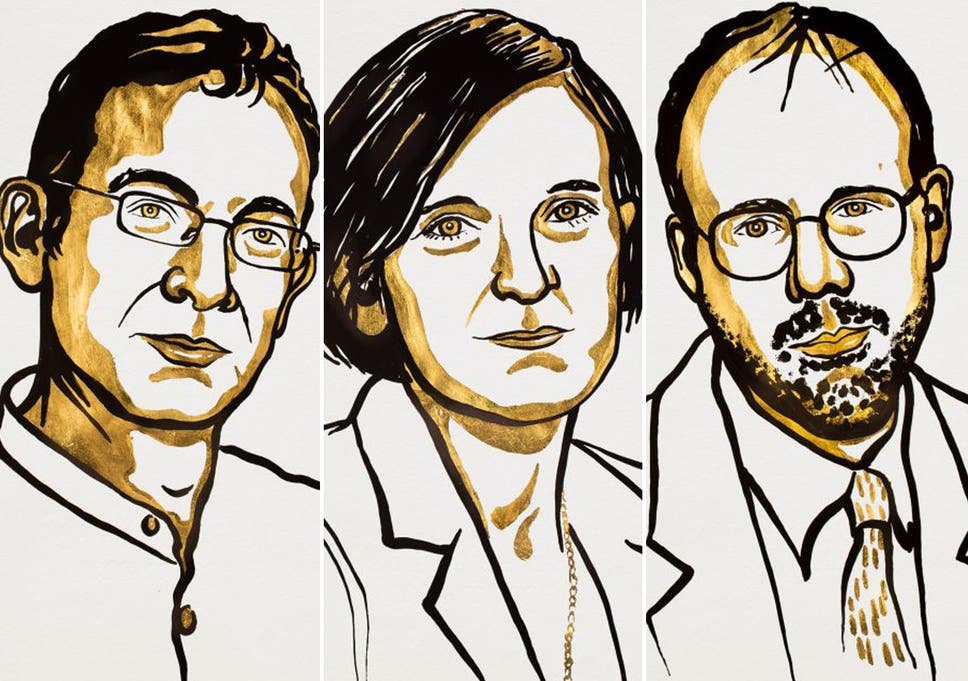
Three US economists, Abhijit Banerjee, Esther Duflo and Michael Kremer, have won the 2019 Sveriges Riksbank Prize in Economic Sciences in Memory of Alfred Nobel for their work on alleviating poverty around the world.
Indian-born Mr Banerjee and Ms Duflo, born in France, work at the Massachusetts Institute of Technology, while Mr Kremer is based at Harvard University.
“The research conducted by this year’s laureates has considerably improved our ability to fight global poverty,” the Royal Swedish Academy of Sciences said on Monday.
The trio’s approach involves dividing the issue of poverty into smaller, more manageable questions – for example, the most effective measures to improve educational outcomes or children’s health. They advocate carefully designed experiments among the people who are most affected and testing not only whether a certain intervention works or not, but also why.
“As a direct result of one of their studies, more than 5 million Indian children have benefited from effective programmes of remedial tutoring in schools. Another example is the heavy subsidies for preventive healthcare that have been introduced in many countries,” the academy said.
Ms Duflo becomes only the second woman to win the economics prize since it was first awarded in 1969. She will share the prize of 9 million Swedish krona (£728,000) with the other two winners.
In the mid-1990s, Mr Kremer and his colleagues demonstrated how powerful the new approach can be, using field experiments to test a range of interventions that could improve school results in western Kenya.
Mr Banerjee and Ms Duflo, often with Mr Kremer, soon conducted similar studies of other issues and in other countries. Their experimental research methods now dominate development economics, the academy said.
Despite recent dramatic improvements, over 700 million people worldwide still live in poverty. Every year, around 5 million children under the age of five die of diseases that could often have been prevented or cured with inexpensive treatments. And half of the world’s children still leave school without basic literacy and numeracy skills.
The economics prize is the only one not created by Alfred Nobel. It was established by Sweden’s central bank in 1968.