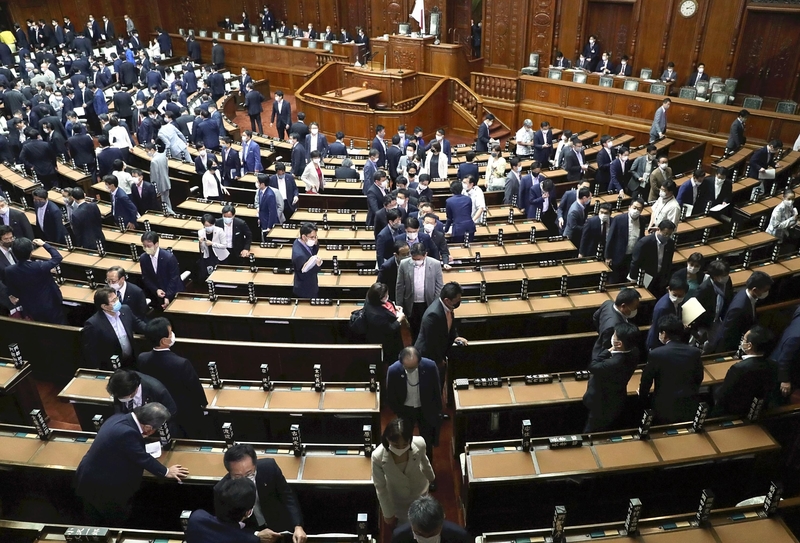
The dust has barely settled after the ordinary Diet session wrapped up Wednesday, but government and ruling party officials are already turning their sights to a reshuffle of senior Liberal Democratic Party and cabinet posts and a possible dissolution of the House of Representatives for a general election.
Prime Minister Shinzo Abe will need to carefully consider the optimal timing for such moves, while he closely watches potential developments in a possible "second wave" of new coronavirus infections and the investigation into alleged vote-buying by former Justice Minister Katsuyuki Kawai and his wife Anri, a House of Councillors member.
Abe insisted Wednesday the government would handle a host of political matters even though the session had finished. "If requested, the government will properly fulfill its responsibility to provide accountability even while the Diet is in recess," Abe said to reporters at the Prime Minister's Office.
During the Diet session, the government had come under a barrage of criticism for constantly being one step behind in dealing with the coronavirus outbreak. The government came under further attack for its handling of a scandal in which Hiromu Kurokawa, then chief of the Tokyo High Public Prosecutors Office, resigned after he was found to have played mah-jongg for money. The public support rate for the Cabinet was steadily dropping.
From early on, refusing any extension of the Diet session became the default policy within the ruling administration as it scrambled to deal with one problem after another. "The longer Diet deliberations continue, the more our strength would be sapped," a senior government official admitted.
Although the Diet session has finished, a long list of concerns remain.
The LDP accepted Wednesday notices of departure from the party submitted by both Kawais. LDP Secretary General Toshihiro Nikai has explained that 150 million yen the party's head office transferred to Anri Kawai's campaign was for "the costs of publicity material distributed across the whole prefecture several times." But if the investigation into Anri cranks up, the administration will undoubtedly be buffeted further over its full support for the lawmaker.
Amid all this, a personnel shuffle is one of the few options at Abe's disposal to boost public support. The terms of Nikai and other senior LDP leaders will expire in September, and many observers expect Abe will reshuffle the Cabinet to coincide with this. "If [Abe] can cleverly rekindle public enthusiasm, the situation surrounding the administration also will change," a young LDP lawmaker said.
Nikai has indicated his desire to retain his post. "I want to offer my assistance by working hard as secretary general for the full term of the current administration," which runs until September 2021, Nikai said to reporters Wednesday.
-- Dinner engagements set to resume
Speculation about a lower house dissolution also has created a stir within the ruling parties. One suggestion being bandied about would have the convening of an extraordinary Diet session this autumn put on ice, which would open up space in the political calendar for an election. There were whispers within the LDP this month that the lower house might be dissolved in late September with voting and vote-counting done on Oct. 25.
Nikai has recently stepped up moves to brace the party for the upcoming political situation. He met Deputy Prime Minister Taro Aso, who also is finance minister, on Tuesday, and he held talks with Chief Cabinet Secretary Yoshihide Suga on Wednesday. From Friday, Abe also will resume evening dinner engagements -- which he has refrained from attending for about three months -- and is scheduled to have such meetings with Aso, Suga and Akira Amari, chairman of the LDP Research Commission on the Tax System. Observers believe Abe wants to exchange views on the upcoming political calendar and other issues with these three key members who have supported him since the second Abe administration was launched in December 2012.
-- Humanities part of revised science law
The upper house passed Wednesday the revised Science and Technology Basic Law, which centers on promoting conventional natural science and now also humanities. This was the first time the law has been fundamentally revised since it came into effect in 1995.
The revised law will come into force on April 1, 2021, and will be renamed as the "science, technology and innovation basic law."
In recent years, artificial intelligence and biotechnology have rapidly developed in the field of science and technology, and the role of humanities such as law and philosophy has been increasing in ethical reviews and establishing legal frameworks. Consequently, humanities was added to the revised law's promotion targets.
The updated law also defines "innovation" as the creation of social and economic change through scientific discoveries and inventions. The law stipulates that innovation and the development of science and technology will be integrally promoted.
Read more from The Japan News at https://japannews.yomiuri.co.jp/