
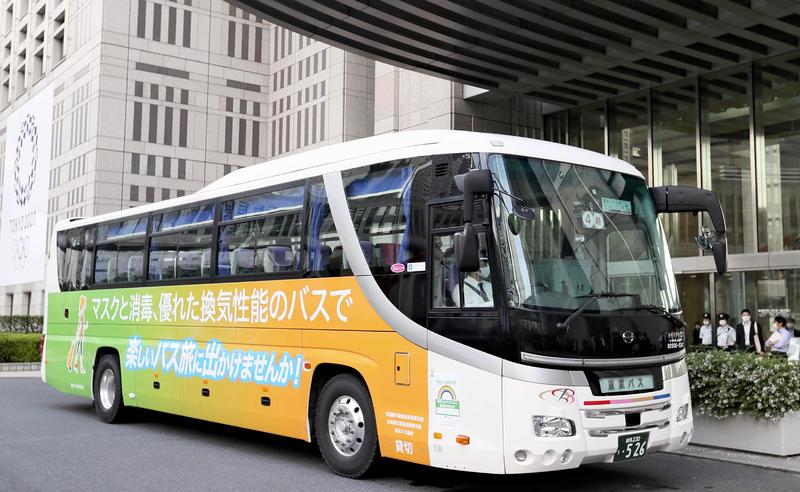
Although there are signs of a recovery in tourism demand thanks to the government's Go To Travel tourism campaign that started in July, chartered bus operators are still facing serious financial difficulties. With the support program mainly centered around small excursions, the main source of revenue for bus companies -- group tours -- remains sluggish due to concerns about the novel coronavirus.
With as many as 50 companies having discontinued their chartered bus operations due to the virus outbreak, the Land, Infrastructure, Transport and Tourism Ministry has decided to provide them support.

--Buses parked for months
"I'm losing my patience," Principle Automobile Co. managing director Chihiro Sekiya lamented recently, looking at the many large buses that have been parked at his charter bus company's headquarters in Machida, Tokyo, since around March.
Founded in 2007, Principle Automobile offers transportation services for group trips and school training camps in Tokyo and Kanagawa Prefecture. Its 50 buses were in full operation until around January.
Sales dropped substantially in and after March as group tours began to decrease around February, when the outbreak kicked into high gear. Year-on-year sales were less than 10% in some months, and operations at its Kawasaki office established three years ago in preparation for the Tokyo Olympics and Paralympics have been suspended.
According to the transport ministry, tourists are finally returning, especially to accommodation facilities. About 13.39 million people used the Go To Travel program, which started July 22, by the end of August. But this number basically does not include group tourists, who obviously are holding back out of infection concerns.
Starting this month, Tokyo was included in Go To Travel, but the program's effects remain unseen as far as group trips are concerned.
"We're taking thorough measures to prevent infections, but the situation remains severe for us," Sekiya said. "We have no choice but to do our best by taking various measures, including focusing on transportation services for corporate customers."
--Promoting safety essential
There were about 4,100 chartered bus operators in the nation as of fiscal 2018, and they were hit hard by the coronavirus outbreak.
According to a survey conducted by the ministry on these charter services, the number of buses in actual operation was as low as 5.7% to 11.6% during March and June. After the Go To Travel program started, there was a meager rise to 12.1% in July and 11% in August.
In total, 50 companies discontinued their bus businesses between February and August because of the outbreak. According to Tokyo Shoko Research Ltd., five bus companies went bankrupt in that period.
The Nihon Bus Association and others are promoting the safety of buses, pointing out that the air inside them is fully recirculated about every five minutes. Association director Masahiro Ishizashi said the number of passengers on chartered buses remains sluggish especially because some chartered bus passengers became infected with the virus earlier this year. He also pointed to a general mood of shunning group trips.
"Many more bus companies may be obliged to close down unless there is a noticeable recovery during the autumn peak season," Ishizaki said.
--Innovation plus govt support
There are moves by some operators to innovate around the group tour slump.
To offer tours for small groups, Tokan Kotsu Co. in Narita, Chiba Prefecture, started van tours that accommodate up to five people at a time in June. The company, which usually operates chartered buses mainly for people using Narita Airport, saw an about 90% decline in sales from March to August. But it has provided the van tours to about 10 groups per month.
A customer who used the new service for a family trip was quoted as saying, "We were able to enjoy travel without constraint, because it was just for the family."
In August, Sakai, Osaka Prefecture-based SS Tour Assist Co. began operating chartered buses under a contract with a local residents' association to help elderly people go to shopping malls and other places.
"Since the users often know each other, they can feel at ease. Although it doesn't generate much profit, it's better than doing nothing," company president Katsuo Takagi said.
The ministry plans to secure subsidies for group tours conducted under the Go To Travel program as part of its budget. It also decided to provide operation subsidies to chartered bus companies that provide transportation to corporate and other customers, as they help to cause the so-called Three Cs -- closed spaces, crowded places and close-contact settings -- at public transportation facilities.
"We will give the operators solid support since they are now at a critical stage," a senior ministry official said.
Read more from The Japan News at https://japannews.yomiuri.co.jp/













