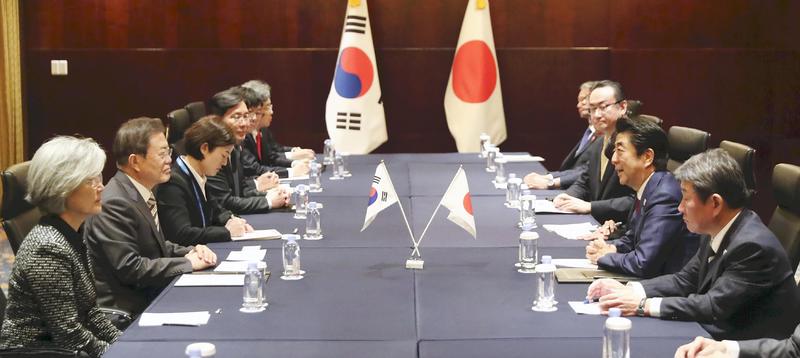
CHENGDU, China -- Prime Minister Shinzo Abe and South Korean President Moon Jae-in held summit talks Tuesday for the first time in about 15 months and agreed to continue discussions.
Athough the meeting appears to have halted the deterioration in relations between their two countries, Abe and Moon were unable to close the gap in their positions on court rulings regarding former requisitioned workers from the Korean Peninsula, highlighting the difficulty of resolving the issue.
Getting nowhere
"I want to improve the valuable Japan-South Korea relationship," Abe said frankly after shaking hands with Moon at the beginning of the meeting. Moon responded that even if things have been strained for a while, Japan and South Korea can never be far from each other.
Prior to the talks, the two leaders spent about three hours together at a Japan-China-South Korea summit meeting and other related events. "The atmosphere between the two leaders became relaxed naturally," a source who was present said.
However, once the bilateral meeting began, they had difficult exchanges over the former requisitioned workers and other issues, in what was described as a "tense atmosphere" by a senior Japanese government official who attended the meeting.
Regarding the former requisitioned workers, Abe urged South Korea to create opportunities as a nation to return to a healthy Japan-South Korea relationship. Moon agreed a swift resolution is needed, but did not provide any specific ideas for solutions.
On South Korea's concern over Japan's tightening of export controls, both sides merely repeated their previous stances.
Showing consideration
The two leaders agreed that talks to resolve the pending issues should continue. The Japanese side accepted the meeting due to the increasingly tense situation involving North Korea.
"If there are discrepancies between the policies of Japan and South Korea, only North Korea benefits," a person related to the Japanese government said.
Another reason for having the bilateral talks is the fact articulated by a source in Abe's orbit: "Whenever the leaders of Japan, China and South Korea meet, there's no avoiding one-on-one talks with South Korea."
With that in mind, Japan has shown consideration to South Korea by implementing such measures as holding a policy dialogue on the tightened export controls and easing the procedures on the export controls for a certain material.
Distrust of Moon
The Japanese government, however, shows no signs of compromising on the issue of former requisitioned workers. Abe is said to have developed a strong distrust of the Moon administration after it overturned an agreement reached in late 2015 on the comfort women issue, which Abe had staked his political life on.
At a press conference after the meeting, Abe reiterated that if the 1965 Japan-South Korea agreement on the settlement of property and claims is not respected, it is difficult to build a relationship between the two countries.
Although talks between Japan and South Korea are expected to continue, relations appear unlikely to improve unless South Korea takes the initiative to resolve the problem.
Read more from The Japan News at https://japannews.yomiuri.co.jp/