NEW DELHI: The city has been witnessing its cleanest July air this year since 2016.
So far, July 2022 has seen 16 ‘satisfactory’ air quality days compared with 11 in July 2021 and 15 in July 2020, according to Central Pollution Control Board’s data.
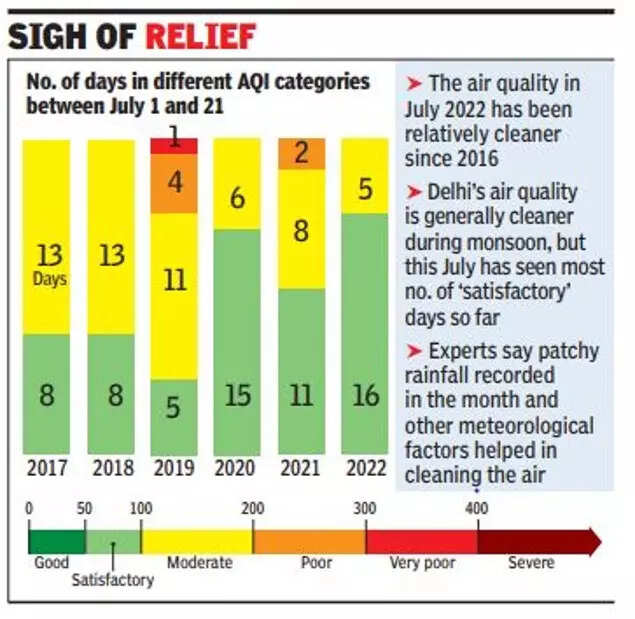
This July saw five ‘moderate’ air quality days. Not a single ‘poor’ or ‘very poor’ was recorded. Experts said patchy rain reported at regular intervals in some parts of the city helped settle down pollutants.
Though the capital’s air quality generally remains clean during the monsoon, this July was better than the previous years as the Air Quality Index (AQI) hovered between ‘satisfactory’ and ‘moderate’ categories. The lowest AQI this month was at 61, on Sunday. The city’s overall AQI was recorded at 70 on Thursday.
Track the pollution level in your city
Safdarjung, the city’s base station, recorded 221.7mm rainfall in July so far. However, some stations received intermittent rain, which helped wash out pollutants, said experts. They said as some parts of Delhi saw two ‘heavy’ rain days in July, the impact was visible for a few days.
Anumita Roychowdhury, executive director, research and advocacy, Centre for Science and Environment, said, “Due to intense heat conditions this summer, dust was one of the major sources of pollution. Rain in July seems to have contributed to cleaner air. However, other contributory factors also need to be assessed.”
Dipankar Saha, former head of CPCB’s air laboratory, said apart from rain, some other meteorological factors helped in keeping the air quality clean this July.
“Meteorology plays a significant role in maintaining ambient air quality. The higher the atmosphere boundary layer, the higher is the vertical dispersion of pollutants, while higher wind speed leads to higher horizontal dispersion. Intermittent rain keeps the top soil wet, controls the formation of resuspended dusts and helps in developing green grass,” said Saha.
According to CPCB, an AQI reading of 50 or below is classified as “good” while a reading between 51 and 100 on the index falls in the “satisfactory” category. Readings between 101 and 200 are considered “moderate”. “Poor” air ranges from 201 to 300, “very poor” from 301 to 400 and “severe” from 401 to 500.