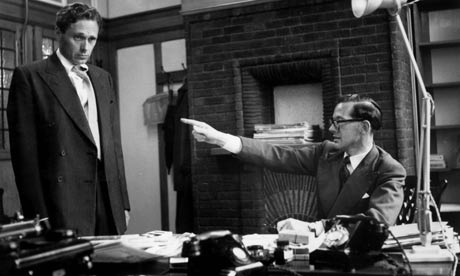
As I write, my colleagues are ranged around the kitchen, muttering darkly. The boss has been closeted in the Head Honcho's office for over an hour. The photocopier has been spewing out mysterious reports since last Tuesday. I'm not paranoid - they really are out to get me. This isn't always obvious in the modern workplace. Appraisals no longer refer to failure but to "areas of challenge" and cock-ups have become "learning points". But does your boss hate you? Of course she/he does. According to website Management Issues, nine out of 10 managers would like to get rid of at least one member of their team - and nearly a fifth would happily sack the lot of us.
It's not just the boss though - I've worked in places where the words "seething" and "resentment" may as well have been included in the job description. And while I've always enjoyed a little huddled gossip, discovering all your colleagues hate each other can be a little uncomfortable (not least because the only rational conclusion is that they must hate you too). So I was rather perturbed to read in the Boston Business Journal that far from pulling together in these credit crunchy times, office politics is actually getting worse.
According to the report, chief schemers include the Lobbyist (who pushes his/her own agenda) the Covert Operator (charming to your face, manipulative behind your back) and the Adviser (the person always just about to "pop in" on the boss). This all sounds fearfully organised. I may have to raise my game, because somehow I doubt "avid watcher of The Apprentice" is going to cut it.
Of course if we're all going to stand shoulder-to-shoulder, pull together and unite we're going to need a common goal - or better still, according to new research from the University of Toronto, a common enemy. Professor Chen-Bo Zhong explains: "Even if people can't agree on who they are and what they want, they can generally agree on who or what they are not ... As in war, you can identify strongly with someone when you share a common enemy." Which is why, presumably, my colleagues are still muttering in the kitchen.
Too much plotting makes me long for a - how can I put it? - more convivial work atmosphere. Fewer extensively cc'd emails and more cosy chat. Less huddling and more, erm, hugging. So it comes as no surprise to find that, given the choice between becoming an astronaut and running a pub, most Brits would choose to go to the, sorry, to takeover a pub. The appeal is obvious, but there are some downsides to leaving the desk-based world. You'd miss the unlimited supply of fancy pencils. You'd miss the posh meeting biscuits. You'd miss Facebook. And worst, you might miss the opportunity to become James Bond.