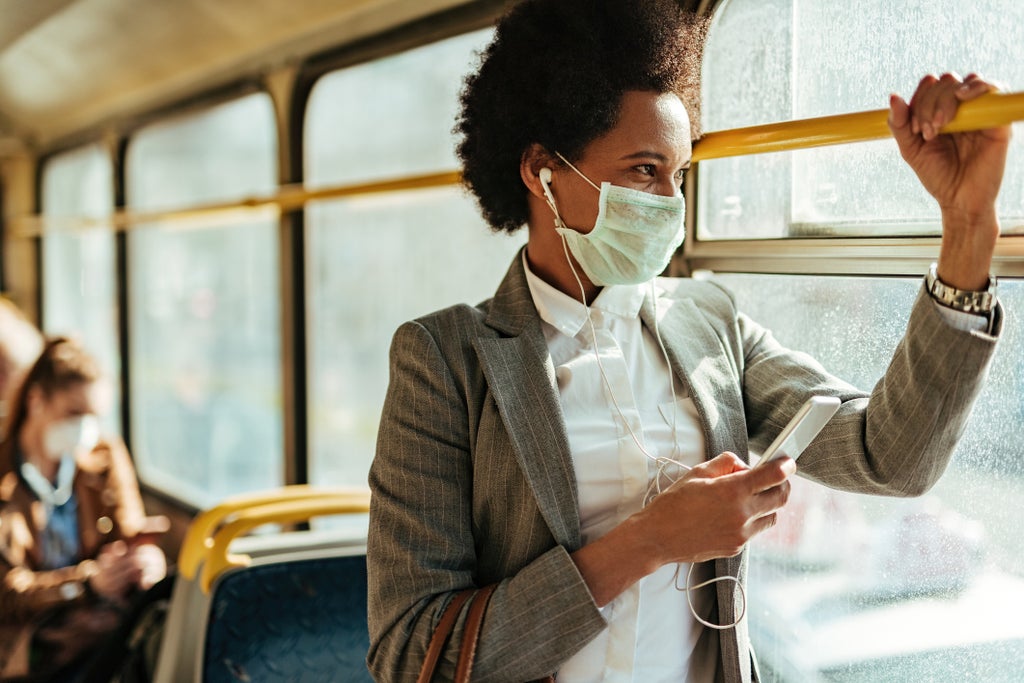
After much speculation, it has now been confirmed that, if all goes ahead as planned, wearing a face covering in England will soon become voluntary. On Monday, the prime minister shared his plans for step four of lifting all lockdown restrictions. While Mr Johnson said that any decisions regarding the timing of entering into this final stage will not be until announced until 12 July, he revealed that as soon as we enter step four, the legal requirement to wear face coverings will be lifted, although government guidance will suggest people might still choose to wear masks in “enclosed and crowded places”.
The announcement, which has been anticipated for some months now, since Mr Johnson laid out the roadmap for England easing out of lockdown, has been met with mixed reaction. Some medical experts have insisted that they will continue to wear face coverings once the mandate has lifted, while others have argued that the lift is long overdue, with Chancellor Rishi Sunak and Environment Secretary George Eustice both stating that they plan to stop wearing face coverings as soon as rules are lifted.
Meanwhile, the British Medical Association (BMA) has called on the government to keep certain coronavirus measures beyond 19 July, including the wearing of face masks in public areas such as in shops and on public transport. "As case numbers continue to rise at an alarming rate due to the rapid transmission of the Delta variant and an increase in people mixing with one another, it makes no sense to remove restrictions in their entirety in just over two weeks’ time,” said the BMA council’s chair, Dr Chaand Nagpaul.
The messaging regarding face coverings has changed numerous times since the start of the coronavirus outbreak. While it has been compulsory to wear them on public transport in England since 15 June 2020 (and later in all indoor settings from 24 July), the World Health Organisation initially stated that masks weren’t necessary unless people were sick with Covid themselves, or caring for someone who was infected.
“There is no specific evidence to suggest that the wearing of masks by the mass population has any potential benefit. In fact, there’s some evidence to suggest the opposite in the misuse of wearing a mask properly or fitting it properly,” Dr. Mike Ryan, executive director of the WHO health emergencies program, said at a media briefing in Geneva, Switzerland in March 2020.
Recommended
However, three months later, the WHO updated its guidance to recommend that governments ask everyone to wear face masks in public areas where there is a risk of transmission of the Covid-19 coronavirus to help reduce the spread of the disease.
The reason for the change was down to “evolving evidence”, with WHO’s technical lead expert on Covid-19, Maria van Kerkhove, stating that they’d seen evidence that, if worn properly, masks “can provide a barrier... for potentially infectious droplets”.
Mask wearing as it happens currently in the UK is a community activity, not an act of personal protection
Now, the advantages of wearing a face covering are well-documented. On the government website, it explains that coronavirus usually spreads by droplets from coughs, sneezes and speaking. “These droplets can also be picked up from surfaces, if you touch a surface and then your face without washing your hands first,” it adds. “This is why social distancing, regular hand hygiene, and covering coughs and sneezes is so important in controlling the spread of the virus.”
The government adds that the “best available scientific evidence” is that, when used correctly, wearing a face covering may reduce the spread of coronavirus droplets in certain circumstances, which helps to protect others.
Speaking to The Independent, Dr Robert White, lecturer in virology at Imperial College London, explains that masks “impede the flow of water droplets into the air, and condense them on the mouth, by filtering them onto the mask”.
Plenty of research has proven their efficacy, with one international report published in The Lancet on 3 June 2020 having analysed data from 172 studies in 16 countries to find that there is a three per cent chance of catching Covid-19 when wearing a face covering.
With this in mind, it makes sense that people are dubious about the sudden lifting of restrictions. Particularly when a further 24,248 Covid cases and 15 deaths within 28 days of a positive test were recorded in the UK on Sunday.
According to Professor Stephen Powis, NHS England’s medical director, it would “not necessarily [be a] bad thing” if some people continued to wear face masks in certain circumstances, such as crowded places. “Those habits to reduce infections are a good thing to keep” he said, noting how the link between coronavirus infections and hospital admissions has been “severely weakened” thanks to the vaccination rollout.
His thoughts were echoed by Professor Adam Finn, from the Government’s Joint Committee on Vaccination and Immunisation (JCVI), who said he will continue to wear a face mask “indefinitely” despite the mandate lifting. “Well on a personal level I shall certainly be continuing to wear a mask if I’ve got any symptoms or if I’m in an enclosed space with lots of other people for a prolonged period of time, indefinitely in fact,” he told Sky News.
There’s also the argument that, once the pandemic is over, masks could help prevent people from contracting other illnesses, such as the common cold or the flu. In many parts of Asia, it has been commonplace for people to wear masks when they go out as courtesy to other people since the 1950s, leading some Britons to believe that this could be the way forward for our post-pandemic lives. In which case, masks may, in fact, prove helpful to those who are immunocompromised in any way. “There will be incremental benefits to this,” adds Dr White, pointing to the ways in which masks do generally prevent the transmission of disease, with the caveat that this is more effective the more people choose to wear them.
However, the benefits of this are contested by experts. “All masks that impede the flow of breath (and especially speech aerosols) are effective at preventing an infected person from transmitting to others,” says Dr White. “So masks are a public health measure that only really work when everyone is wearing one.” Speaking to The Independent, Robert Dingwall, professor at the School of Social Sciences at Nottingham Trent University, adds that immunocompromised people would already be advised to minimize their exposure to crowded areas and poorly ventilated indoor settings, so wearing a mask would, in some cases, be redundant.
There are also, of course, psychological considerations when it comes to abandoning the mask mandate, which experts believe might play a crucial role in the timing of all this. “The government is trying to set a psychological tone in the population to say the pandemic is over and to encourage people to go out,” says Dr White. “Mask wearing as it happens currently in the UK, is a community activity, not an act of personal protection, so abandoning mask mandates in places of close contact and loud speech, where the virus spreads best, will make safety conscious people stay away.”
Once the restrictions surrounding masks do lift, there’s no guarantee that private companies won’t continue to choose to enforce them. For example, after 19 July, companies such as Transport for London may still choose to mandate mask-wearing for passengers, which would require millions of commuters to continue wearing masks. However, this might depend on the views and anxieties of those running said companies. “I doubt whether large companies will wish to require people to continue to wear masks,” says Dingwall, “but there may be some issues with smaller businesses whose owners and staff share the general levels of anxiety about Covid-19.”
I doubt whether large companies will wish to require people to continue to wear masks
On Monday, the care minister, Helen Whately, was criticised for her ambivalence on wearing face coverings on trains during rush hour. Speaking on BBC Radio 4, Ms Whately was asked whether she would wear a mask on a rush-hour train from her constituency of Faversham in Kent to London. “I think it’s the sort of environment where, if something’s crowded, I think I might,” she said. “There are real downsides to wearing masks. So this is about taking a balanced approach … recognising that we have the huge protection provided from so many people being vaccinated.”
In response, the general secretary of the UK’s biggest rail union, the RMT union, Mick Lynch, said: “Yet again there’s a real danger of the government making up policy on the hoof on critical issues and that is reflected in the comments of the minister this morning.”
Kate Nicholls, chief executive of trade body UK Hospitality, has said that certain pubs and restaurants may choose to still enforce masks once restrictions are lifted. “There’s going to be customers who are expecting everything to fall away and there’s going to be places that they won’t be able to do that,” she said.
“If you do feel confident, you’re very happy to go to a pub that is crowded, it’s showing football and people are standing up, and if you are a more reticent consumer then you’re going to look for ones where it’s table service.”
A recent YouGov poll found that as many as two thirds of Britons intend to continue wearing face coverings once the rules end. So it seems that regardless of whether you’re feeling confident or anxious about restrictions lifting, there will undoubtedly still be people wearing masks out and about after 19 July. In fact, you could even say that face coverings will become an integral part of “the new normal” that awaits us as we emerge from this pandemic.