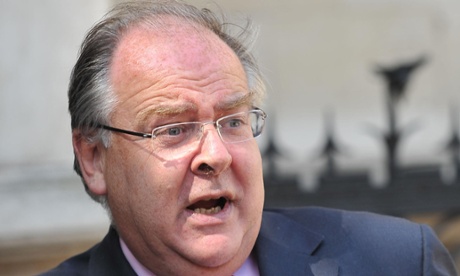
A future Labour government is determined to avoid a repeat of the damaging rivalry that disfigured the relationship between the Treasury and Downing Street during the Blair-Brown years, according to Lord Falconer, who has been charged with preparing the party for an election win.
In an interview with the Guardian, Falconer also said the party had planned for a beefed-up Downing Street that could drive policy through departments more forcefully as well as acting as a check to avoid “another Andrew Lansley health bill disaster”.
Falconer, a lord chancellor under Blair, was appointed by Ed Miliband in October 2013 to oversee Labour’s preparations for the transition to government, and since early 2013 shadow ministers have been told to hold detailed talks with permanent secretaries including the cabinet secretary, Sir Jeremy Heywood. Some shadow ministers have held as many as six meetings with officials to discuss their plans.
Falconer suggested Miliband and Ed Balls were aiming for more openness and transparency between No 10 and the Treasury.
“The key thing is a determination to make it work, and you can make sure that No 10 has access to all the information and advice the chancellor is getting on the economy and the chancellor knows what material is given to the prime minister so there is a shared advice and information,” he said. “The two Eds are committed to a strong working partnership.”
Revealing his thinking for the first time, Falconer said conversations within the party had centred on how to drive policy more effectively from No 10. “We have focused in the discussions about how you make a strong centre, by which I mean you have a prime minister’s office that is able to evaluate and drive policy in the priority areas of the government. It needs to be able to monitor implementation of policy, and give adjustments and drive where it is not being adequately implemented.
“The aim is not just to leave departments to operate in isolation. Of course we want good relations between the departments and the centre, but in relation to the priorities of the government, history tells us they need to be driven. That is especially true in relation to issues that are substantially cross-cutting like devolution to the cities, ensuring a massive increase in apprenticeships and dealing with a low-wage economy.”
He said No 10 needed to have “a policy-making and evaluation capacity to make sure, for example, we do not ever get another Andrew Lansley health bill disaster. It has got to have the capacity to evaluate and whether that is done in a policy unit or a delivery unit or something else is to be decided.”
In 2010 David Cameron abolished Labour’s delivery unit and strategy unit, starting his period of government with a slimmed-down number of special advisers and a relatively small apolitical policy unit. Some of his early decisions on the machinery of government were later overturned, but only this week the public administration select committee criticised the short-term horizons within Whitehall.
Falconer said: “In relation to delivery, there has to be much, much more than regular stock takes between department and Downing Street. Ultimately, it has to be a group of people in which the prime minister has confidence and who can tell him frankly what is happening in departments.
“For instance, if the apprenticeship strategy or the plan to build 200,000 homes a year by the end of the parliament is not implemented from a very early stage, we will not meet these targets. You have to hit the ground running.
“At the same time we need some mechanism to look at the longer-term issues and this must not be be a resource that can be taken when a crisis has developed.” He also promised a full review of major government IT projects, saying “sometimes projects in government can get a momentum of their own”.
Falconer suggested there would be some shakeup in the architecture of Whitehall. “There is no point in changing the machinery of government and switching around departmental responsibilities unless you think it will make a difference to delivery. I think we will make some machinery-of-government changes that do meet the criteria I have set out that it will bring greater focus or lead to better coordination.
“If you take the themes of the government – devolution to the cities, tackling low-wage economy, skilling up the workforce and a galvanised housing programme – those are the kind of areas where you will look to see if the machinery of government works.”
If the civil service thought the arrival of a Labour government would lead to any reversal in the reforms to the civil service introduced by Francis Maude, they are likely to be disappointed. Falconer said he favoured the idea of ministers receiving external advice, including an expanded private office with more experts and political appointees.
He said: “Maude’s ideas about extended ministerial offices seem to me to be perfectly sensible and ones that I can see are in principle a good idea. The idea of a minister coming in with only one or two ministerial advisers and trying to turn the machine round seems wrong. People can help without offending in any way the principle of non-politicisation.”
But he stressed Labour would not be spoiling for a fight with an unresponsive civil service. “My own view – and the Labour leader shares this – is we have no prospect of achieving anything unless we do it in partnership with the civil service and we have to develop a trusting relationship with them.
“Generally blaming the civil service for inadequate delivery is not an adequate excuse. We most certainly do not want to get into a divisive relationship with the civil service. My experience as a minister is that the civil service are always incredibly keen to deliver what ministers want, and it is for ministers and government to be clear – and if they are clear, they will get delivery.”