At this stage last year, Saracens destroyed Clermont Auvergne at Twickenham in a record-breaking advance to the final. It was a gruesome day for a proud rugby club. And it did not happen again. It was different here – the Stade Geoffroy Guichard being anything but the home of the game in England.
In the strange ways of deciding what is a semi-neutral semi, the game came here to the footballing city of Saint Etienne. It is rugby city now, made so by the impassioned 41,500 who came over the Massif Central from Clermont-Ferrand – from one industrial city to another. The Clermont faithful made this a desperately difficult place for a visiting team. The crowd was a factor; they were brilliant.
It was not the warmest April day Saint Etienne had ever seen before kick-off, but the yellow shirts of the crowd brightened up the spectacle and certainly made Clermont feel at home. The black-shirted Saracens were outnumbered, it seemed, a thousand to one in the stadium.
And then the sun did come out and on the thick, cropped grass of the football stadium, hosting a European rugby game for the first time, the scene was perfectly set for some sparkle on the playing side. At which point, Napolioni Nalaga dropped the first high pass that came his way. Jonathan Davies dropped another, that might have released him. The scene was set but the play was cloudy.
Clermont did heave one scrum on their own feed to earn a penalty, that became a kick to the corner, that became in turn a catch by Sébastien Vahaamahina and the first chance for the Clermont eight to build one of their driving mauls. Saracens kept that first compressed threat at bay, but when the ball went wide to Nalaga again, it seemed a try was inevitable. But the passing to the wing was laboured and Chris Ashton, without exactly overusing his arms in the tackle, battered him into touch.
In the battle of the England full-backs, between the self-exiled Nick Abendanon and Alex Goode, the current number two to Mike Brown, Goode was the more prominent, starting the counterattack that put Charlie Hodgson in position for a long drop goal, beautifully struck.
Brock James, who had missed a much shorter attempt at a drop goal, levelled the scores with a penalty. He was engaged in a compelling head-to-head of his own, pitting his wits – as opposed to Billy Vunipola’s contest with, well, the entire Clermont pack – against Hodgson. The fly-halves’ finesse against Billy’s forthrightness. There was a glimpse too of the talents of Maro Itoje, who made a catch and a run that left the industrious Julien Bardy parked in slightly undignified style on his rear.
Hodgson, who wisely stayed well clear of such confrontations, could not quite finesse over all the penalty opportunities he was given in a 12-minute period towards the end of the first half. In fact, he managed only the middle one, which left his side ahead 6-3 at half-time, but only by a slender margin. Sunshine rugby had yet to come out to play.
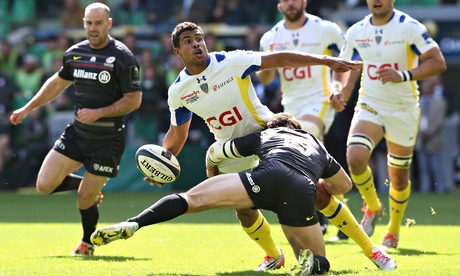
And it did not appear after the break. Thunder rugby struck, Clermont cranking up their forwards’ game and coming at Saracens with venom. Chouly led the charge, followed by Benjamin Kayser and Vincent Debaty. It was not subtle – or at least not at first, not until James dinked a little chip over the Saracens backs and Wesley Fofana followed up to score untouched. Clermont were in the lead for the first time. James converted and the missed penalties looked expensive. The game opened up, release on the field coinciding with the rush of replacements from the bench. Julien Bonnaire had a dash, as did Davies, looking the full part now in the yellow storm that was raging in the stands. There was an expectation, every time the ball went near Fofana that he would be able to do something extraordinary. He twisted and he turned but and he had had his moment for the try.
There was not going to be another try. But the crowd sensed – sniffed – victory. Their unique exuberance was hushed for a moment by Owen Farrell, on for Hodgson and on kicking duty. His penalty hit the flag on top of the posts and was good. Clermont led by just the one point, but it was point that could be defended through territorial dominance.
The storm rose. The rumble of full-on celebration began. Saracens were trying to play from a long way out. They tried to take the ball wide to Chris Ashton but defenders bore down on the wing, every tackle roared. From further and further back, Goode had to initiate counters, only for a wall to from in front of him.
It was warm. It was exhausting. But Clermont piled into their tackles to the very end. A proud club was erasing the memory of the humiliation of last year’s semi-final. Every tackle was a statement. Saracens did not release at a breakdown and up stepped man of the match James again to make the margin four points again.
Play remained resolutely in the Saracens half. The more yards Clermont gained and did not yield the more the crowd gave them a rising volume of support, and the faster the clock ran down for Saracens.
A forward pass gave a final set piece to Clermont and they began the ritual of feeding it and booting the ball off the park. They were on their way to the final. Not in sunshine style, but in a rip-roaring ear-splitting shower of sound, the bull-fight between stewards and handfuls of pitch-invading fans given the full roar way after the players had left the scene. Gone, to start making plans for the final.