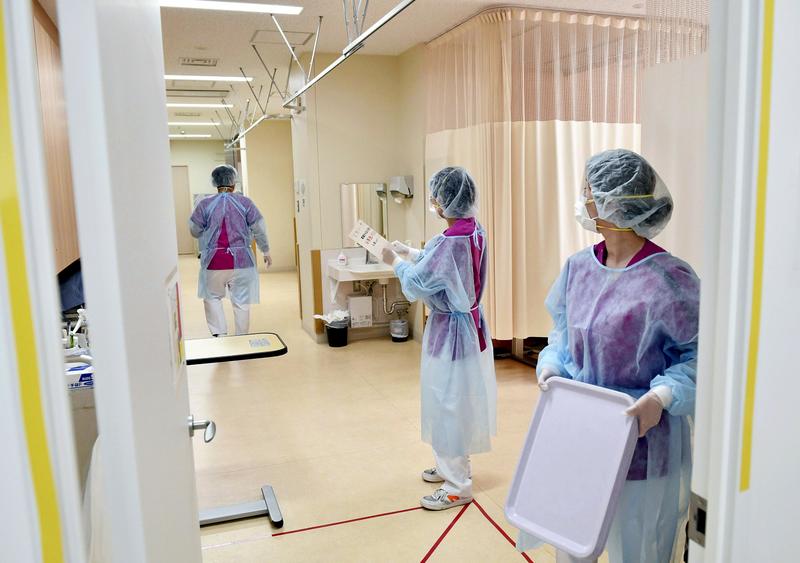
The situation at medical facilities accepting patients infected with the novel coronavirus has remained tense throughout the year-end and New Year's holiday period.
At Tokyo Medical and Dental University Medical Hospital in Bunkyo Ward, more than twice as many staff members as usual have been on duty during this holiday season. Beds for COVID-19 patients are nearly full at the hospital, with eight beds allocated for those with severe symptoms fully occupied.
"There are also many patients suspected to have been infected," an official of the hospital said. "The current situation is severe."
Some medical institutions also began having difficulty accepting patients with a high risk of developing serious symptoms. According to a joint committee of three organizations, including the Japanese Association of Dialysis Physicians, Tokyo faced its first case Saturday in which a COVID-19 patient who undergoes dialysis was unable to find a place to be hospitalized.
"It's as if we are walking a tightrope," said Kan Kikuchi, head of the Housaikai medical group who chairs the joint committee. "The collapse of the medical system could be said to be occurring. It's not easy to increase the number of hospital beds. There is no way to improve the current situation except to prevent the number of infected people from increasing."
According to the Health, Labor and Welfare Ministry, as of Dec. 22, the occupancy of hospital beds that could be available at the time of peak infection reached 37% nationwide, while the bed occupancy for seriously ill patients was 26.1%. Among Tokyo, Kanagawa, Chiba and Saitama, the capital exceeded the yardstick for Stage 4, which indicates the most serious infection situation with hospital bed occupancy at 50% or higher.
"It's highly possible that the current situation of hospital beds has become more serious," said Hideaki Oka, a professor specializing in infectious diseases at the Saitama Medical Center in Kawagoe, Saitama Prefecture. "As the number of seriously ill patients has been increasing since the end of the year, the workload of the on-site staff has reached its limit."
At the center, seven COVID-19 patients with severe symptoms have been hospitalized, already exceeding the four beds allocated for such patients.
"As the number of infected people continues to be high, it has become difficult to provide medical care to newly infected people," said Koji Wada, a professor specializing in public health at International University of Health and Welfare. "Regardless of whether a state of emergency is declared, stricter measures, such as calling on people to reduce person-to-person contact, are needed."
Read more from The Japan News at https://japannews.yomiuri.co.jp/